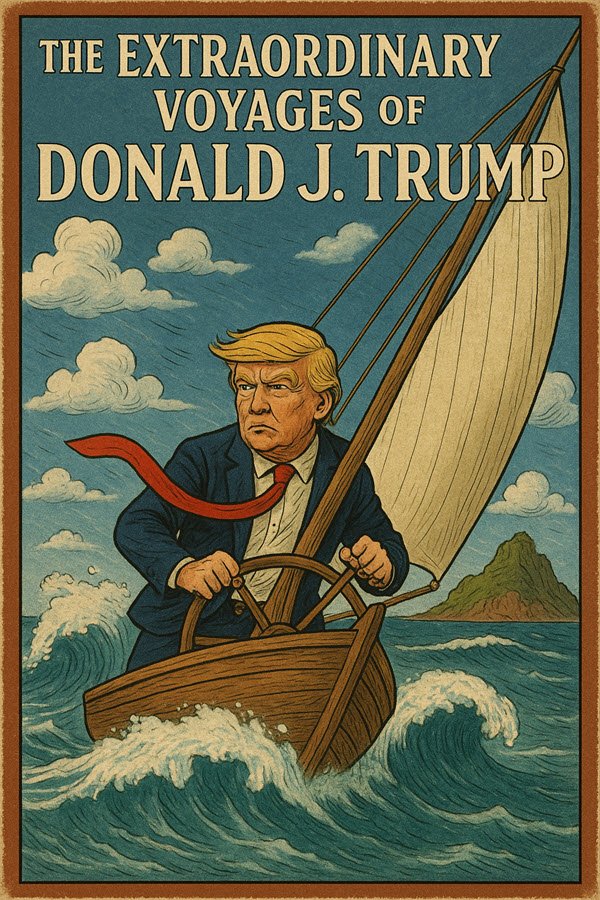
This year marks the 300th anniversary of Gulliver’s Travels—a work so sharp, so mischievous, and so dangerously honest that it has managed to offend, delight, and expose humanity in equal measure for three centuries.
When Jonathan Swift first released his peculiar tale of shipwrecks and strange lands in 1726, readers believed they were embarking upon an adventure. What they did not realize, at least not immediately, was that they themselves were the destination.
Swift had invented something rare: a literary mirror disguised as a travelogue. In Lilliput, we saw our pettiness. In Brobdingnag, our arrogance. In the land of the Houyhnhnms, our capacity for self-deception dressed as reason. The voyage was fictional; the exposure was not.
And for 300 years, this particular alchemy, which blends an absurd journey with piercing societal critique, has remained largely unmatched.
Until now.
Enter The Extraordinary Voyages of Donald J. Trump.
At first glance, it appears to follow Swift’s blueprint: a central figure travels through strange lands, encountering odd customs, exaggerated peoples, and systems so illogical they seem almost impossible. But as Swift understood—and as this modern work boldly revives—the further one travels into these absurd worlds, the more familiar they become.
For this is not merely a book about a man. It is a book about us.
In the kingdoms and curiosities encountered throughout The Extraordinary Voyages, we find reflections of 2026:
- A world where truth bends to convenience
- Where loyalty outpaces reason
- Where spectacle replaces substance
- And where power, once questioned, now demands applause
The genius of Swift was not simply that he mocked society—it was that he allowed society to mock itself, often without realizing it. That same tradition is alive here. The reader laughs, then pauses, then—quietly—recognizes something uncomfortably close to home.
And that is the enduring power of this form.
Satire, when done well, is not an attack. It is a revelation. It does not shout; it reflects. It does not accuse; it invites recognition. And in that recognition lies its sharpest edge.
Three hundred years after Swift first set sail, the voyage continues—not across oceans, but across the peculiar landscape of modern thought. The characters have changed. The costumes have evolved. But the essential journey remains the same.
We travel outward.
Only to discover, inevitably, that we have been looking inward all along.