A Tragic Death In Minneapolis: January 7, 2026
In moments of national discomfort—such as the problematic and tragic death of one of our citizens—it is vital that order be restored. Swiftly restoring order is highly valuable. Facts, after all, are slow creatures. Facts are slow because information must be verified, which takes time.
Power, by contrast, moves quickly and speaks with admirable confidence.
Thus, we must applaud the modern improvement whereby truth is no longer discovered but rather announced.
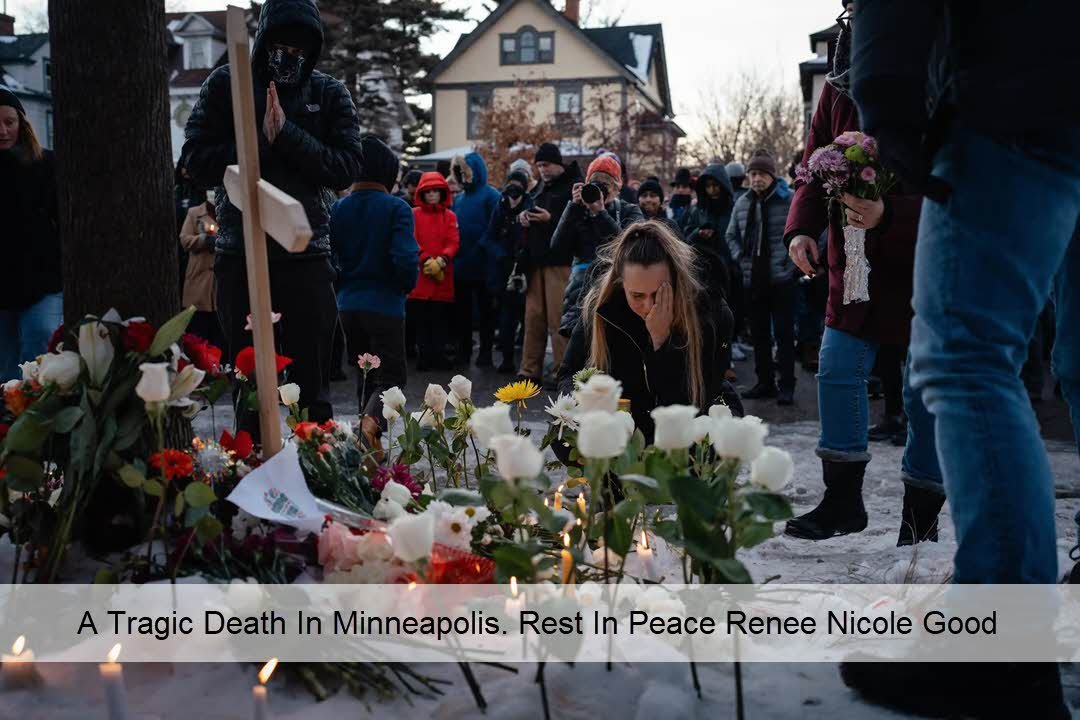
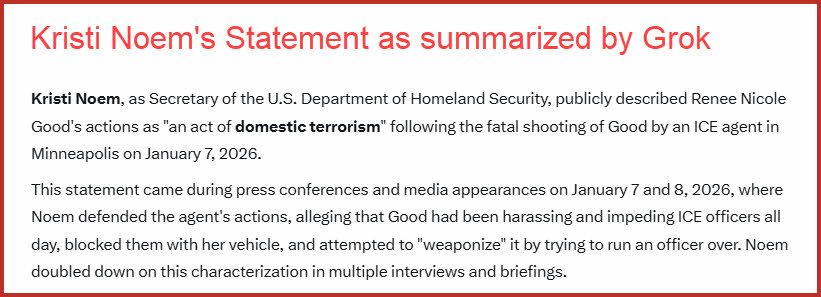
Consider the recent killing of Renee Nicole Good, a woman whose greatest offense appears to have been being near ICE authorities while also being insufficiently invisible. Within hours after the shooting and her death, officials relieved the public of uncertainty by explaining what had happened, what it meant, and why no further thought was required.
The Department of Homeland Security declared that a vehicle had been “weaponized,” a pleasingly versatile term that transforms an ordinary object into a hostile intent without the tedium of evidence.
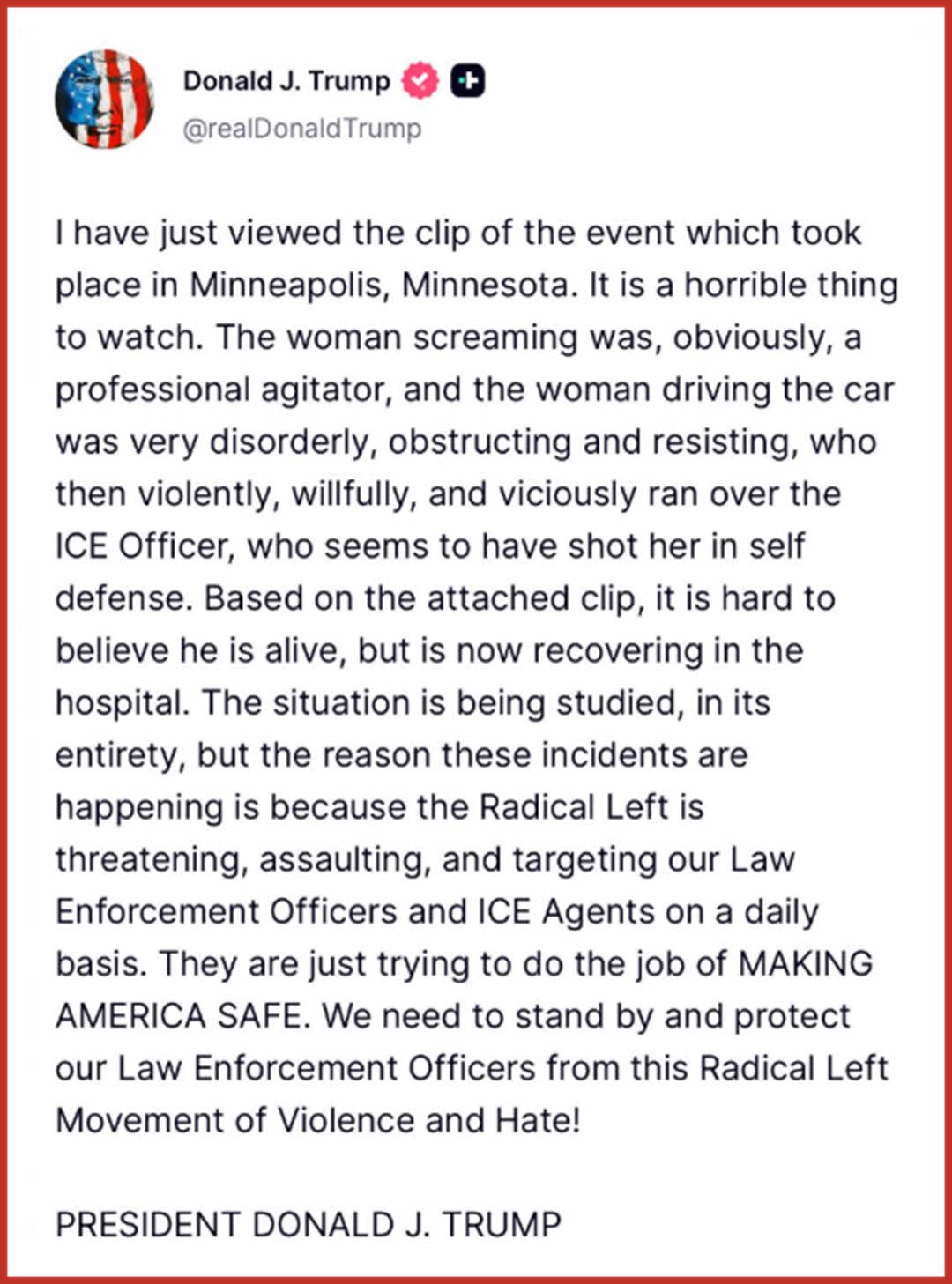
The President, never one to understate, clarified that the victim had “viciously run over” an agent—an act so ferocious that it occurred even without contact.
Unfortunately, the video footage proved uncooperative. It showed no collision, no assault, no weaponized sedan lunging heroically at federal authority. This was inconvenient, but not fatal to the narrative. Modern governance has matured beyond the need for alignment between claim and reality. The important thing is that the explanation arrived promptly and with conviction.
To further stabilize the story, as the story needed a great deal of stabilizing, the President identified the victim’s wife, audibly screaming in grief, as “a professional agitator.” This was an inspired touch by the President. Grief, when inconvenient, is best reclassified as performance. Love, when excessive, becomes subversion. A spouse, when distraught, must surely be on the payroll of someone.
Moreover, the President believes that his policies are so wonderful that anyone who protests must therefore be paid to protest.
Local officials, regrettably, failed to cooperate. The mayor committed the grave impropriety of watching the video and describing what it showed. He used plain language, calling the killing reckless and unnecessary.
Such behavior, by the mayor, undermines the careful architecture of official certainty. One worries about the precedent this sets: if mayors begin to believe their eyes, where will it end?
Indeed, people may start believing their own eyes too.
Other officials compounded the error by pointing out that Renee Good was a legal observer—a role so threatening that it apparently warrants death. Observing, after all, is a dangerous activity. One never knows what might be noticed.
Blocking a street in the presence of federal law enforcement has become a capital offense in practice, though the statute is still being drafted.
The public was further unsettled by learning details about the deceased: that she was a poet, a mother of three, a legal resident, a student of language. These facts were unnecessary and potentially destabilizing. Humanity complicates narratives. It is far easier to manage the dead when they remain abstract, preferably described as theoretical rather than real people.

Is this the face of a domestic terrorist in Donald Trump’s America? If this is true, then domestic terrorists are everywhere. I am sure that this is the thinking of Stephen Miller, Kristi Noem, and Donald Trump. We must always be fearful, as danger from domestic terrorists is everywhere.
We must also admire the speed with which accountability was redirected. The question was not whether excessive force had been used, but whether anyone might successfully prevent consequences. Impeachment was proposed, outrage expressed, statements issued—democracy performed its familiar dance. Yet the central lesson remained untouched: power had acted, and explanations would follow afterward, if at all.
This is progress. In earlier ages, governments labored under the burden of proof. Today, proof is optional; assertion suffices. Video may contradict words, witnesses may object, but authority speaks first, and therefore speaks truth.
One can only hope that future incidents will be handled with even greater efficiency. Perhaps next time the explanation can be released before the body hits the ground, sparing everyone the distress of having to observe. Perhaps facts themselves can be preemptively detained.
Until then, citizens are advised to remember their proper role: to accept statements calmly and politely. They must distrust their own senses, and understand that when power kills, it does so for reasons that are always reasonable—especially when they are not explained.
After all, nothing preserves order quite like certainty. And nothing threatens it more than the truth arriving late, out of breath, carrying the evidence.
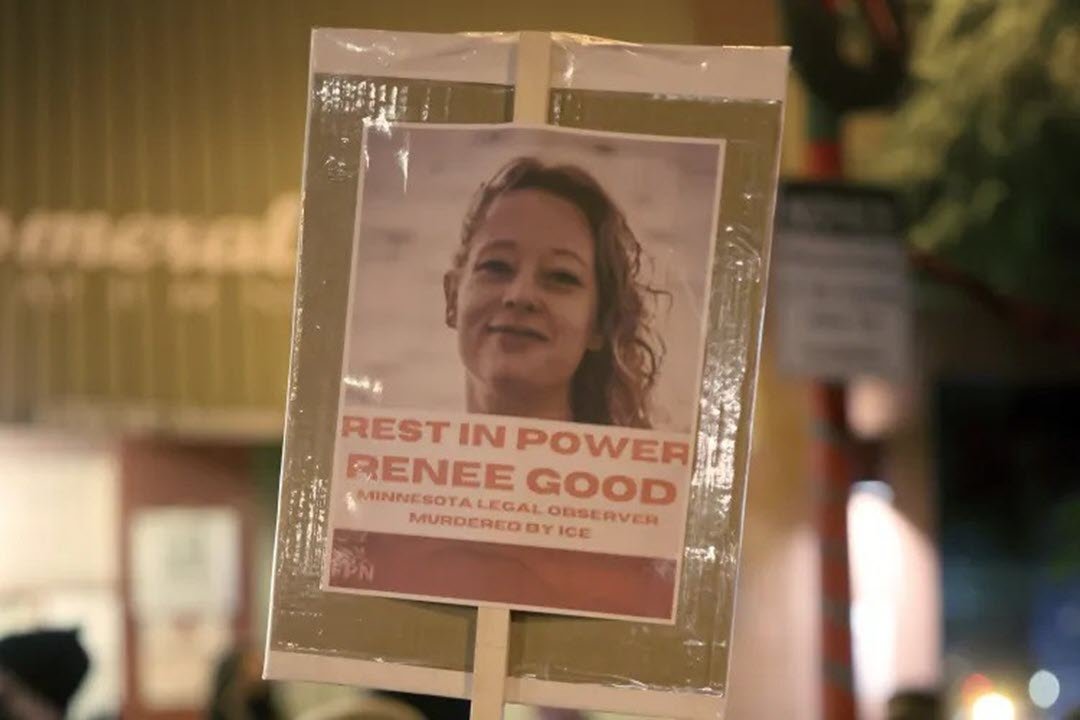
Blonde hair, blue eyes, white Christian, unarmed mother of 3, Renee Nicole Good was killed by an ICE agent in Minneapolis, on January 7, 2026.
Please note that hate and inhumanity beget hate and inhumanity.