Donald Trump’s Oh-So-Slippery Tariffs
There was a time when bananas were simple. They arrived quietly, ripened obediently, and asked nothing of the consumer beyond a modest place on the counter. Under Donald Trump’s stewardship of trade policy, however, even the banana has been conscripted into the great tariff pageant of confusion.
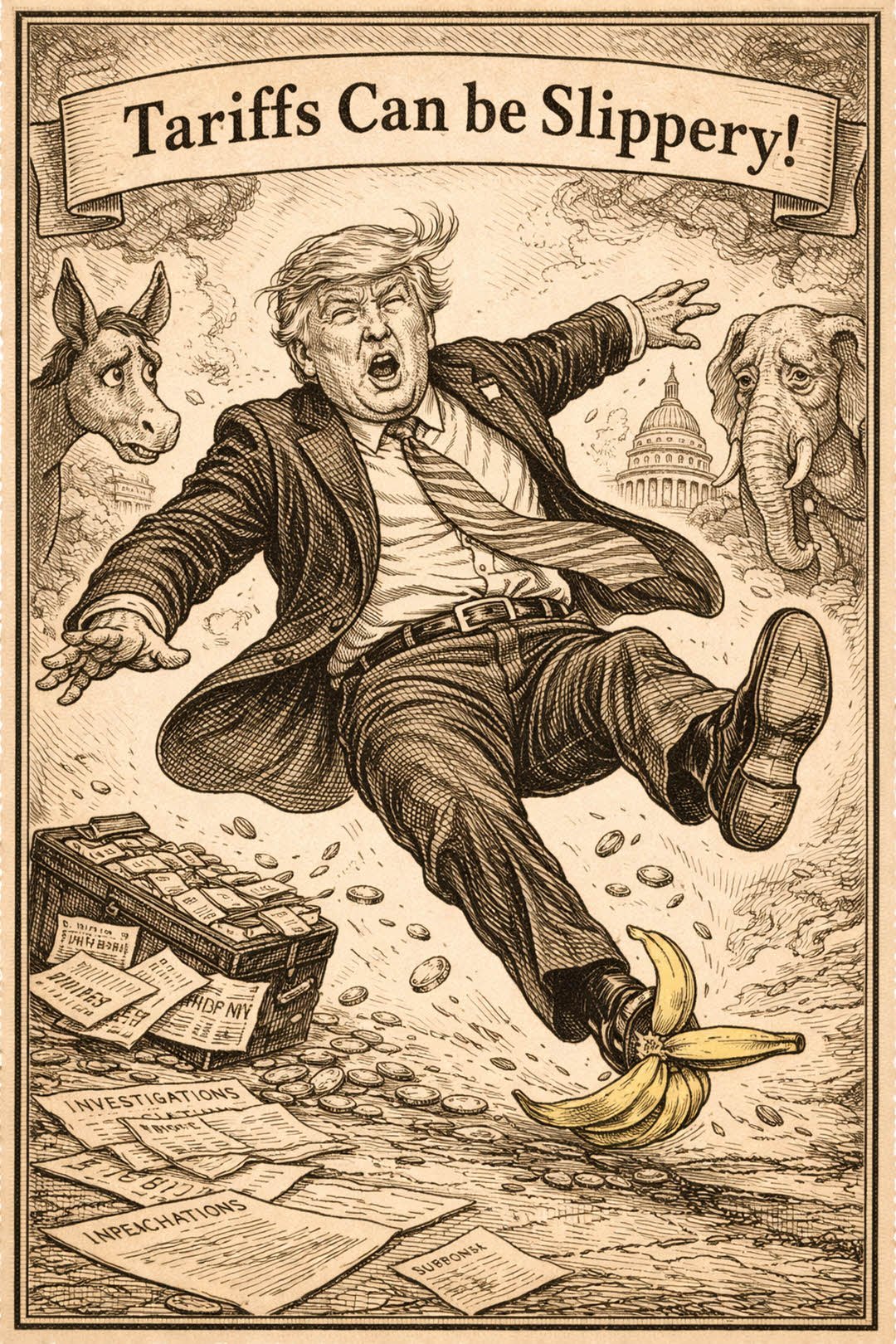
Tariffs, we were assured, were instruments of strength. They would punish enemies, reward allies, and restore a lost golden age in which prices fell precisely because they had risen first. Bananas, being foreign, yellow, and insufficiently patriotic, became suitable participants in this great tariff experiment.
At various moments, bananas were tariffed, exempted, re-tariffed, threatened, and finally liberated again—often without explanation and occasionally without anyone in the administration appearing to know which state they were in at the time. Importers awoke to new costs announced on social media. Grocers adjusted prices based on rumors. Consumers paid more, then were told they were imagining it.
The genius of the policy lay in its inconsistency. If tariffs had been applied steadily and consistently, economist (i.e., critics) might have measured their effects. But by shifting the rules mid-shipment, the administration ensured that no one could quite prove what had gone wrong—only that something had.
We were told the tariffs were about fairness. American workers would be protected from unfair competition, though no one could identify the American banana industry in need of rescue. We were told the tariffs were about leverage, though the principal effect was to apply leverage to grocery bills. When prices rose, the explanation was inflation. When prices fell, the credit belonged to tariffs. When prices did both, the subject was changed.
At one point, tariffs were imposed on bananas from certain countries while being lifted on others, creating a kind of fruit-based diplomatic caste system. Bananas from one port were patriotic; bananas from another were suspicious. The fruit itself, identical in taste and origin, could not tell the difference, but the price consumers paid was clearly evident.
Eventually, as the confusion began to show up in inflation data and voter irritation, the tariffs were quietly rolled back. This reversal was not presented as a correction, but as proof of flexibility. The problem, we were told, was not that the policy had failed, but that it had succeeded so completely that it was no longer necessary. This, by any measure, was brilliant marketing, the best!
This is the hallmark of Trump’s tariff regime: every outcome confirms the wisdom of the original decision, including its abandonment. If prices rise, tariffs are working. If prices fall, tariffs have done their job. If supply chains snarl, it is evidence of toughness. If they collapse, it is proof that globalism was fragile all along.
Bananas, humble witnesses to this drama, reveal the deeper mismanagement. Trade policy became a stage for performance rather than a tool for governance. Decisions were announced before they were understood, reversed before they were evaluated, and defended long after they were forgotten.
In the end, the banana survived. Consumers paid more than they should have. Importers learned to expect chaos. And the administration moved on to the next object suitable for symbolic punishment.
The lesson is clear: when tariffs are used not to manage trade but to generate noise, even the simplest fruit may be in the way. In Trump’s hands, the banana was no longer just a banana. It was a prop—slipped on repeatedly, then blamed for being on the floor.