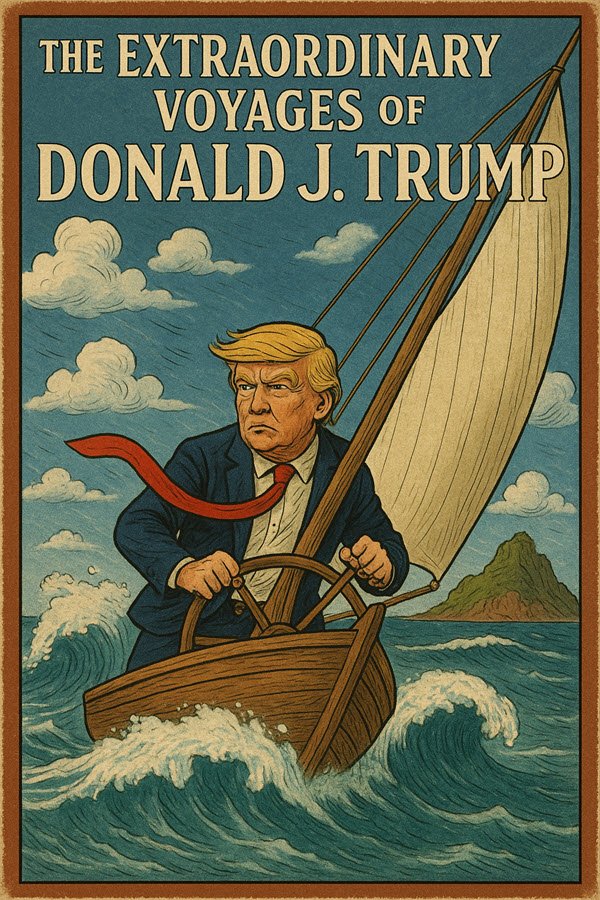
Sometimes You Need a Dictator
It is a comfort, in troubled times, to know that clarity still exists somewhere in the world. At Davos, clarity arrived in the form of a joke so honest it briefly forgot to disguise itself.
“I’m a dictator,” said Donald Trump, pausing just long enough for the room to decide whether this was comedy or confession. “But sometimes you need a dictator.”
The room laughed, which is always the surest sign that the audience has heard something true and finds it profitable.
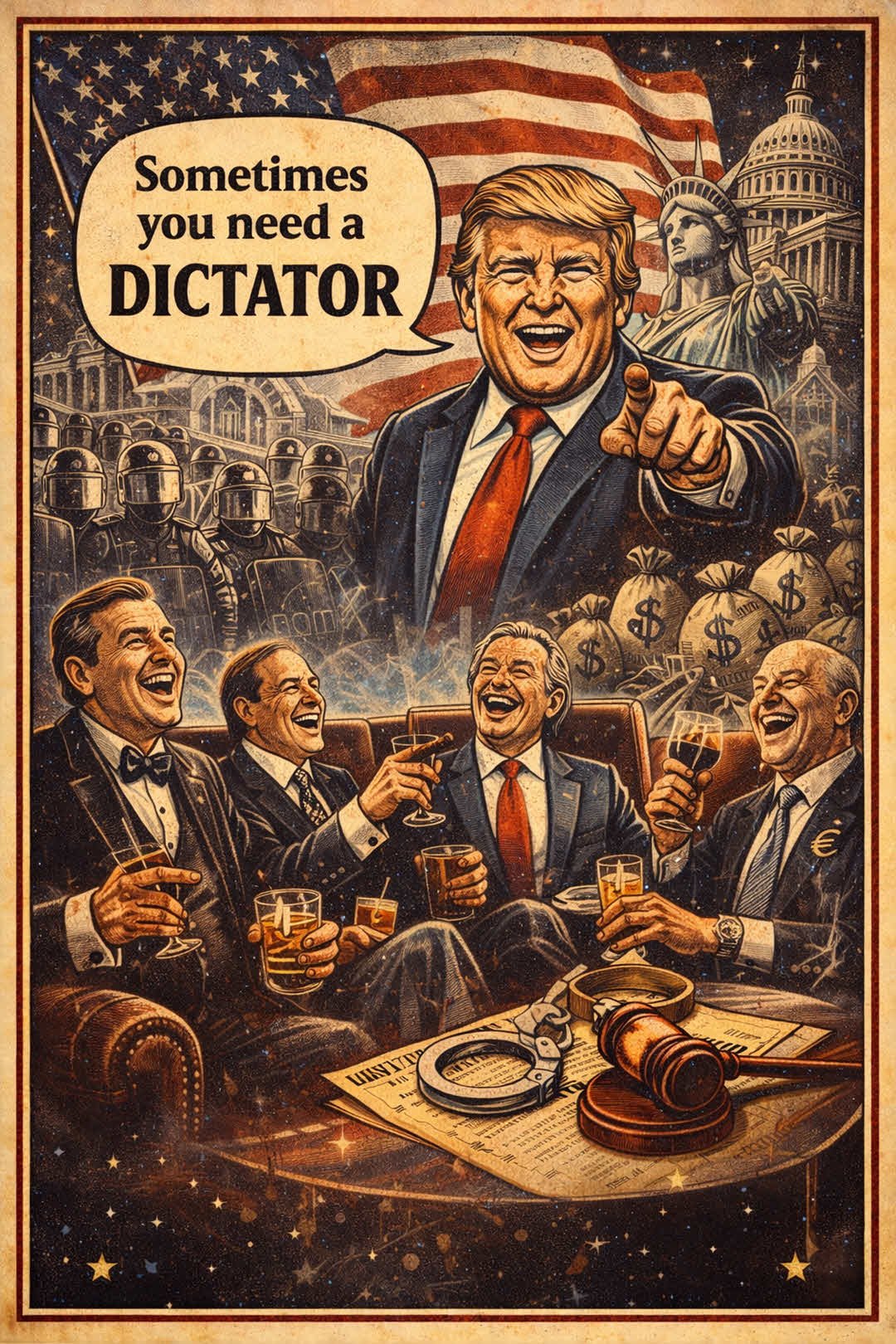
This was not said from the podium, where presidents traditionally pretend to govern for the benefit of nations. It was said afterward, in the softer light of the donor lounge, where the real policies are explained in plain language. There, Trump congratulated the assembled elite on doubling their net worths, assuring them that his presidency had given their genius “room to work,” by which he meant fewer laws, fewer rules, and fewer obstacles between money and more money.
This, we were invited to understand, is what success looks like: wealth rising upward, applause flowing towards him, and the law hovering somewhere perhaps in a confused state.
Trump’s formal speech had already prepared the ground. America, he explained, is the engine of the world. When it booms, everyone booms; when it crashes, everyone else deserves it. Europe was scolded for weakness, mocked for windmills, and reminded—incorrectly but confidently—that without America, everyone would be speaking German. (Switzerland, where much of the audience already does, absorbed this lesson politely.)
Greenland made its usual appearance, described as a large, beautiful object that should clearly belong to whoever wants it most (meaning the United States). Denmark’s claim, Trump suggested, rested on nothing more than an old boat and bad judgment. The fact that postwar America deliberately returned territories to prevent future wars was dismissed as historical stupidity. Restraint, after all, is just power wasted by people insufficiently impressed with themselves.
But it was the off-script moments that revealed the governing philosophy in its purest form. Troops in cities? Effective. Consent? Slow. Law? Optional. Immigration? A matter of removing whole categories of people quickly and loudly, because nuance does not poll well in donor lounges.
All of this might have remained merely grotesque theater were it not for the timing. While Trump joked about dictatorship abroad, courts at home were quietly clarifying that presidents are not kings, candidates are not immune, and shouting loudly does not convert private ambition into public duty.
The law, it turns out, does not laugh on cue.
And that is the tension Trump cannot resolve: applause versus accountability. In Davos, power was framed as personal, wealth as virtue, and force as efficiency. Law was treated as a minor inconvenience, something that could surely be managed with enough confidence and enough donors.
But law is not impressed by net worth. It does not clap. It does not care how many wars you claim to have ended, how many medals you covet, or how many executives laugh when you say the quiet part out loud.
Sometimes, Trump told us, you need a dictator.
History suggests that what dictators always bump into, eventually, is an audience that stops laughing, and a court that was not laughing in the first place.