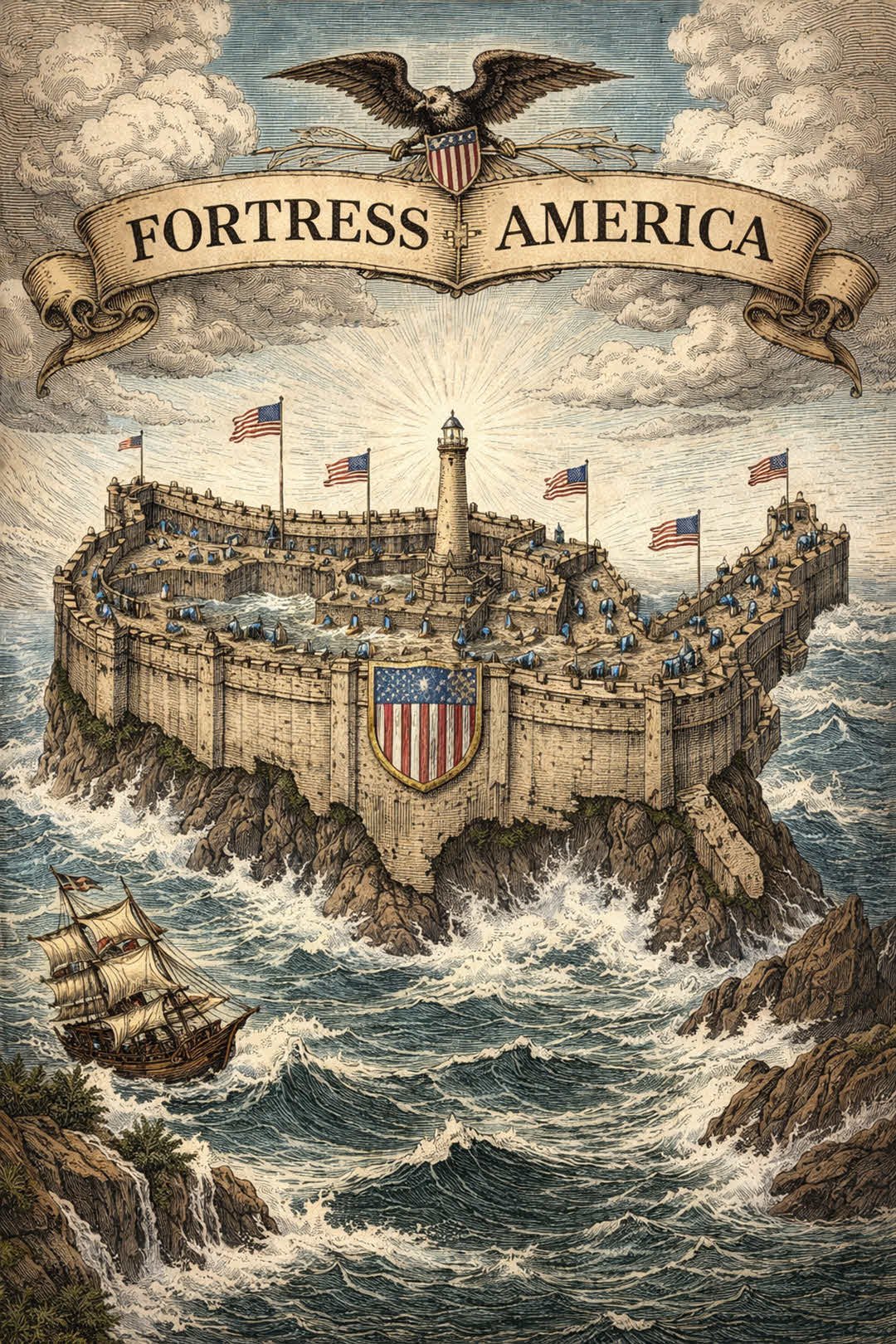
Fortress America
Tariffs
The Golden Dome
Iceland (or rather Greenland)
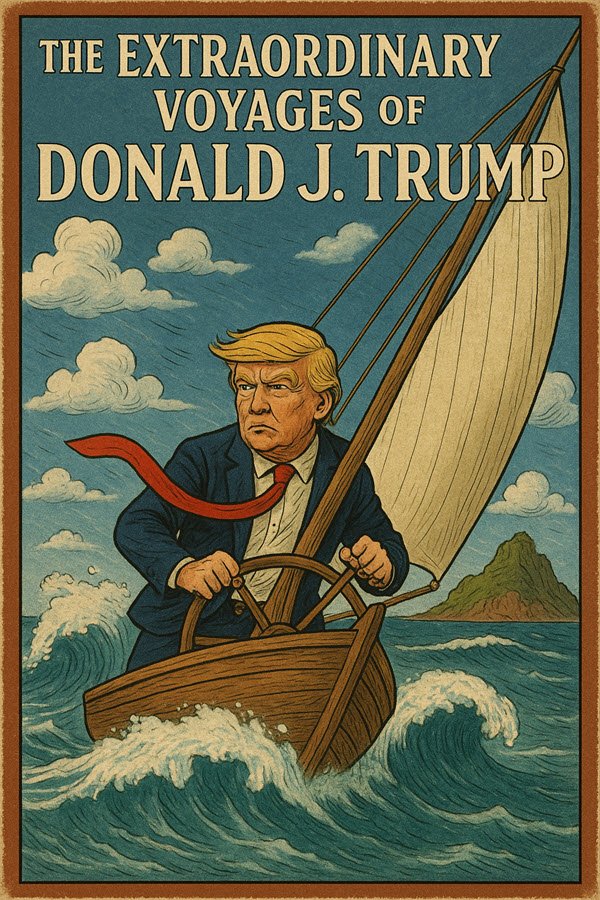
It is recorded by several reliable witnesses that a certain celebrated gentleman, being possessed of an exceptional confidence in his own magnificence, did ascend the snowy heights of Davos with the express purpose of improving the world by simplifying it. His name, already familiar to mirrors everywhere, was Donald Trump.
Arriving among the assembled financiers, ministers, and professional nodders, he assured them that strategy was vastly overrated, that alliances were mostly decorative, and that history itself would run more efficiently if treated like a real estate negotiation conducted between cocktails. He explained that patience was for losers, planning was for academics, and leverage was something best demonstrated by unpredictability shouted loudly enough.
With a grand sweep of the hand, so practiced it might have been rehearsed before a gilt-framed reflection, he proposed that tariffs, treaties, and friendships be regarded as interchangeable items, raised or lowered according to mood, applause, or the Dow Jones Industrial Average. “People love it,” he said, which settled the matter entirely.
The gathered audience, grateful not to be required to think in terms of decades, applauded politely. Markets fluttered. Allies, standing at the edge of the room, exchanged looks of the sort usually reserved for ship passengers noticing water where water ought not to be.
Donald Trump assured everyone that no harm could come of such arrangements, for nothing was permanent. Frameworks, he explained, were wonderfully flexible—by which he meant they could be bent, discarded, or denied having existed at all. Rivals, he said, were “very smart people” who respected strength, particularly when strength appeared confused.
Some timid soul ventured to ask about the long-term consequences. This was waved away. Long-term thinking, the gentleman declared, was precisely what had gotten everyone into this trouble in the first place. Why manage a world order when one could dominate a moment? Why lead when one could perform?
And so, amid the gentle and controlled laughter, influence was gently set down, like a coat one means to retrieve later. Confidence was mistaken for command, noise for power, and applause for loyalty. Rivals listened carefully. Partners took notes. History, as usual, was not invited.
The remarkable thing was not that anything collapsed, of course, nothing so vulgar occurred, but that so much drifted and seemed unsteady. No treaty was shattered, no flag lowered. Only expectations shifted, habits eroded, and trust quietly packed its bags and left.
The Moral
Thus, we learn that empires are not always conquered by enemies, nor undone by catastrophe. Some are misplaced. This one may simply be set aside by a man who mistakes the sound of his voice for the movement of the world. And when Donald Trump later asks who took the influence of the United States, the answer will be most inconvenient: no one did. You traded it. You misplaced it somewhere, believing applause to be interest, and performance to be power.