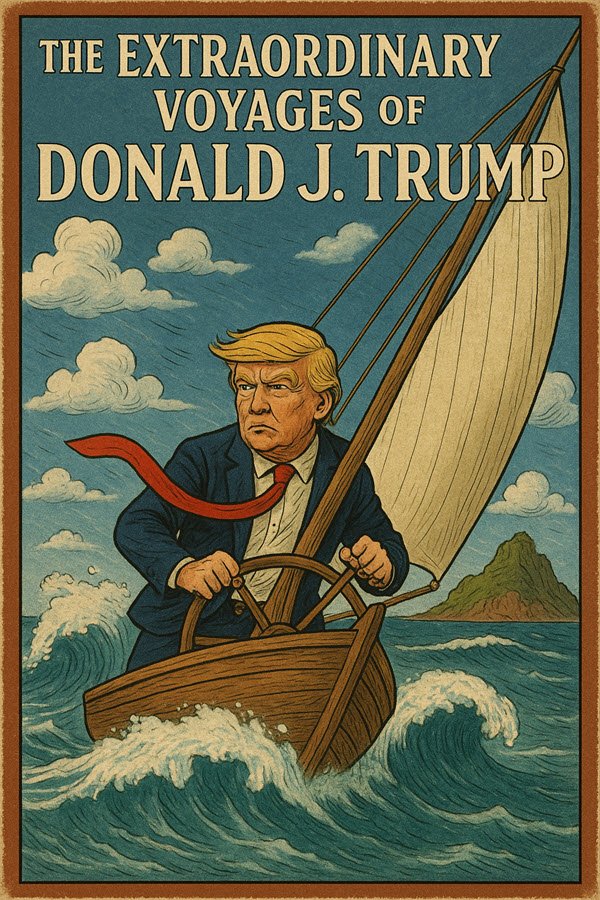
European leaders, with admirable restraint, have begun to repeat, slowly and clearly, that NATO was designed as a partnership of equals.
It has lately been observed in the capitals, courts, and council chambers of Europe that a most extraordinary clarification was required. It is a very important clarification indeed.
The clarification is that the North Atlantic Treaty Organization is a union of thirty-one nations, and not, as previously assumed, the United States, followed by thirty-one spectators politely applauding from the balcony.
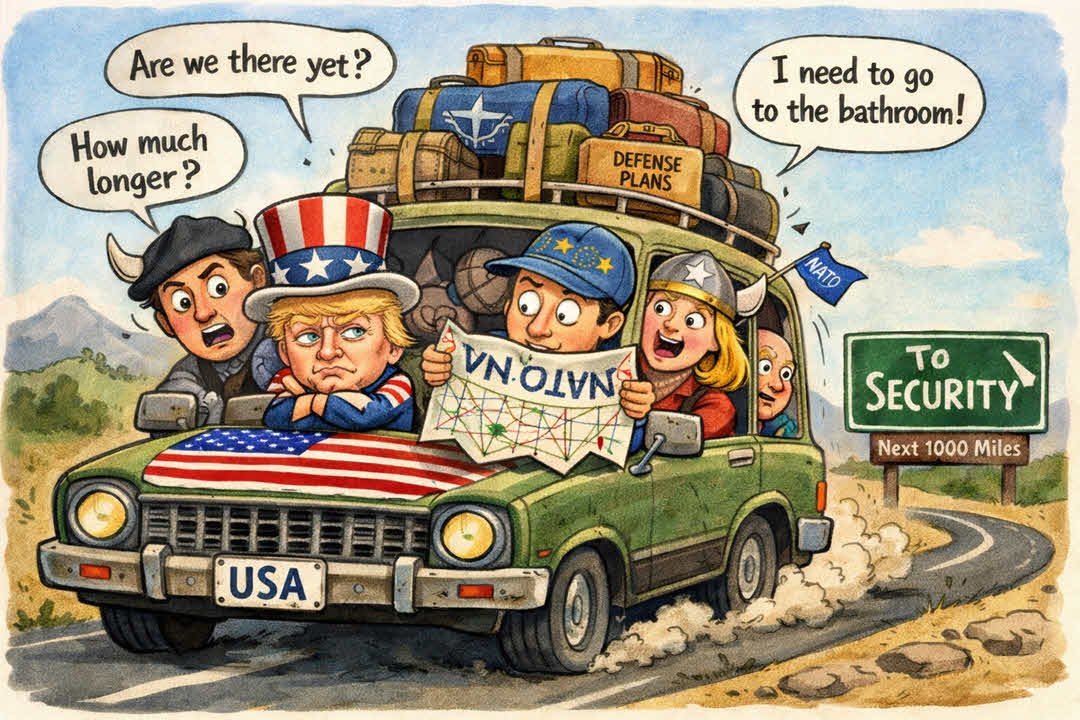
This revelation came as something of a shock to certain officials who had grown accustomed to the idea that NATO functioned much like a family road trip: America driving, Europe holding the map in a confused manner, and everyone else asking if they were “almost there yet.”
European leaders, with admirable restraint, have begun to repeat, slowly and clearly, that NATO was designed as a partnership of equals. Each nation, they remind us, is meant to possess one voice, one vote, and one modest illusion of influence. This was not intended as a radical reinvention of the alliance, merely a return to its founding documents, which had apparently been misplaced beneath several PowerPoint presentations prepared by Stephen Miller and Pete Hegseth, in Washington.
The urgency of this reminder has increased of late, owing to the peculiar behavior of the alliance’s largest member, which has taken to speaking of collective defense in ways usually reserved for extended car warranties. If you have ever purchased a car and then were confronted by a sales person trying (too dame hard) to sell you an extended warranty you will know what I mean. Security guarantees, it seems, may now be subject to review, renegotiation, or cancellation should the smaller members fail to smile enthusiastically enough or fail to show enough appreciation, or meet quarterly spending targets with sufficient cheer.
Matters were not improved when the United States, in a moment of entrepreneurial inspiration, floated the idea of acquiring Greenland. Greenland is an island belonging to a fellow NATO member. This entrepreneurial idea introduces the novel concept of intra-alliance real estate speculation. This maneuver caused some confusion, as Denmark struggled to determine whether Article 5 applied to hostile invasions, friendly invasions, or friendly invasions followed by invoices.
In response, European officials have begun speaking of NATO not as “the U.S. plus others,” but as a shared enterprise, a phrase which here means: please stop treating us like interns guarding the nuclear umbrella while you decide whether to renew the lease.
This rhetorical shift does not, as some alarmists suggest, imply that Europe believes itself ready to defend the continent armed only with resolve, baguettes, and press releases. On the contrary, European leaders freely admit that without American logistics, intelligence, and hardware, the alliance would currently resemble a well-meaning book club attempting to repel a mechanized invasion. Book clubs are tough, but not that tough.
What they do suggest, very gently, is that an alliance whose survival depends entirely on the mood of one electorate every four years may not be the pinnacle of strategic design.
Thus, the phrase “a union of 31” is not a declaration of independence, but rather a plea for adulthood. It is an aspiration that NATO might function as an institution rather than a personality, a treaty rather than a temperament. The hope is that Europe might become a pillar within the alliance, instead of a decorative column wheeled out for summits and tucked away during decisions.
In essence, Europe is not asking America to leave the table. It is merely asking that the chairs be evenly spaced, the menu shared, and the threat of flipping the table slightly reduced.
For as every sensible alliance knows: a union that survives only so long as its loudest member remains in a good mood is not a union at all—it is a performance. And performances, however grand, have a way of ending abruptly when the star storms offstage.