A Story From The Book
Donald Trump Lands at Hoaxminster-by-the-Sea
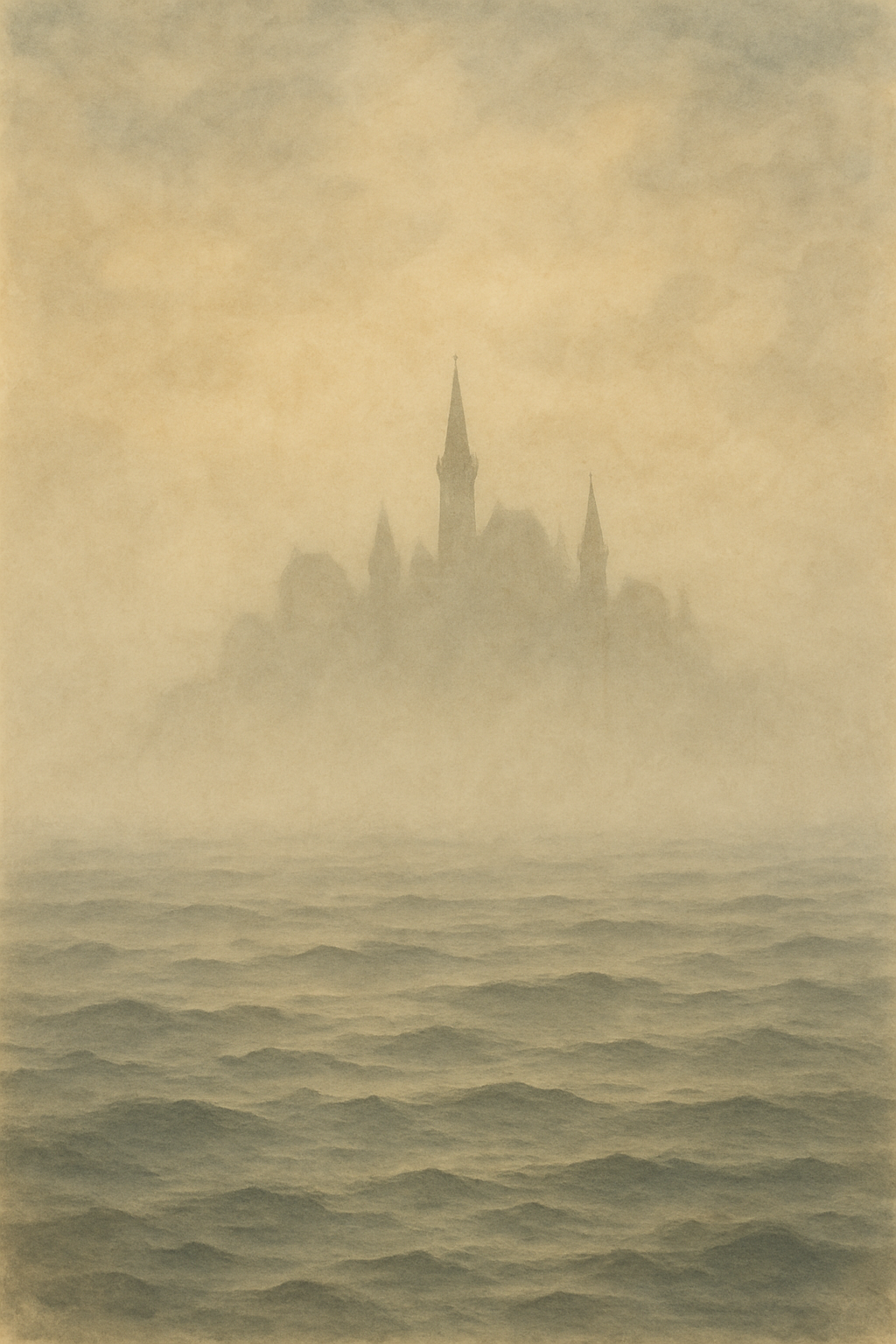
Hoaxminster-by-the-Sea as seen from the sea.
Before I explain what Donald Trump experiences at Hoaxminster-by-the-Sea, a brief history of this society would be helpful.
The town of Hoaxminster-by-the-Sea was, according to its own proud inhabitants, founded in the Year of Our Astonishment, which coincidentally is also the year in which society stopped keeping reliable records. They, therefore, forgot their history, and their history became distorted. The earliest chronicles describe it as a small village that, quite by accident, discovered that stories sold better than anything else it could produce.
The transformation began when a local fisherman, Tobias Grievance, returned from a dull morning at sea with nothing but a vivid imagination. Rather than admit the ocean and the fish had outwitted him, he declared that he had seen a mermaid auditing the tides with a golden ledger. The village, being short on entertainment and long on boredom, believed him immediately. The people promoted this story, and tourists began to arrive. Suddenly, they realized that they had something to sell and people would buy it.
Prices rose. Inns filled. The fish continued to be scarce, but it was agreed that stories about mermaids were a more sophisticated and steady source of income.
Encouraged by this success, the town elders formed the Council for Astonishing Occurrences, whose official duty it was to verify that every tale was as untrue as possible while remaining plausible enough to the hopeful and the ill-informed. In time, the Council developed standards, categories, and even a modest bureaucracy. They distinguished between Harmless Hoaxes, Laudable Deceptions, Profitable Wonders, and Strategic Nonsense, and they became good at it.
Hoaxminster’s prosperity grew in exact proportion to its detachment from reality. When other towns erected lighthouses to prevent shipwrecks, Hoaxminster erected Illusion Towers, which shone no light at all but were painted and presented in such a way that sailors felt safer approaching them. The number of wrecks remained unchanged, but the town advanced the notion that the sea around Hoaxminster was the safest ever seen. In fact, it was a hoax, and every captain, it was claimed, was relieved to have seen such an impressive structure before running aground.
During the Great Age of Enlightenment, when other cities busied themselves with telescopes and reason, Hoaxminster declared itself the World Capital of Credible Untruths. Philosophers were invited to lecture, not on what was real, but on how appealingly the imaginary could be dressed. The town motto, inscribed above the Harbor Gate, still reads:
“If it did not happen, it should have or would have.”
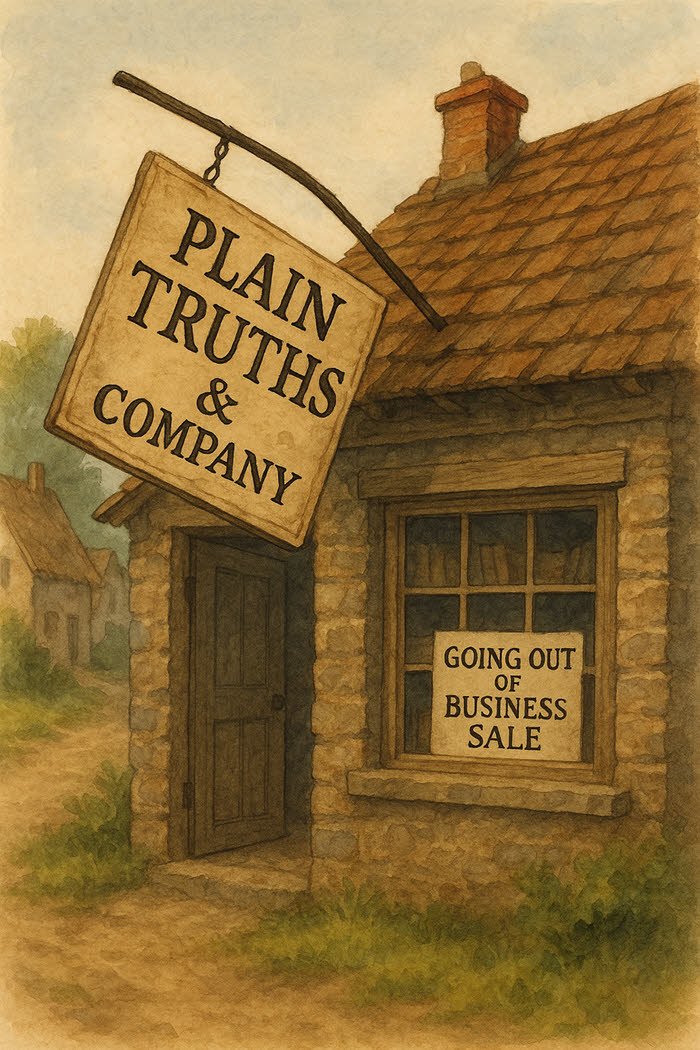
In later years, the town experienced a brief crisis when a reformer attempted to introduce facts. He opened a small shop called Plain Truths & Company, offering verifiable information at modest prices.
The business failed within a fortnight. Customers complained that the facts, though accurate, lacked charm, suspense, and the gratifying sensation of knowing what others did not.
Thus, in Hoaxminster, expressing the truth was not a profitable business, and people debated (indeed, some were certain) whether truth was even necessary in society. Scientists and scholars were even ridiculed by people who infrequently or perhaps never at all had ever opened a book.
Thus, Hoaxminster-by-the-Sea settled into its current condition: a place where rumors are tended like roses, conspiracy theories are fattened like pigs, and each citizen takes pride in being deceived—provided the deception is sufficiently elaborate. They regard reality with polite tolerance, as one might regard an elderly relative who insists on speaking plainly. Some, within society, even regarded reality with disdain.
The town’s historians agree on only one point: that nothing stated in public is entirely reliable, and therefore, as long as it was close enough to reality and if repeated often and with confidence, people would believe it.
Donald Trump Embarks Again Upon The Sea and Arrives at Hoaxminster-by-the-Sea
Having been wearied by many adventures among nations that professed reason while daily disproving it, Donald Trump embarked again upon the sea, in hopes that the elements might at least be consistent in their malice. This time, his vessel was small but stout, the crew resolute, and the captain a man who declared that he believed only what he could see, which made him particularly unfit for navigation.
After some weeks of tolerable weather, the vessel was overtaken by a fog so thick that the Sun could not be seen, and some members of the crew became frightened and began to speculate that the Sun may have resigned his office, leaving the world to be governed by conjecture alone. The mariners took frequent soundings, but found nothing save ignorance on every side, which did not surprise Donald Trump, as he had met the same result in many parliaments.
At length, through this universal obscurity, there appeared faintly before them a shoreline, with towers and spires standing like bold assertions against the shapeless clouds.
As they drew near, the captain cried out that he had never seen this coast on any chart. The pilot swore it must be a mirage. The cabin-boy, being the least corrupted by knowledge, simply pointed and said, “There, sir, I see an island through the mist.” Thus, by a rare triumph of plain observation over learned unbelief, Donald Trump arrived at Hoaxminster-by-the-Sea.
The crew cast anchor in a bay adorned with several curious structures. Some resembled lighthouses yet emitted no light. Others were tall columns upon which were inscribed various proclamations: “We Declare the Sea is Calm by Public Decree,” though the Waves buffeted the hull of their small vessel; “All Ships Are Safe within Sight of this Pillar,” although the crew observed three Wrecks lying within close proximity to the pillar.
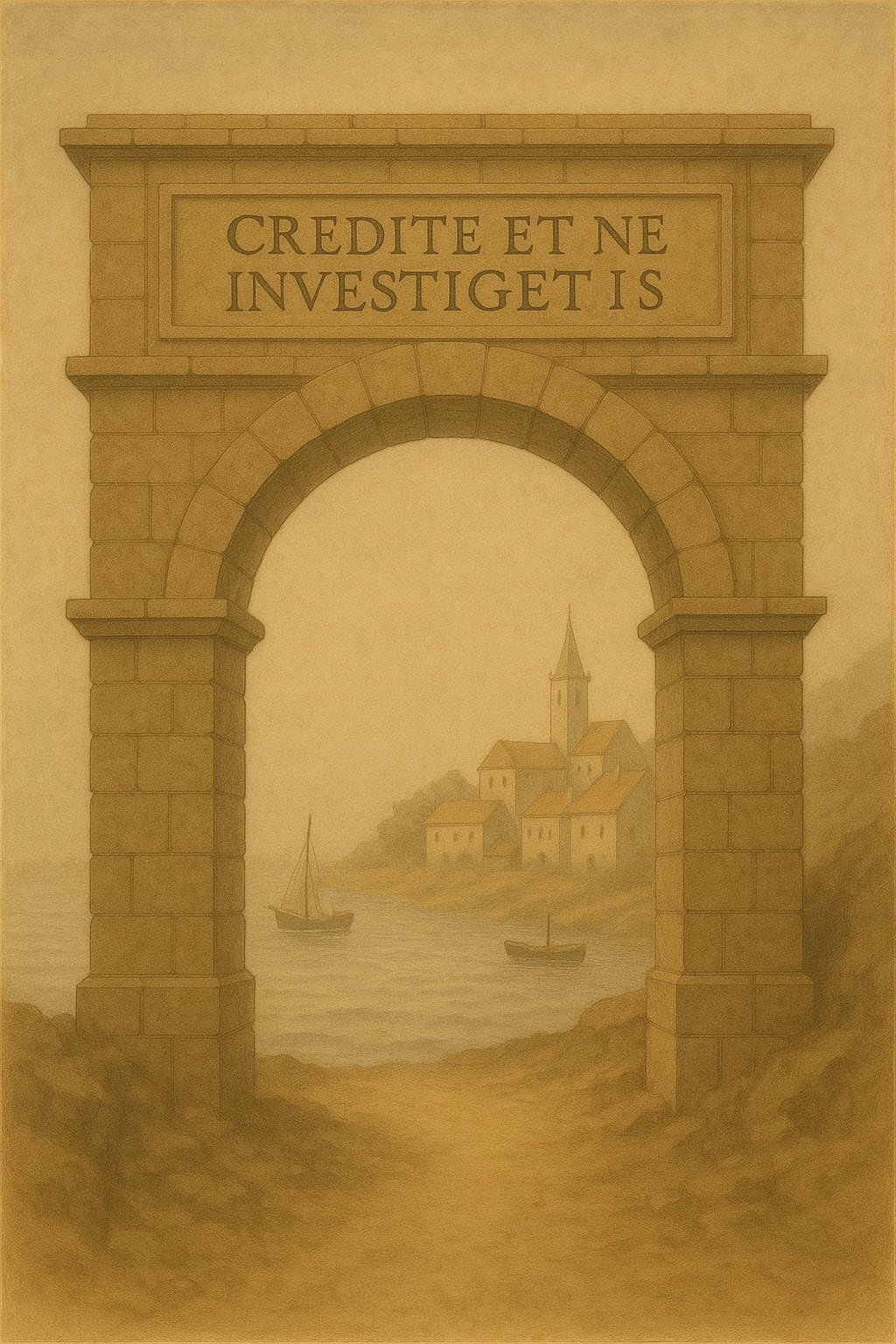
Near the shore stood an arch bearing, in large letters of Gold, the Words: Credite et ne Investigetis, which came from ancient Latin and means, “Believe, and do not investigate,” as if spoken to a crowd.
Upon Landing, Donald Trump was met by Hoaxminster-by-the-Sea officers, who escorted him to the town and asked many questions. These officers wanted to know his land of origin, what news he brought, and whether he had witnessed any miracles lately that might be available for licensing. Donald Trump pondered this last question as he always looked for opportunities to license something. Donald Trump answered as modestly as truth would allow, which greatly disappointed them.
They led him through narrow streets, whose houses were hung with signs advertising Verified Wonders, Certified Mysteries, Authentic False Reports at reasonable Rates, and even a shop that was advertising Alternate Facts for Sale.
Author’s Note: To read more about the adventures of Donald J Trump during his time at Hoaxminster-by-the-Sea you may purchase the full book of The Extraordinary Voyages of Donald J Trump at Amazon.