February 24th Is The Anniversary of Russia’s War with Ukraine
We are now on Day 1461 of Vladimir Putin’s three-day war.
Three days. It is worth repeating.
That was the Russian swagger. That was the muscle-flex. Kyiv would fold. Ukraine would faint. Tanks would roll through Ukraine like a victory parade. Western analysts — intoxicated by years of recycled propaganda about Russian might — nodded gravely and agreed.
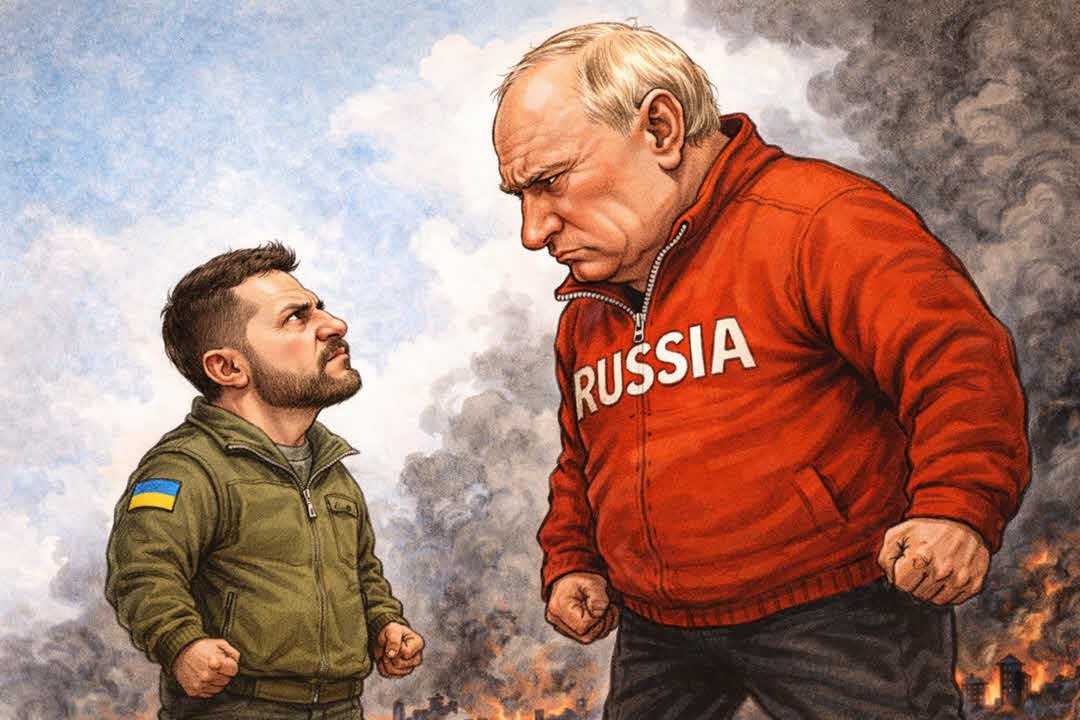
Some American commentators and Donald Trump practically needed a cigarette afterward, so enthralled were they by the imagined masculinity of Russian columns. An anti-woke army, a bare-chested Putin, the whole fantasy package.
Then reality intervened.
The three-day war turned into a four-year trench of drones, mud, shattered armor, and humiliating miscalculation. The vaunted Russian juggernaut met Ukrainian stubbornness and discovered that propaganda does not stop American Javelins.
It is almost unfair to call it a stalemate. It is more accurate to call it a grinding exposure of myth.
This is what happens when machismo collides with logistics.
The modern battlefield does not reward chest-thumping. It rewards coordination, supply lines, and the quiet mathematics of industrial capacity. Drones hover. Artillery calibrates. Breakthrough fantasies dissolve into kill zones.
And yet somewhere in Washington, the Department of Defense flirts with a “warrior ethos,” as though flexed biceps can defeat precision-guided munitions. One imagines a recruitment poster featuring bulging arms holding a spreadsheet.
Modern war is not an arm-wrestling match. It is an accounting exercise with explosions.
Which brings us to the most unsettling development of all: the moral retreat of the United States.
For three years, America, cautiously, sometimes frustratingly, supported Ukraine. The aid was imperfect. It was slow-walked. It was hedged with restrictions born of fear that Russia might lose too badly.
But it was support.
Now we have a president who seems less concerned with Ukraine’s survival than with avoiding the discomfort of crossing Vladimir Putin. He does not announce allegiance to Moscow. Oh no, that would not be proper. However, he tightens the valves. Delays deliveries. Allows support to wither.
It is a quiet betrayal. A bureaucratic suffocation.
America once styled itself as the main pillar of democracy. Now it behaves like a landlord threatening eviction.
And yet — infuriatingly for those who assumed Ukrainian collapse — Ukraine still stands.
Russia’s year-long offensive, from last summer, has produced rubble, not victory. Cities like Pokrovsk become symbolic trophies, reduced to dust with no strategic consequence. War does not break open because modern warfare refuses to cooperate with twentieth-century fantasies.
Meanwhile, Europe, so often accused of timidity, does something profoundly inconvenient: it pays.
European nations ramp up production. They buy weapons. They transfer systems. They invest in manufacturing. They begin, awkwardly but unmistakably, to act like the economic giant they are.
This has caused visible irritation in Washington. The notion that Europe might develop “buy-European” defense provisions has been treated almost as heresy. Imagine the audacity: a continent realizing it should not remain permanently dependent on a partner that might one day turn its back.
The irony is almost operatic.
America reserves the right to leverage its defense industry for geopolitical pressure — including, apparently, on behalf of dictators it prefers not to antagonize — yet fumes at the idea that allies might seek autonomy.
As for the war’s ultimate outcome, it will not be decided by rhetoric.
It will be decided by production lines.
Russia has a larger population than Ukraine. It has a bigger GDP. But Ukraine has friends. These friends are imperfect; they sometimes waver and occasionally are cowardly. However, increasingly, these friends have their own industrial momentum.
Wars do not end because a leader insists he has the cards.
They end when one side runs out of shells, money, or will.
Russia appears to be trying terror bombing as a substitute for strategy. History suggests that civilians under bombardment rarely respond with submission. More often, they respond with fury.
The most damning sentence of this entire episode may not concern Russia at all.
It may be this: America had a chance to stand clearly on the side of a smaller democracy fighting naked aggression. America chose equivocation.
Even if Ukraine ultimately prevails, and it may, the stain will remain on America.
The three-day war has revealed more than Russian incompetence.
It has revealed American hesitation and a lack of leadership.
And hesitation, in the face of tyranny, is not neutrality.
It is abdication.
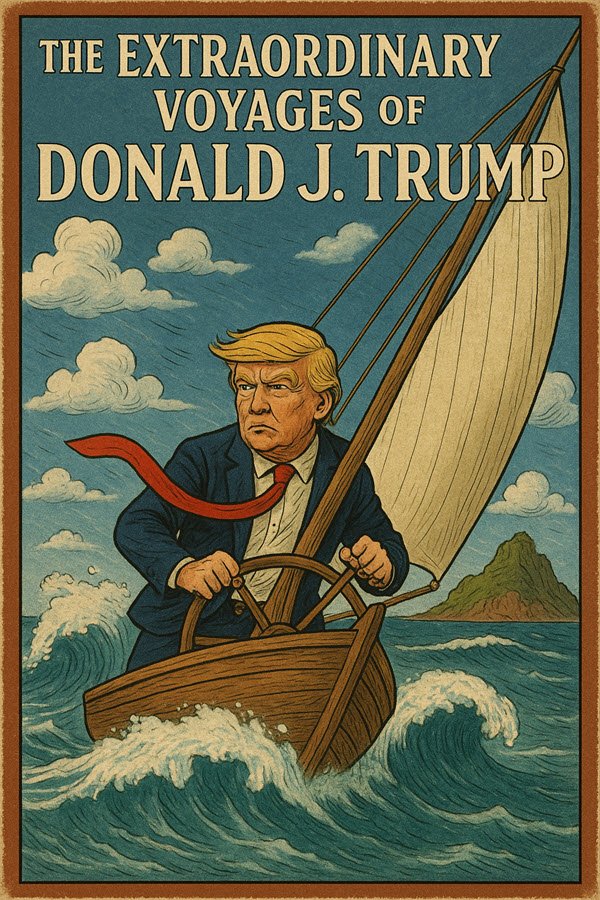
Now available on Amazon Kindle!
A book about the travels of Donald J Trump as he visits many strange and humorous places and leaves each place perhaps a bit wiser and without getting into any trouble.

For fans of the book Gulliver's Travels.