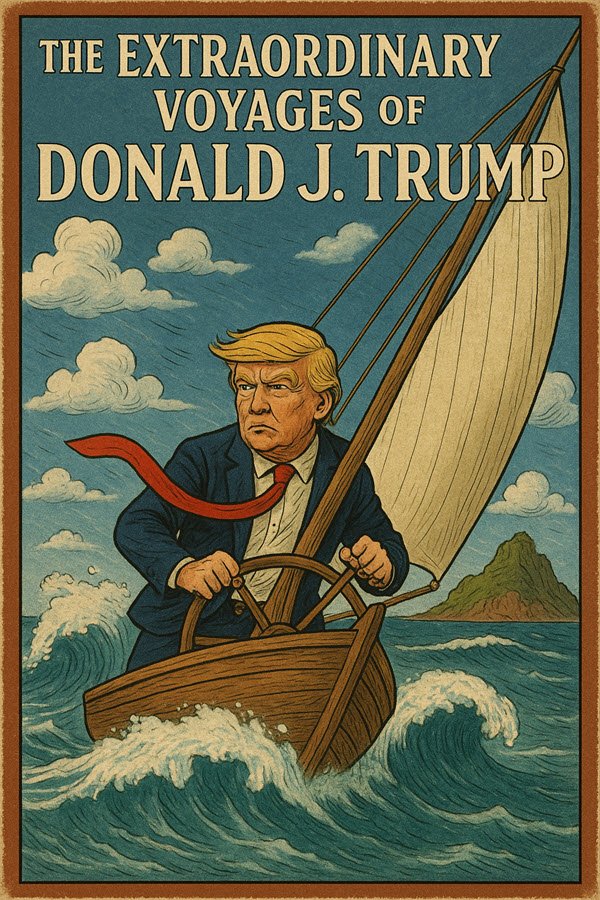
Trump and the American People Insist Upon Unconditional Surrender
There are many ways for a president to conduct foreign policy. Some read history. Some consult diplomats. Some study maps, alliances, logistics, or the occasional physics of geography.
And then there is the Trump method, which appears to involve shouting “UNCONDITIONAL SURRENDER!” into the internet like a man attempting to win World War II with a caps-lock key.
Last week, the President of the United States announced that the war with Iran would end only when Iran offered precisely that: unconditional surrender.
Now, historically, this phrase has a pedigree. Franklin Roosevelt used it during World War II, when confronting regimes that had already conquered half the planet and were being ground down by armies numbering in the millions.
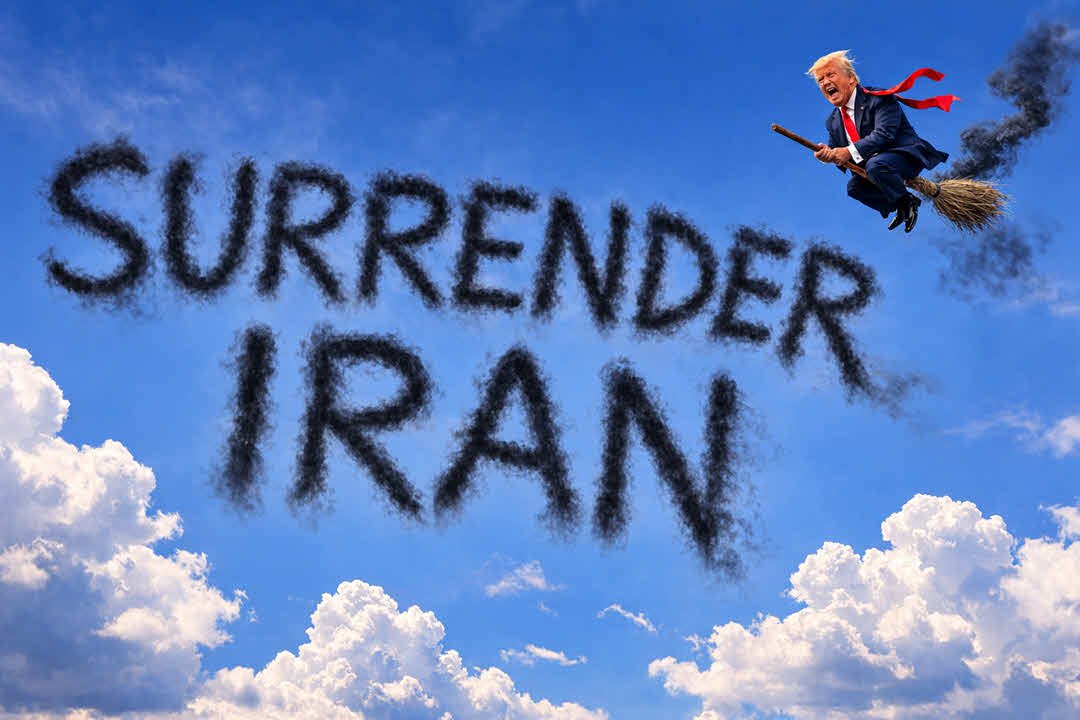
Trump, by contrast, seems to have discovered the phrase somewhere between a World War II documentary and a professional wrestling promo.
One can imagine the scene in the Oval Office.
A junior aide, perhaps trembling slightly, raises a hand.
“Mr. President… historically unconditional surrender requires occupying the country, dismantling the regime, and rebuilding the state structure.”
Trump nods gravely.
“Perfect,” he replies. “Put it on Truth Social.”
And so the phrase entered the bloodstream of modern diplomacy like a Red Bull poured into the Geneva Convention.
To be fair, Trump has explained the concept with remarkable clarity. According to him, surrender will occur when Iran “can’t fight any longer.”
This definition, while technically accurate, also describes the end of every war in human history, including several bar fights and most hockey games.
The beauty of the Trump doctrine lies in its elegant simplicity.
Diplomacy is complicated.
War is complicated.
History is complicated.
But yelling “surrender!” is easy.
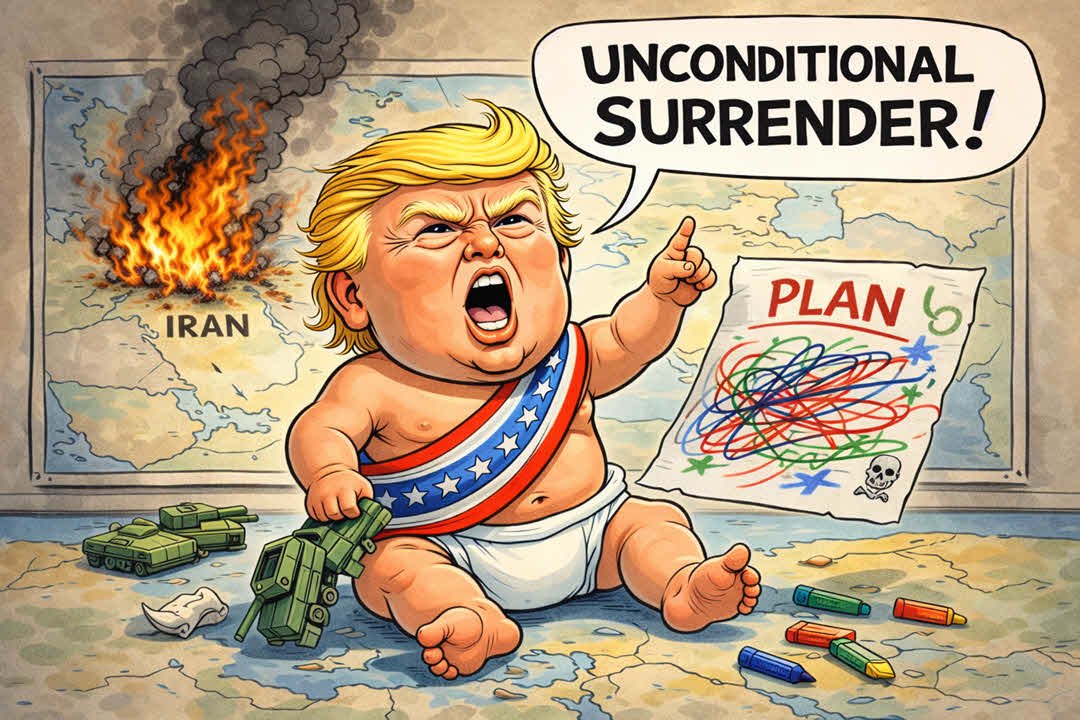
It has the advantage of sounding decisive while requiring absolutely no plan whatsoever.
Indeed, the phrase “unconditional surrender” has always implied certain logistical inconveniences: armies on the ground, reconstruction costs, governance structures, and the occasional decades-long occupation.
But those are details for later.
Trump’s theory of war resembles his theory of construction: announce the tower first, then figure out whether the land exists.
In fairness, Iran has not reacted with the gratitude one might expect from such bold strategic thinking. Iranian officials have described the demand as a fantasy that should be taken “to the grave.”
This response is puzzling.
After all, when Emperor Trump demands your unconditional surrender on the Internet, the customary reaction is compliance.
That is how international relations work now.
One particularly fascinating feature of this episode is that Trump has managed to revive a phrase from 1943 while simultaneously discarding the one thing that made it possible: overwhelming global alliances.
Roosevelt demanded unconditional surrender while commanding the largest coalition in human history.
Trump demands it while tweeting after alienating many of our staunchest allies.
The comparison is instructive.
Roosevelt had Eisenhower.
Trump has Truth Social.
Roosevelt had supply chains stretching across oceans.
Trump has a smartphone and the faint hope that history is too busy to notice the difference.
Of course, unconditional surrender also carries an awkward implication: someone must administer the country afterward.
Who exactly will be running Iran once this surrender occurs remains unclear.
Perhaps a “great and acceptable leader,” as Trump cheerfully suggested, selected with the same careful vetting process used for his casino management teams.
Or perhaps the entire plan ends where most Trump strategies do — with a triumphant announcement followed by someone else cleaning up the mess.
Still, one must admire the audacity.
It takes a rare mind to look at the tangled geopolitics of the Middle East and conclude that the solution is simply shouting “you lose” at a country of ninety million people.
Historians will study this moment carefully.
Future students will learn that in the early 21st century, the United States briefly attempted to conduct global diplomacy using the rhetorical techniques of a professional wrestling announcer.
And somewhere, deep in the archives of political absurdity, the words will remain.
UNCONDITIONAL SURRENDER.
Typed, apparently, with tremendous confidence.
And almost no understanding of what the words mean.