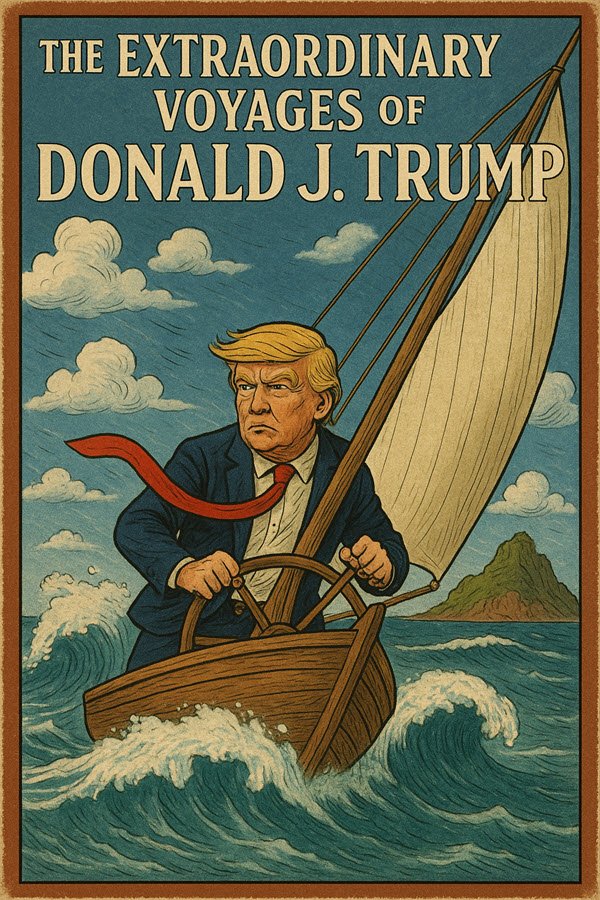
Excerpts from The Extraordinary Voyages of Donald J. Trump
Explore three satirical excerpts from The Extraordinary Voyages of Donald J. Trump, each revealing a different world where truth evolves in unexpected ways.
In Tremendacia, bold claims shape reality. They also worship anyone who exaggerates or makes a point to exclaim greatness.
In Hoaxminster-by-the-Sea, spectacle replaces substance entirely. Also, in this land, plain truths have no place in the culture.
In the Kingdom of Perpetual Chaos and Confusion, everything that is done by magistrates and leaders is confusing.
These selections showcase the book’s signature blend of humor, insight, and sharp political satire. Written in a style inspired by Jonathan Swift, the excerpts invite readers into imaginative landscapes that reflect real-world dynamics of power, belief, and influence. Whether you’re drawn to clever satire or thought-provoking commentary, these passages provide a perfect introduction to the larger journey.
The Ceremony of Seemingly Infinite Praise
(from The Nation of Tremendicia)
No sooner had Donald Trump been welcomed in Grandiosity than Clarion announced that the nation must perform its highest rite in his honor: the Ceremony of Infinite Praise.
The very name of the ceremony pleased Donald Trump, who regarded both ceremonies and praise as two of a society’s most important features. He also thought that they were often significantly undervalued.
The great hall chosen for the event was long and adorned with many mirrors placed on the walls. The great hall was filled with the citizens of Grandiosity and with people who had come from the far-flung regions of Tremendicia. When the people saw Donald Trump, they erupted into a chorus of astonishment and indeed amazement at his greatness. Some citizens even fainted at the sight of him. They had not imagined how great he was. Donald Trump noticed that the floor was inlaid with tiny likenesses of past heroes, all of whom appeared to be engaged in triumphant speeches.
Donald Trump was ushered to a great reinforced dais and was seated. Around him stood thousands of Tremendicians clutching scrolls. At Clarion’s signal, the people closest to Donald Trump unfurled their parchments and began.
“O Giant whose hair defies even the most forceful winds!” they cried. “O Giant whose words reorder the world! O great Donald Trump, whose presence enlarges all that stand near him!”
The hall now echoed these words as a grand chorus with everyone joining in. Donald Trump beamed with approval. These people were confirming his understanding of reality and his greatness.
Then, people a bit further back took their turn. “Behold him whose enemies increase his prominence, whose friends bask in reflected glory, whose critics labor in vain!”
“You see?” Clarion whispered. “Even your detractors and critics contribute to your greatness.”
“I’ve said that many times,” Donald Trump replied.
So, it went for hours. Each group contributed a new catalogue of virtues: his boldness, his confidence, his disregard for lesser people’s doubts. One group staged a short play in which Donald Trump stood upon a mountain and commanded nations to be more impressed with The Great Donald Trump.
Between rounds, Clarion confided that some in Tremendicia considered such ceremonies excessive. “There are those,” he said darkly and ominously, “who believe that quiet work and modesty are preferable to grand claims.
They also believe that any leader is in the leadership position to serve and support the people, rather than the people spending all their time and effort to honor the leader.
“They are called The Mindful.”
…
Donald Trump after Passing Through the Sea of Opinion
(from Hoaxminster-by-the-Sea)
Having been wearied by many adventures among nations that professed reason while daily disproving it, Donald Trump had left Electria by sea, in hopes that the elements might at least be consistent in their malice. This time, his vessel was stout, the crew resolute, and the captain a man who declared that he believed only what he could see, which made him particularly unfit for navigation.
Yet somehow, they had passed through the stormy Sea of Opinion.
After some weeks of somewhat tolerable weather, the vessel was overtaken by a fog so thick that the Sun could not be seen, and some members of the crew became frightened and began to speculate that the Sun may have resigned his office, leaving the world to be governed by conjecture alone. The mariners took frequent soundings, but found nothing save ignorance on every side, which did not surprise Donald Trump, as he had met the same result in many parliaments.
At length, through this universal obscurity, there appeared faintly before them a shoreline, with towers and spires standing like bold assertions against the shapeless clouds.
As they drew near, the captain cried out that he had never seen this coast on any chart. The pilot swore it must be a mirage.
The cabin-boy, being the least corrupted by knowledge, simply pointed and said, “There, sir, I see an island through the mist.”
Thus, by a rare triumph of plain observation over learned unbelief, Donald Trump arrived at Hoaxminster-by-the-Sea.
The crew cast anchor in a bay adorned with several curious structures. Some resembled lighthouses yet emitted no light. Others were tall columns upon which were inscribed various proclamations: “We Declare the Sea is Calm by Public Decree,” though the Waves buffeted the hull of their small vessel; “All Ships Are Safe within Sight of this Pillar,” although the crew observed three wrecks lying within close proximity to the pillar.
Near the shore stood an arch bearing, in large letters, the Words: Credite et ne Investigetis, which came from an ancient language (perhaps Latin) and means, “Believe, and do not investigate,” as if spoken to a crowd.
…
A Modest Proposal Concerning Tariffs
(from The Kingdom of Perpetual Chaos and Confusion)
At this point, Trump forcefully inquired whether the kingdom had ever considered the use of tariffs. He explained to them that tariff was one of his most valued words and one of the most powerful words in the dictionary of his land.
The Minister of Currency looked startled, then intrigued, then immediately uncertain.
“Tariffs?” She repeated, as though she wanted to take a break to study the term before continuing the conversation. “You mean charging merchants who have relationships with merchants in another kingdom for bringing us too much of what we want to purchase and which they want to sell to us?
Donald Trump explained that if a neighboring land had great skill in producing a certain product and then became enthusiastic about trading it, a trade imbalance could result. Tariffs would surely correct the imbalance. He said that tariffs would reduce their enthusiasm.
By making trade more expensive, one could discourage excessive success for either nation while appearing decisive and demonstrating great leadership.
Donald Trump also noted that appearing to be dominant and exhibiting leadership were essential.
The Minister reflected carefully.
“That sounds promising,” she said at last. “If another kingdom trades too much with us, you are saying that our best approach would be to punish them and our merchants for working with them. If they trade too little, we will be punished. Either way, balance is achieved.”
A junior official raised a concern: “But what if tariffs make goods more expensive for our own citizens?”
Donald Trump waved this away. “That would merely prove the policy is working.”
However, the minister now seemed confused and wanted to double check with Donald Trump for confirmation. Donald Trump confirmed, with complete certainty, that if the costs of goods go up for your citizens, it is therefore clear that the tariffs were working. The Minister looked relieved, her confusion replaced by understanding.
Donald Trump also further explained that tariffs can always be adjusted. On day one, a tariff could be 50%, and on day two, you could adjust it to 75%.
One could even announce that the tariff rate would be 75.03457% to indicate that it had been precisely and wisely considered and calculated. Donald Trump said with great conviction that one of the prime values of tariffs was that they are adjustable, announceable, and re-announceable. Moreover, a tariff can be changed at will. All of this appealed to the kingdom’s sense of motion without commitment.
Furthermore, the idea of tariffs being announced, changed, and then re-announced was confusing, which was exactly consistent with the kingdom’s philosophy. Confusion and chaos, particularly with trade and resource management, were always highly regarded.
The idea of tariffs was immediately forwarded to three committees, two subcommittees, and one emergency clarification office, each of which issued statements both endorsing and rejecting tariffs before adjourning indefinitely. One of the subcommittees immediately wanted to announce that all tariffs be defined to a minimum of five decimal places, as this would convince everyone how carefully the tariff rate had been considered. The second subcommittee immediately supported a five-decimal decree and had their leader sign an executive order mandating this for all tariff announcements.
By the following morning, tariffs had been declared essential, disastrous, temporarily suspended, retroactively applied, and proudly credited with preventing a trade crisis that did not exist. Tariffs had even been declared on trees within the kingdom because it had been studied and concluded that trees had never purchased any goods or services. The trees, it was claimed, were taking advantage of the people of the kingdom.
…
Now available on Amazon Kindle!
A book about the travels of Donald J Trump as he visits many strange and humorous places and leaves each place perhaps a bit wiser and without getting into any trouble.

For fans of the book Gulliver's Travels.