Baby Trump Did Not Get His Trophy
It is a truth universally acknowledged—at least by one man with a permanent marker and a clear grievance—that peace is best preserved when awarded with medals, and that any peace not accompanied by applause is, by definition, illegitimate.
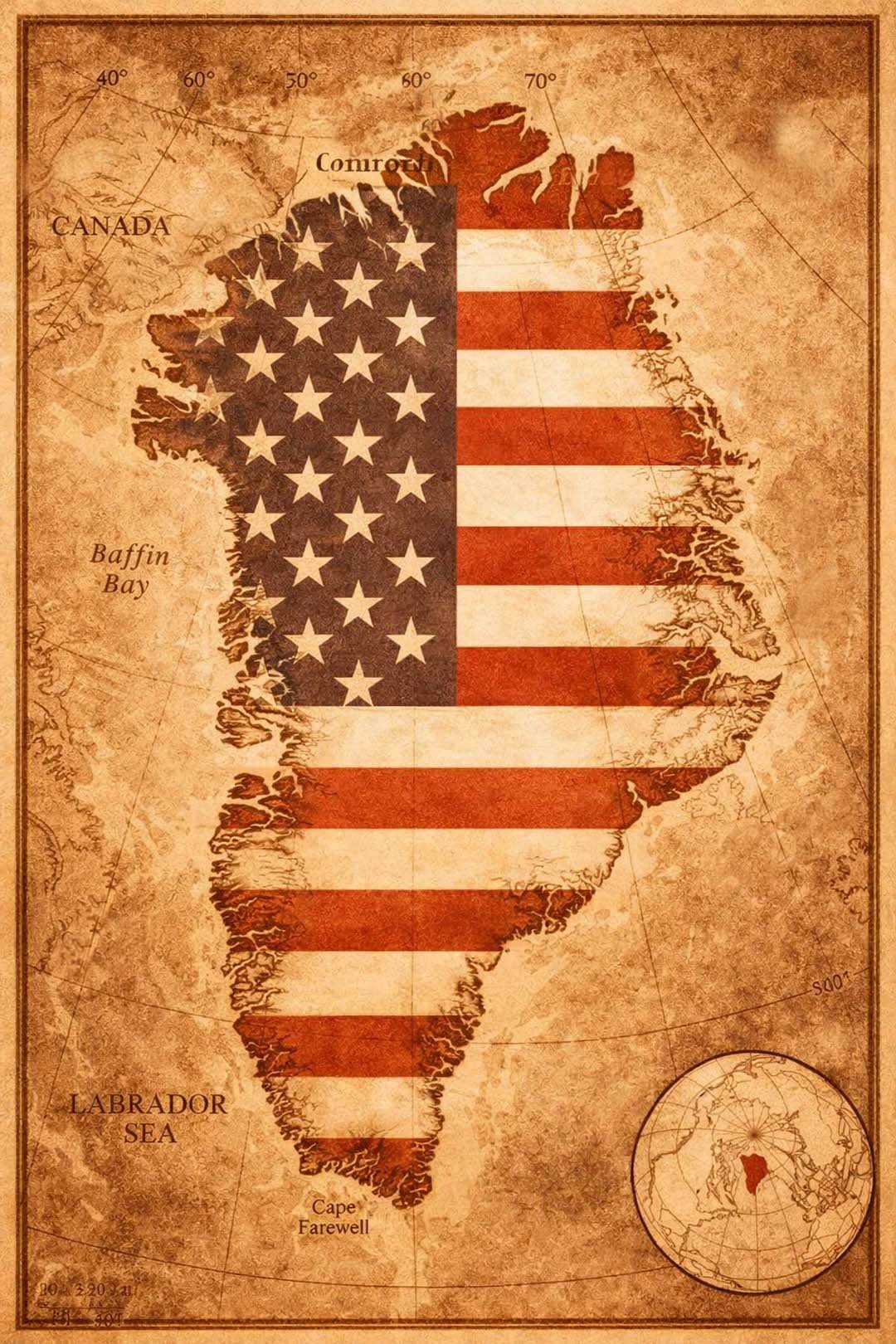
Thus, we arrive at the present moment in world affairs, in which the fate of Greenland, NATO cohesion, and the basic concept of international law now hinge on whether Donald Trump feels sufficiently admired and revered. What a child.
The logic is elegant in its simplicity. The Nobel Peace Prize was not bestowed upon him. Therefore, peace itself has breached an important formality and even the basis of a contract. And when peace misbehaves, there is only one true solution: the one who should have received the prize now has the right to acquire a very large island.
Trump’s letter to Norway’s prime minister reads less like diplomacy than a toddler’s note to the playground supervisor: I was nice. You didn’t clap. Now I will take your toys. In this worldview, restraint is not a principle but a courtesy, extended only when properly rewarded. The absence of a medal voids the warranty on civilization.
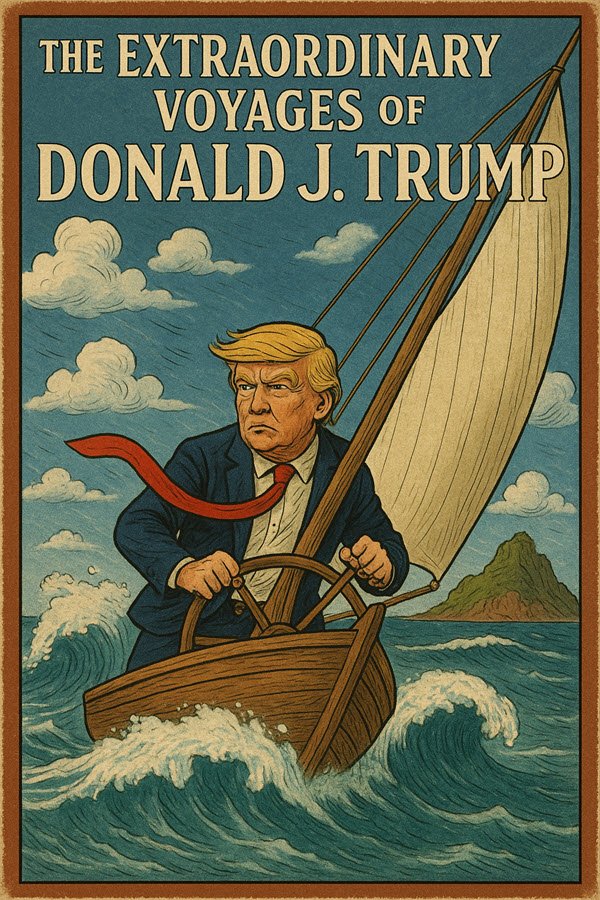
Greenland, we are told, must be seized not because it belongs to the United States, nor because it has requested rescue, but because Denmark’s claim is insufficiently supported by historical evidence. A boat landed there once, Trump argues. Trump claims that this is no way to establish sovereignty. America landed boats, too, he notes, apparently everywhere, and therefore owns everything by nautical proximity.
Who Owns The Moon
At this point in the narrative, it is important to reflect on the Moon. It has come to my attention that certain foreign powers continue to eye the Moon with suspicious enthusiasm. It is clear that both China and Russia may aspire to use the Moon’s resources in ways that may infringe on the United States’ security. This confusion about the ownership of the Moon must be addressed at once. The matter of lunar ownership is, in fact, quite simple.
The United States owns the Moon because the United States landed on it.
This is not a metaphor, nor is it symbolic. We put boots on it. Actual boots. Flag-adjacent boots. The sort of boots that settle all questions of cosmic property law. Russia, for all its thinking about the Moon, never arrived. China, for all its planning, is still circling. And as every schoolchild knows, circling does not count. Only landing counts.
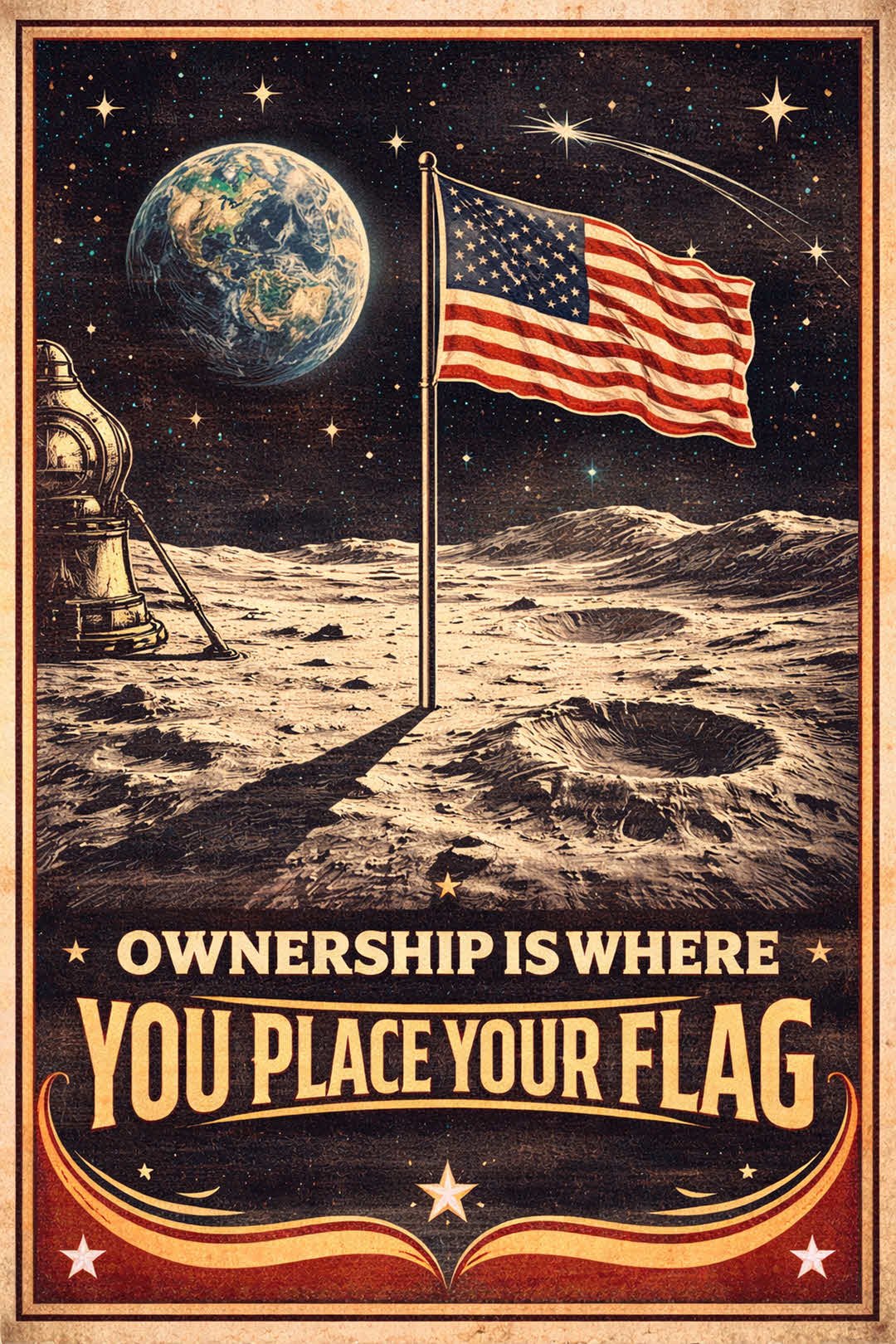
One does not “claim” a celestial body through treaties, science, or collective human endeavor. One claims it is the way history has always claimed things: by showing up first and planting a flag. The flag is a clear sign of ownership, and the United States owns the Moon.
Some will protest that the Moon belongs to all humanity. This is a charming sentiment, similar to believing international waters are respected or that billionaires experience shame. In reality, ownership flows naturally from presence, and presence flows from moon landings. Rockets are expensive, which means the United States has invested heavily in the Moon.
Therefore, Russia and China may look at the Moon. They may admire it. But ownership is reserved for those who arrived, waved, and went home confident enough to never return.
The Moon is American. We landed on it. Case closed.
Now, back to Greenland.
History, in this formulation, is not a record but a suggestion.
NATO fares no better. Having existed for decades as a mutual defense alliance, it is now revealed to be a loyalty punch card. Trump claims he has “done more for NATO than anyone since its founding,” which raises an interesting question: if alliances are measured by self-assessment, why stop at Greenland?
What makes this episode remarkable is not the threat itself, but its stated cause. Not a strategy. Not intelligence. Not an emergent security risk. No, the withdrawal of peaceful intent is punishment for insufficient praise. Diplomacy has been reimagined as customer service, and the customer is furious.
Meanwhile, the Nobel Prize, awkwardly uninterested in being transferred like a trophy for participation, has become a prop in this morality play. A medal is waved about as evidence of virtue, despite being explicitly non-transferable, which in turn becomes proof of conspiracy by the Noble committee. If legitimacy cannot be acquired, it must be simulated.
And so, we are left with a president who confuses recognition with righteousness, applause with authority, and peace with a receipt. He does not ask whether actions deserve honor; he demands honor so actions may proceed.
The danger, of course, is not Greenland. It is precedent. When restraint becomes conditional, when treaties depend on ego maintenance, and when military threats are framed as emotional consequences, the world is governed not by rules but moods.
Donald Trump acts like a child. He must annex an Arctic territory because his trophy shelf feels incomplete; his suggestion now seems refreshingly grounded.
In the end, Greenland is merely the stage. The real performance is smaller, pettier, and far more alarming: a man testing how much of the world can be held hostage by wounded pride—and discovering, to everyone’s discomfort, that the answer may be quite a lot.