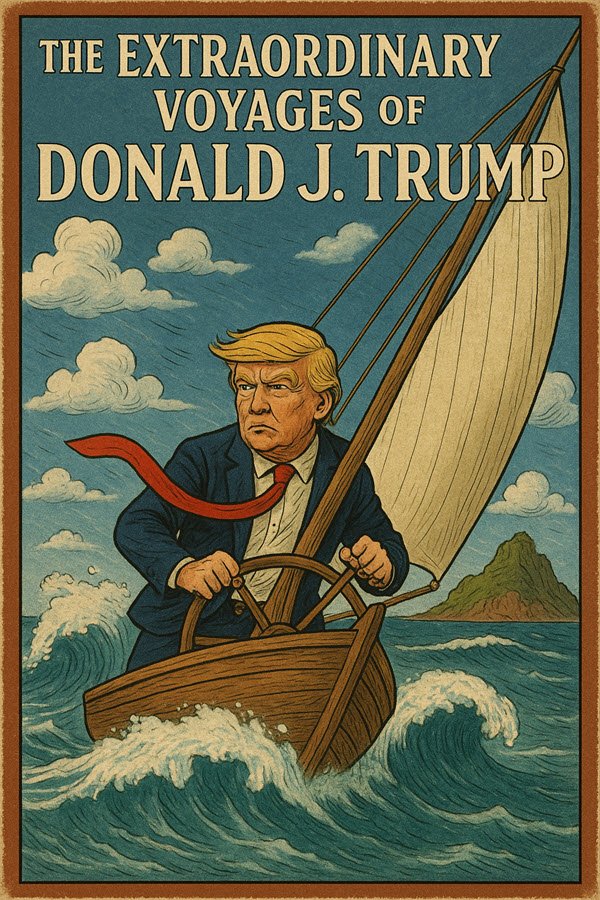
or . . . “I Feel It in My Bones”
There are many ways to run a war.
There is the traditional model—briefings, intelligence, strategy, alliances, logistics, maps with arrows, and people who have read books.
And then there is the Trump model.
This one involves vibes.
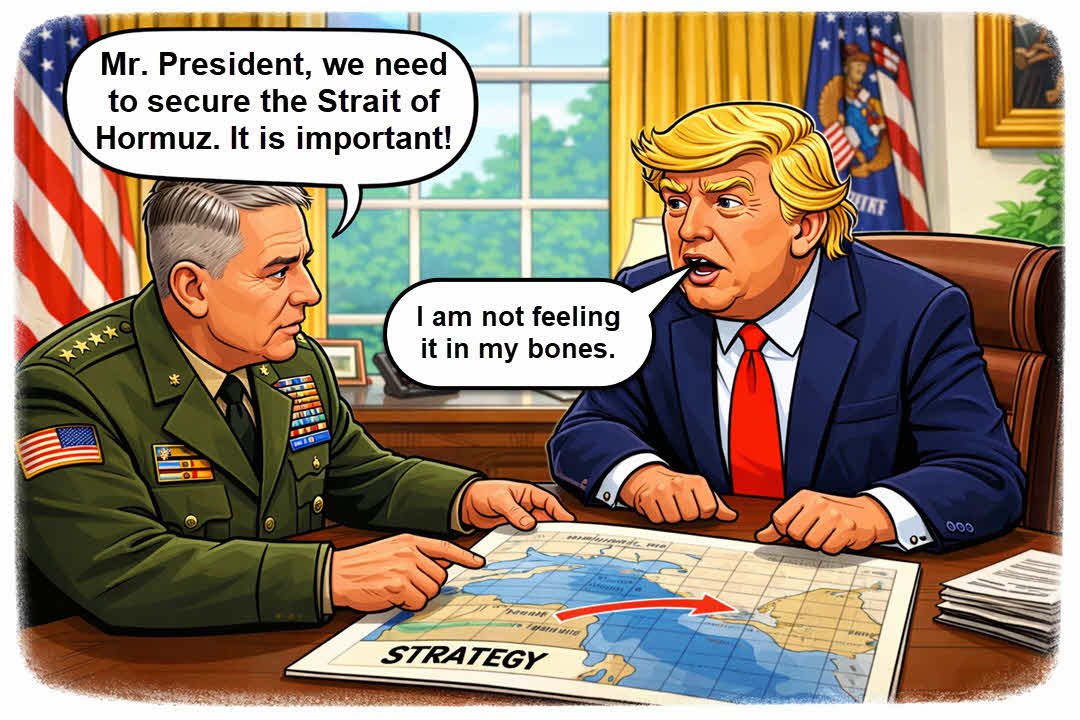
Welcome, then, to what historians will one day call The Bone-Based Doctrine, in which the fate of the Middle East hinges not on intelligence reports, but on a presidential sensation somewhere between a hunch and indigestion.
“I don’t need advisers,” the President declared, in a sentence that should have been followed immediately by the sound of every historian fainting in unison.
This is, of course, a bold position to take while running a war. Most leaders consult generals, diplomats, economists, and occasionally reality. But why clutter the mind with expertise when one possesses the far more reliable instrument of personal certainty?
After all, this is a man who once explained that he makes decisions with “very little knowledge” plus “common sense.”
And now, that same methodology has been generously extended to international conflict.
What could go wrong?
Take, for example, the small matter of Iran retaliating.
When Iran responded to U.S. strikes by attacking targets across the Gulf—Qatar, Saudi Arabia, the UAE, Bahrain, Kuwait—the President expressed astonishment.
“Nobody expected that,” he said.
Nobody.
Not the BBC, which had outlined the exact scenario.
Not Foreign Affairs, which had politely suggested escalation might occur.
Not regional analysts, who had been discussing this possibility for months.
Not even Iran, which had publicly hinted, repeatedly, that it might do precisely this.
But aside from all those people, nobody.
The President was so confident in this claim that he repeated it multiple times, like a man trying to convince both the press and himself that gravity had just been invented that morning.
“Nobody. Nobody. No, no, no, no.”
It was less a statement than a mantra.
Meanwhile, his own Defense Secretary quietly admitted, with the tone of a man explaining basic physics to a stubborn relative, that yes, actually, it had been considered “a possibility.”
But possibility is a dangerous word in the Trump lexicon. It implies uncertainty, complexity, and worst of all—thinking.
Far better to operate in a world where events are either obvious or shocking, and preferably both at the same time.
This explains the administration’s broader strategic framework, which might be summarized as follows:
- Intelligence is optional
- Expertise is overrated
- Allies are inconvenient
- And outcomes will be determined by skeletal intuition
The Strait of Hormuz, for example, has been treated less like one of the most critical chokepoints in the global economy and more like a casual afterthought—something one might secure, or not, depending on how the President feels that day.
At one point, allies are essential.
The next moment, unnecessary.
Policy, in this system, is not a plan. It is a mood.
And moods, as we know, are famously stable foundations for war.
Perhaps the most remarkable feature of this entire episode is not the contradictions, but the confidence with which they are delivered.
There is no hesitation.
No doubt.
No acknowledgment that launching a war in the Middle East might require, at minimum, a passing familiarity with its likely consequences.
Instead, there is only certainty—pure, unfiltered, bone-deep certainty.
It is governance as performance art.
Strategy as improvisation.
War as a kind of television-based instinct.
And so, the United States finds itself in a familiar yet surreal position: engaged in a costly, escalating conflict, led by a man who appears less interested in understanding events than in declaring them understood.
In another era, this might have been called recklessness.
Today, the Trump Administration and the GOP simply call it leadership.
Or, more precisely—