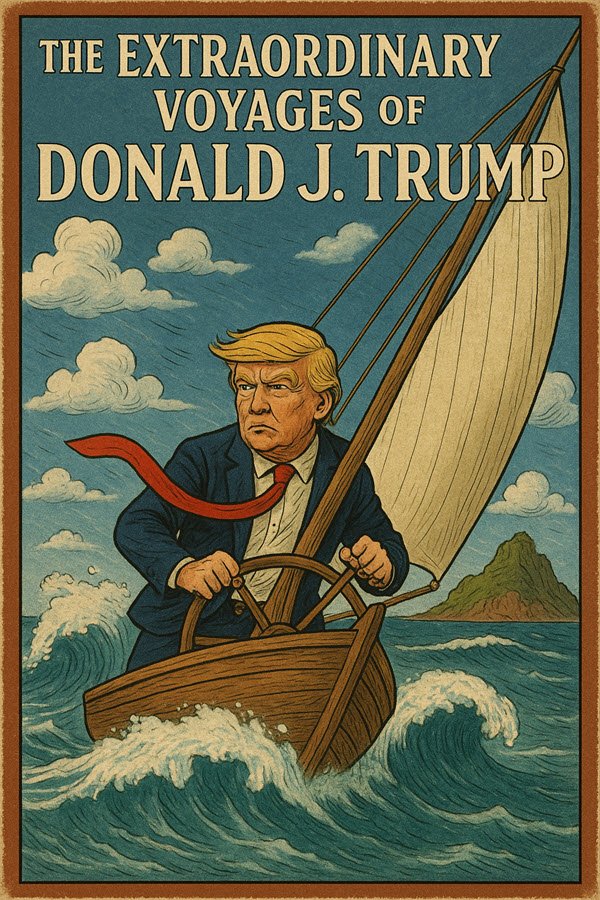
The boat is taking on water. Fast.
This, we are assured, is just politics.
The boat is taking on water. Fast. This much is evident to anyone with eyes, ankles, or a functioning relationship with gravity. The lower decks are already knee-deep, the engines are coughing and may quit soon, and the lifeboats have been quietly reassigned to wealth donors. And yet, a marvel of modern citizenship, an earnest and heartfelt committee remains gathered mid-deck, passionately debating whether the paint should be “Freedom Blue” or “Patriot Red,” whether gloss communicates strength better than matte, and whether acknowledging the water might be considered divisive and disruptive.
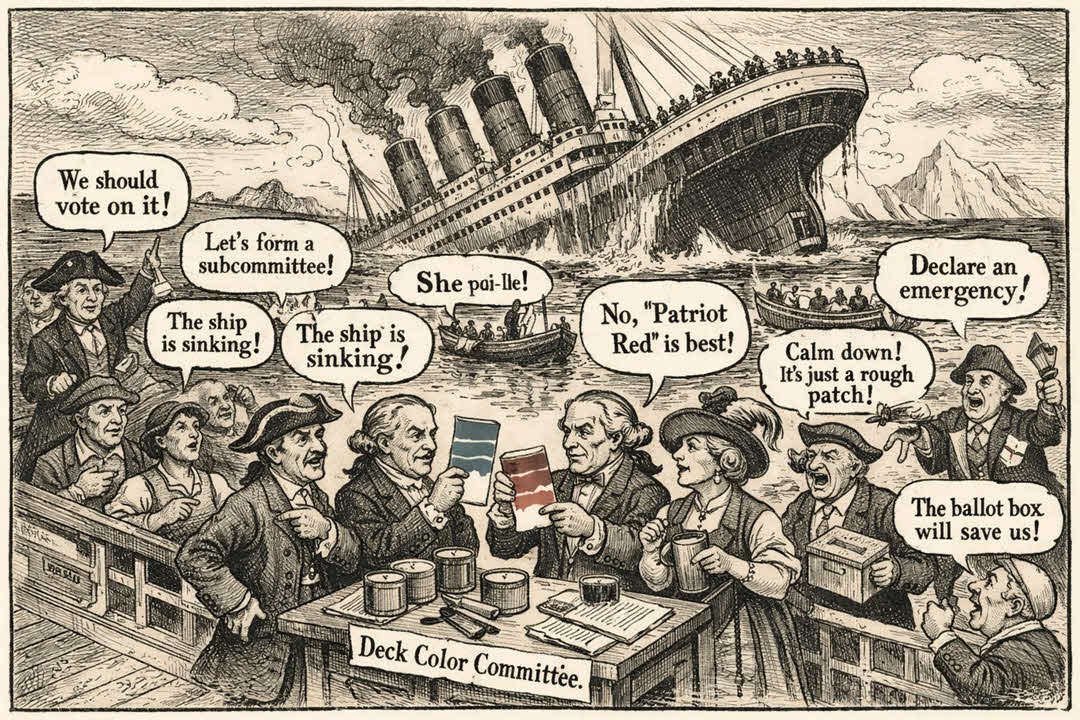
This, we are assured, is just politics.
The committee is not composed of extremists. Extremists are noisy and inconvenient. They shout, wave flags upside down, and propose firing squads. No, the committee is made up of moderates, fence-sitters, pragmatists, and Very Serious People™ who pride themselves on balance. They are the ones saying, “Yes, the boat is leaking, but let’s not be alarmist,” and “Every boat leaks a little,” and the all-time favorite, “It’s too early to say whether this water is actually bad water.”
They remind us that the boat has survived storms before. They note that the orchestra is still playing. They caution against using historical metaphors, especially the ones that make people uncomfortable, because discomfort, as everyone knows, is the true enemy of democracy.
Meanwhile, the water rises.
At some point, federal sailors, who insist they are merely following maritime best practices, begin operating independently of the ship’s rules. They burst into cabins, break down doors, drag passengers into the corridor, and in at least one unfortunate case, kill a fellow traveler during a “routine inspection.” The ship’s deckhands, who are very knowledgeable about the ship and best practices, are told to stand back. The incident is sealed off. Questions are discouraged. The deceased is promptly labeled a “terrorist,” which on this ship, now in the hands of federal sailors, is all you need to know.
This, we are told, is still just policy to protect everyone.
But policy, when armed and insulated from oversight, becomes something else. It becomes a structure. It becomes architecture. Load-bearing authoritarianism. The kind of thing you don’t notice until it’s already holding up the whole ship, and you’re no longer allowed to ask who designed it.
Some passengers whisper the forbidden analogy. They do so reluctantly, apologetically, as though apologizing to history for noticing patterns. They are immediately scolded. “You can’t compare this to that,” the committee says. “There are no skulls on the uniforms. The fonts are different.” History, after all, is very literal, and only repeats itself if it can secure the rights to the original costumes.
What history actually does, though this is rarely mentioned at committee meetings, is arrive disguised as normalcy. It comes with exceptions, special powers, emergency rules, and reassuring phrases like for your safety. It comes with manufactured enemies (many people love and indeed need manufactured enemies), curated fear, and violence wrapped in procedural language. It arrives quietly, while people are busy arguing about paint.
Then there is Minneapolis. Or rather, the situation formerly known as an incident. We are encouraged not to dwell on it. Dwelling is unproductive. Dwelling is emotional. Dwelling might lead to questions, and questions might lead to accountability, which everyone agrees would be terribly destabilizing at a time like this.
Instead, we are invited to browse the ship’s internal message boards—particularly the “Americans for the Captain” lounge. In this lounge, passengers openly fantasize about invoking the Insurrection Act, arresting elected officials, suspending civilian control, and replacing elections with something more efficient (such as violence). They do this cheerfully, proudly, and with a confidence that suggests they believe the lifeboats are reserved for them.
This, we are told, is organic.
It is not organic. It is engineered. This ship runs on an advanced information system designed by wealthy technicians who discovered that outrage is more profitable than truth, that lies scale better than facts, and that if you break reality into enough competing fragments, no one can tell which direction is down or which is up. The result is a population psychologically scattered across decks, each convinced that the others are the real problem, while the hull quietly fails.
Still, many insist this is just politics. We are in a rough patch. A phase. A pendulum swing. They believe voting alone will fix it, the way believing in exercise fixes a heart attack. Voting is necessary, of course, but believing it is sufficient while the ship is actively sinking is less civic virtue and more magical thinking.
History, inconveniently, suggests that authoritarian systems do not reform themselves because they read a touching op-ed. They slow down only when confronted by mass, coordinated, peaceful disruption: strikes, marches, refusal to comply with illegitimacy. When workers, students, doctors, artists, truck drivers, teachers, nurses, engineers, parents in other words—people decide that the cost of obedience has exceeded the cost of resistance.
This idea makes the committee nervous. It sounds disruptive. It sounds uncomfortable. It sounds like effort. Surely there must be a less inconvenient way to save the ship and paint it properly.
There is not.
Time, as it turns out, is not neutral. Systems harden. Surveillance expands. Emergency powers become stronger. Violence turns procedural. Atrocities are filed in triplicate. And years later, people ask, with genuine confusion, “How did this happen so fast?”
It didn’t. You’re just noticing it in the middle.
For those who supported the Captain, defended him, rationalized him, or told themselves “both sides,” there is still time. Redemption remains available. History is remarkably forgiving of late arrivals, provided they actually do arrive.
But the window is closing. The water is not waiting for consensus.
This is no longer about parties, ideology, or left versus right. It is about whether the ship remains a constitutional vessel or becomes a managed authoritarian cruise, complete with ceremonial elections, curated enemies, and violence as standard operating procedure.
The state forming before us does not feed on strength. It feeds on fear. On grievance. On lies. On rage. It drains the ship while calling itself salvation.
And yet, against all odds, the boat is not fully sunk. People are still on deck. The pumps still work. The hull, though cracked, has not yet split. Which means the only remaining question is not what will happen, but who you will be.
History will not ask whether you were polite.
It will not ask whether you waited for consensus.
It will not ask whether the paint color was tasteful.
It will ask whether, when the water reached your knees, you kept arguing or whether you finally grabbed the pump and chose to be brave.
Choose wisely.
Now.