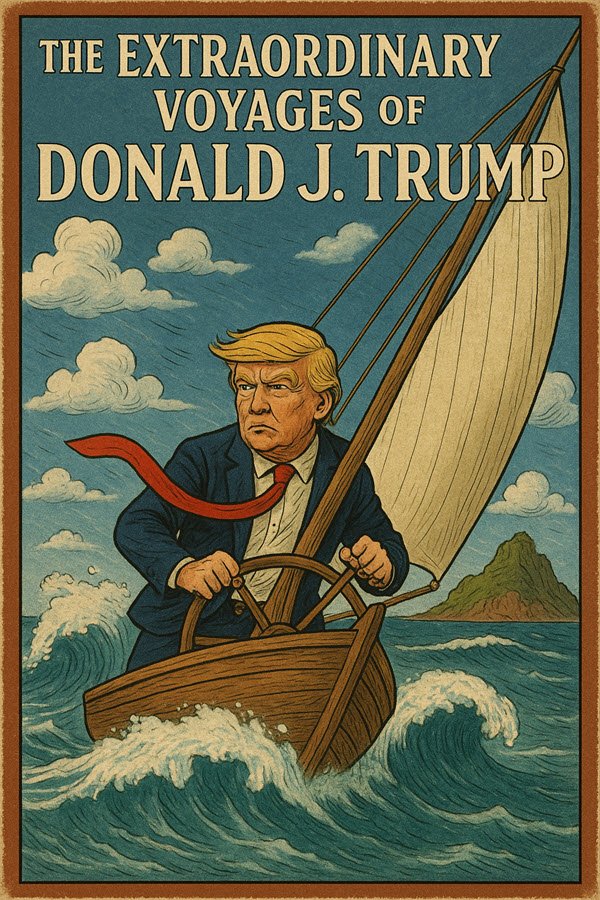
The greatly celebrated Donald Trump was so intensely admired for being decisive. It mattered little what decision was made, so long as it arrived swiftly, loudly, and with a finger pointed at someone else—usually one of his predecessors.
Hesitation was considered a moral failing; reflection, a sign of weakness; and revision, an unforgivable betrayal of confidence.
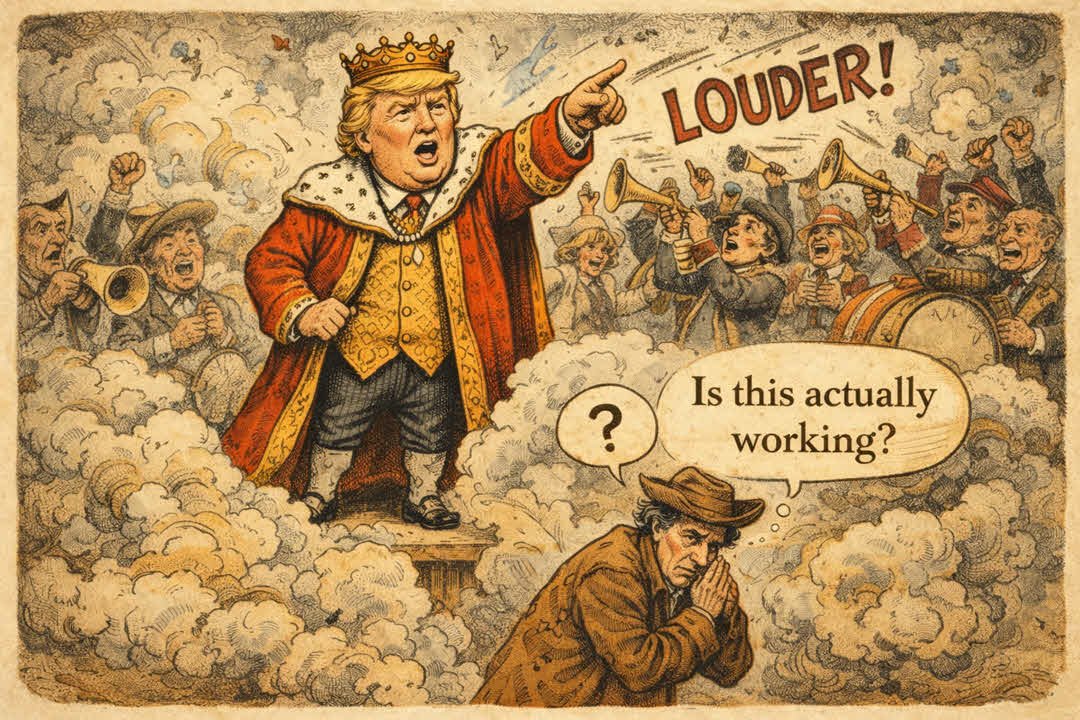
The Great Leader understood this perfectly. He discovered early in his reign that the appearance of decision produced more applause than the quality of it. Thus, he cultivated decisiveness as one of his great traits.
When presented with a complicated matter—trade, law, governance, or the economy—the Great Leader would not trouble himself with particulars. Instead, he would stride into the chamber, strike the table, and announce, “It is decided.” What had been decided was rarely specified, but his ministers and his minions erupted in cheers and statements of adoration nonetheless. The people were relieved to know that something—anything—had been resolved.
To ensure the illusion remained intact, the Great Leader adopted several helpful techniques. First, every decision was declared irreversible upon announcement. This prevented inconvenient questions from forming, as the matter was already settled. Should the decision later prove disastrous (as was often the case), a new one, equally irreversible, simply replaced it, and perhaps even proclaimed even louder.
Second, all decisions were framed as acts of courage. “Only the timid seek more information,” proclaimed the Royal Herald.
“The brave act immediately, preferably before facts can interfere.” This doctrine was engraved above the palace doors, though the letters were later removed when they began to wobble, and some letters fell off.
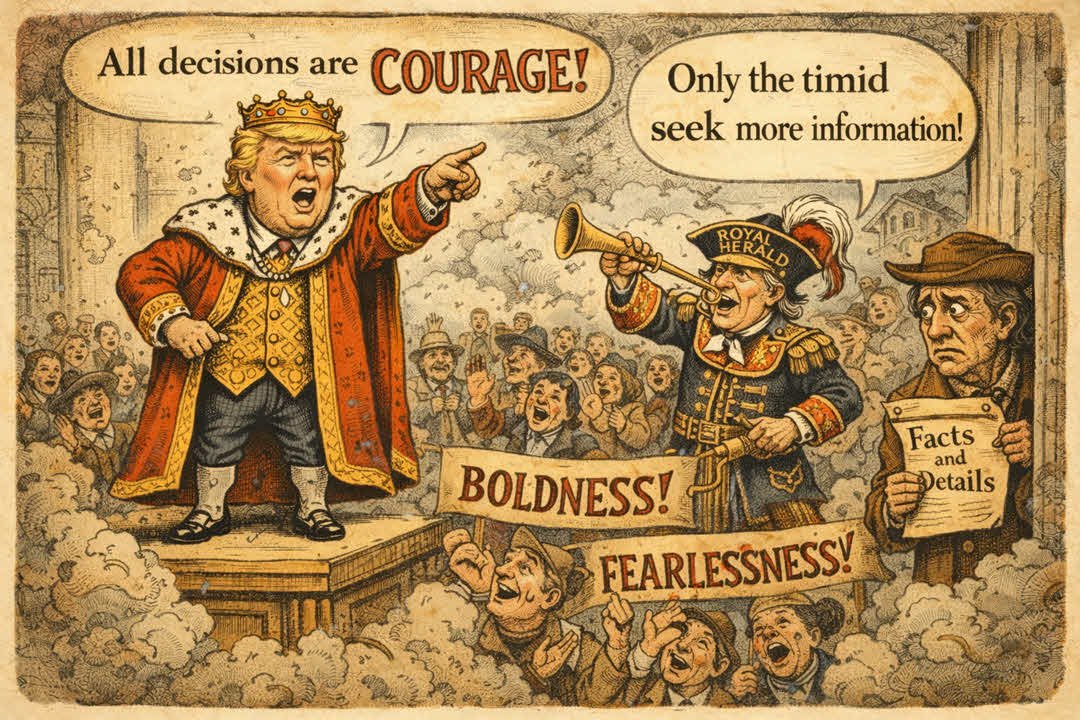
Third, decisiveness was measured not by outcomes but by posture. A man who stood still while proclaiming a decision was considered weak. A man who paced, gestured wildly with arms moving in and out, and spoke in absolutes was deemed heroic. The most decisive moments involved maps, charts, or scrolls that were never consulted but dramatically unfurled.
The citizens soon learned to admire decisiveness as a form of entertainment. Each morning, they gathered to witness the Day’s Decision, unsure whether it concerned tariffs, festivals, enemies, or who might be attacked next. The uncertainty added excitement. “It may ruin us,” they whispered, “but at least it will be decisive.”
Naturally, problems persisted. People were hungry, prices rose, alliances frayed. When asked why these matters remained unresolved, officials replied that they had already been decided—often several times. “You cannot expect reality to keep up,” said one minister patiently.
In time, even indecision was reframed as decisiveness. Changing one’s mind became proof of flexibility, provided it was done abruptly and with sufficient confidence. Contradictions were celebrated as strength, for only a truly decisive leader could afford so many.
And so the Great Leader and his followers marched forward, confidently, decisively, and in no particular direction at all.
For with Donald Trump, decisiveness was never about choosing wisely. It was about choosing loudly—so that no one could hear the question quietly waiting underneath:
Is this actually working?