By nightfall in Minneapolis on January 7th, order had already been restored. The federal government, efficient as ever, supplied the necessary explanation before confusion could take root.
It was clear, an ICE officer had acted in self-defense. A violent individual attempted to weaponize a vehicle. Shots were fired. Regrettable, certainly, but the official story makes it clear that this was unavoidable. The public was spared the burden of uncertainty.

This account arrived fully formed, requiring no witnesses, footage, or inquiry. It bore all the marks of reliability: familiar phrasing, solemn tone, and the gentle assurance that nothing further needed to be examined.
Unfortunately, there were videos. . . many videos.
This was an unfortunate breach of protocol. Instead of requesting patience, promising an investigation, or deferring judgment to unnamed authorities, the videos committed the error of description. The videos showed us what had occurred, and they did so plainly. The videos indicated that no ramming had taken place. The videos exposed that the official story did not align with what could be seen. In doing so, the videos endangered the official narrative, which had been functioning admirably until then.
Videos can be tricky and awkward.
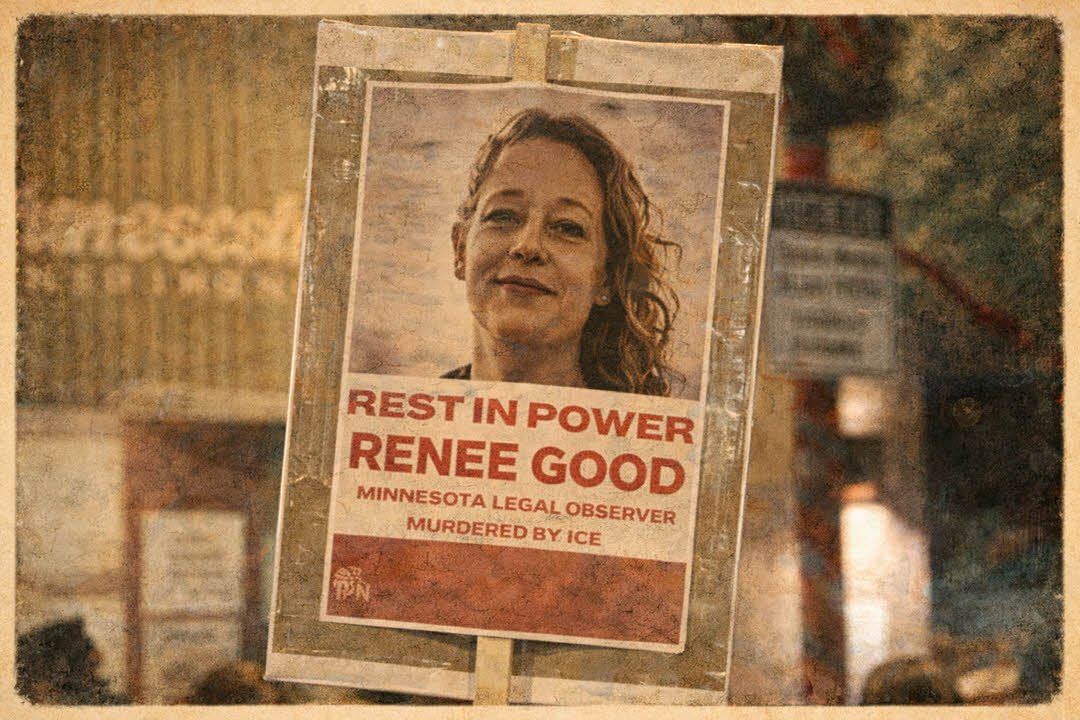
At this point, the deceased acquired an additional inconvenience: a name. Renee Nicole Good. A citizen. A wife. A mother. A poet. None of these facts were operationally useful and should ideally have remained undisclosed. As many of us know, human details (the details of a human life) complicate administrative clarity.
What Our Nation Demands!
The difficulty was not a lack of information. The citizens on the street provided an excess of it. There was footage. There were witnesses. There was the sound of people screaming as CPR was performed in the snow. These elements were disorderly, emotional, and certainly ill-suited to official statements.
Worse still, troublesome journalists, annoying clergy, and irritating neighborhood residents attempted to observe what had happened. This created further disorder. They were addressed appropriately with shouted instructions, ensuring that the scene returned to a state of proper confusion. Recording devices were discouraged. Later, questions were met with chemical persuasion. Authority reasserted itself through volume and force, as the traditions of our nation demand.
It is important to clarify that this was not a mistaken arrest, nor an enforcement action gone awry. No arrest was being made. The vehicle was blocking traffic. The driver attempted to leave. Shots were fired. The matter concludes there, provided one does not insist on proportion, restraint, or maintaining the life of a human.
That this occurred on the first day of a planned month-long federal surge is coincidental and need not be emphasized. The rhetoric preceding the operation—regarding cities, immigrants, and disorder—is similarly irrelevant. Bloodshed was not inevitable; it was merely foreseeable.
When communities predict such outcomes, they are accused of provocation. When those outcomes arrive, they are told this is the cost of noncompliance.
The public was then offered clarification by television experts. A former federal official explained that the true danger lay not in the killing itself, but in the mayor’s language. His refusal to soften the event, to replace description with euphemism or more neutral wording, was characterized as irresponsible. One must be careful with words when a dead body is involved.
In this improved version of events, the dead woman disappears entirely. In her place stands a more useful abstraction: the sanctuary city. If local authorities had cooperated more fully, agents would not have been forced into such regrettable circumstances. Responsibility is thus efficiently reassigned. Power acts as dissent explains the consequences.
Details that might interfere with this understanding—video footage, eyewitness accounts, a woman dying in the snow—are omitted for clarity. Tone is examined. Anger is criticized. Politeness is demanded retroactively.
Thus, the process completes itself. First, the killing is justified. When justification falters, language is corrected. When language fails, blame is relocated. By the end, the only remaining transgression is that someone spoke too plainly while a body lay cooling in the street.
Renee Nicole Good’s name is inconvenient because it interrupts this sequence. It insists on memory. It resists reduction. Renee Nicole Good was a human. A mother, A partner. A citizen. This was a human life, and restraint was not considered in the taking of it.
And so, the public is left with a choice: trust the version that was conceived in advance, awaiting only a corpse to validate it, or the version that unfolds in panic, grief, and contradiction—the version that power attempts unsuccessfully to suppress.
Minneapolis did not erupt from misunderstanding. It erupted from comprehension and knowledge.