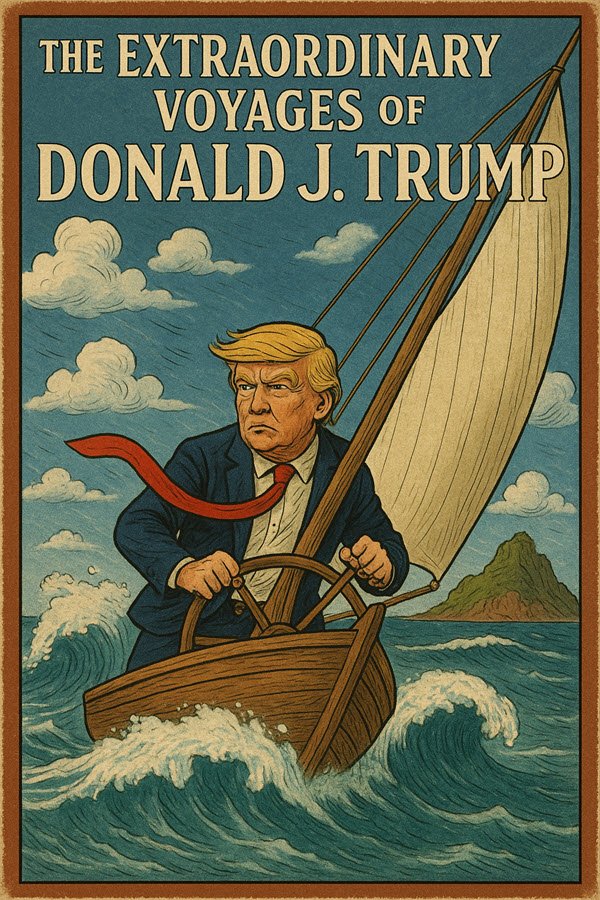
The Latest Proclamation of Our President, Donald Trump
It is a curious advancement of modern governance that entire civilizations may now be scheduled for expiration somewhere between lunch and supper. One notes with admiration the efficiency: where once empires required centuries to decline, we now manage annihilation within the news cycle.
The latest proclamation of our President, Donald Trump, delivered with all the subtlety of a town crier who has misplaced both his crier bell and his judgment, assures us that “a whole civilization will die tonight” should negotiations fail to satisfy the theatrical demands of the hour.
One must commend the ambition of Donald Trump—a true jester. 
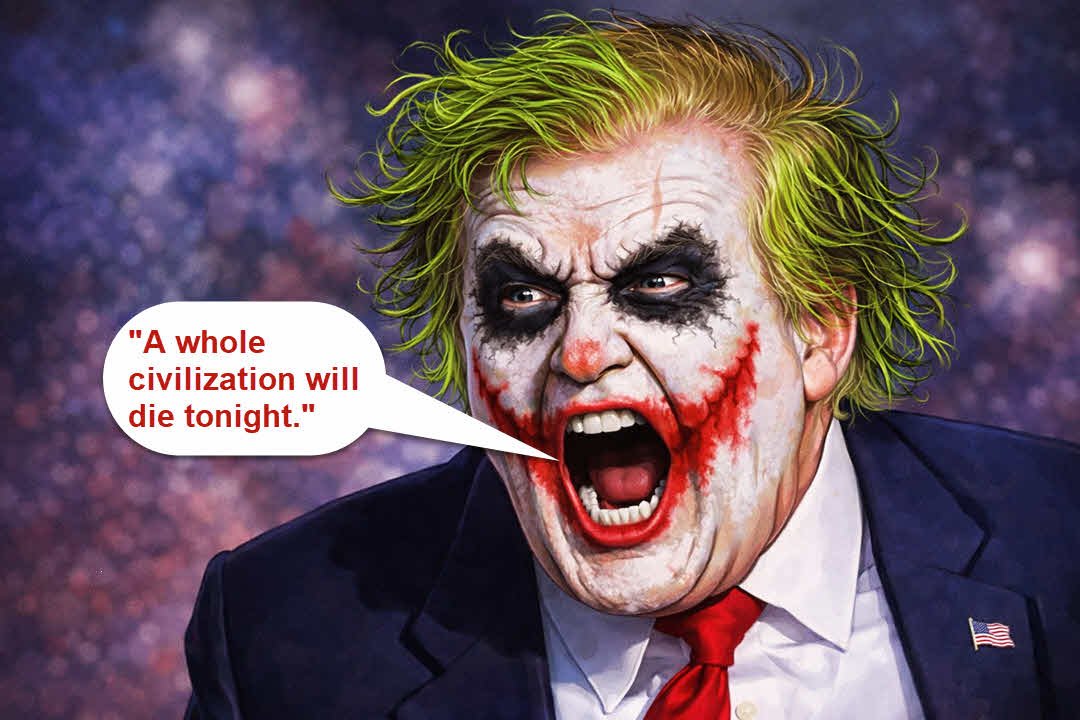
It is not every day that a man volunteers to serve as both diplomat and narrator of the end times.
There was, in ages past, a tendency among leaders to speak of war in hushed tones, as if aware that human lives were involved. Now we find a refreshing candor: mass death is no longer a tragedy but programming for the MAGA. It is framed less as a catastrophe and more as an event—something one might attend, were seating available and refreshments nicely arranged.
The markets, ever the nervous aristocrats of our age, have responded accordingly. Oil rises like a startled ghost, while investors clutch their ledgers as though they might double as life preservers. It turns out that when one threatens to extinguish a civilization before bedtime, the price of gasoline becomes relevant, very relevant indeed! Thus, apocalypse has been democratized: no longer reserved for historians and theologians, it now visits the common man at the gas pump. MAGA must be so proud.
One imagines the scene in households across the land:
“Will we perish tonight?” asks a citizen.
“Perhaps,” replies a man with a ledger. “But more urgently, shall we be able to afford to commute tomorrow?”
In this way, the grand and the mundane are united. The end of a civilization is no longer an abstract horror but entertainment driving ratings (those all-important ratings). It may be costly, but it is explained more as a sacrifice, and after all, we all must sacrifice for the greater good. It is, in its way, the most modern of achievements: to render the unthinkable both thinkable and billable.
Yet there remains something unsettling in the tone of it all. The language is not merely reckless—it is theatrical. One suspects that the true audience is not the adversary abroad, but the spectators at home, the very core of Trump’s followers, the MAGA, who have grown accustomed to spectacle and now demand it in ever larger portions. What better spectacle than the suggestion of history itself coming undone on a deadline defined by the dear leader?
And so we arrive at the present moment, poised delicately between negotiation and narration, between diplomacy and declaration. Whether the night brings resolution or ruin, one thing is certain: the performance will continue, and with better-than-average ratings.
For in this new age of governance, it is not enough to wield power. One must also narrate its consequences—preferably in terms sufficiently dramatic to ensure that, even if the world does not end, the ratings will be good.