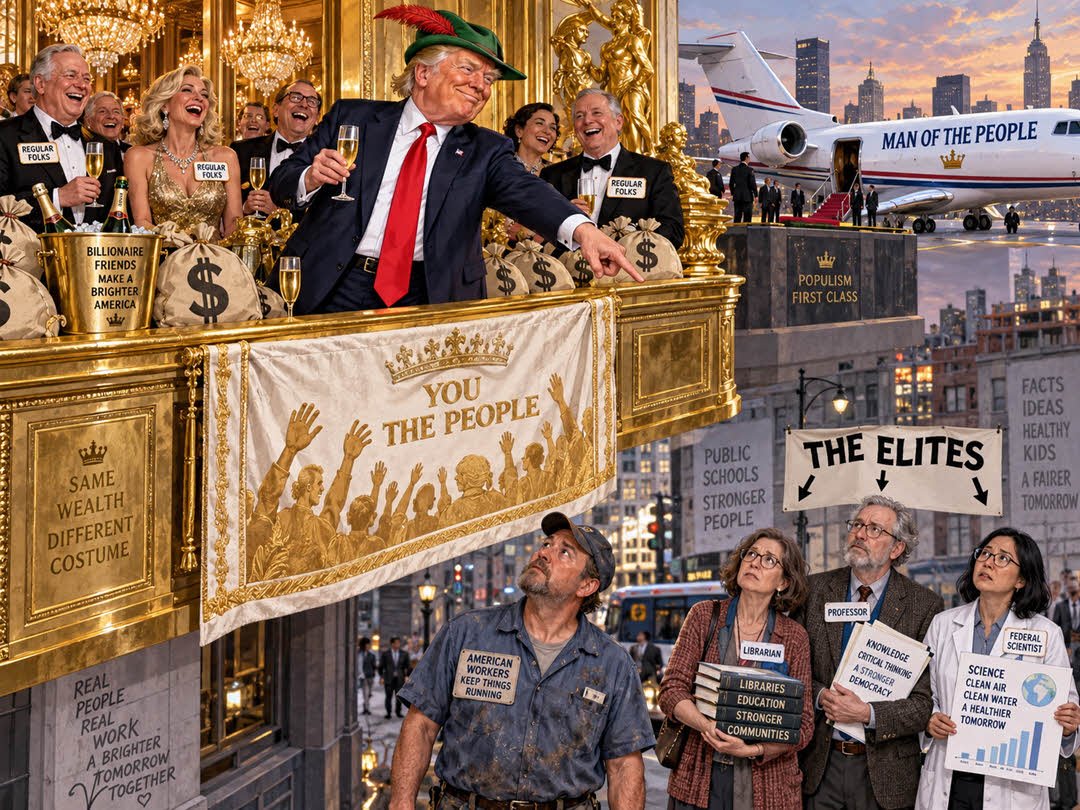
One of the more impressive magic tricks in modern American politics is Donald Trump’s ability to stand beneath a chandelier, surrounded by millionaires, billionaires, private jets, gold-plated furniture, and enough donor money to finance a small country, and still present himself as the guy fighting for the little man.
Ordinarily, enormous personal wealth might create a slight image problem for a politician claiming to wage war against elites. But Trump discovered the loophole: redefine “elite.”
In Trumpworld, an elite is not necessarily someone with vast amounts of money. That would be inconvenient. An elite is someone who works at a university, writes for a newspaper, runs a federal agency, appears on public television, uses the phrase “peer-reviewed,” or owns a tote bag from NPR.
A hedge-fund billionaire? Potentially one of the people.
A public-school history professor? Dangerous ruling class.
This is the central genius of Trump’s political branding. The enemy is not primarily economic. It is cultural, institutional, educational, bureaucratic, and occasionally anyone who may correct his spelling.
That means Trump’s wealth becomes not evidence that he belongs to the establishment, but proof that he has sufficient financial firepower to go against the establishment.
He is, in this telling, Robin Hood if Robin Hood owned the forest, charged admission, licensed his name to the arrow and bow makers, and held a fundraising dinner for the Sheriff of Nottingham.
His supporters are therefore not asked to see him as financially similar to themselves. They are asked to see him as emotionally aligned with them. He may live in a mansion, but he dislikes the same television networks. He may fly privately, but he also complains about Washington. He may dine with billionaires, but he insults the right professors.
That cultural identification is powerful because it turns class politics upside down.
The wealthy politician is no longer the elite.
The librarian is.
The billionaire donor is merely a patriot with excellent liquidity.
The federal scientist, meanwhile, is part of the shadow government because he used a chart.
Trump’s great achievement has been persuading millions of Americans that the important question is not, “Who has the money?”
It is, “Who annoys me?”
Once politics is organized that way, the billionaire in the penthouse can become the champion of the factory worker, while the assistant professor earning $58,000 a year becomes a member of the sinister ruling class.
And somewhere, social scientists close their notebooks and decide they need a drink.