Why Does He Always Distort Reality, Why?
President Donald Trump’s latest attack on mail-in voting follows a familiar pattern: a court ruling goes against him, and he immediately claims the decision opens the door to cheating. But once again, the central problem with Trump’s argument is simple. He has produced no credible evidence that mail-in ballots create widespread voter fraud.
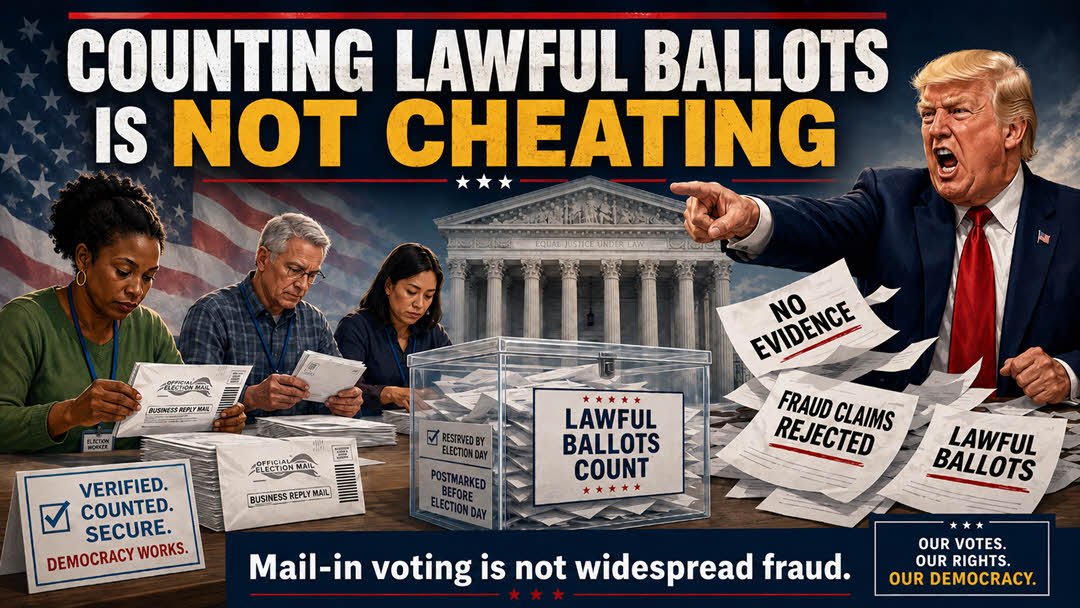
The Supreme Court’s recent decision involving Mississippi did not say that votes can be cast after Election Day. It said that states may count mail-in ballots that were postmarked by Election Day and received within a legally defined grace period. That distinction matters. A ballot mailed on time is not a late vote. It is a timely vote delivered through a system that depends partly on the mail, election offices, and administrative deadlines.
Trump’s response was to call the ruling a “tremendous loss” and to insist that opposition to stricter voting laws can only mean one thing: “cheating.” That is not an argument. It is an accusation. And accusations, especially accusations about elections, require evidence.
The evidence does not support Trump’s claim. Mail-in voting has been used for years across the United States, including by military voters, seniors, rural voters, disabled voters, students, and citizens who cannot easily appear at a polling place. Like every voting method, it requires safeguards. Those safeguards already exist: signature verification, voter registration checks, ballot tracking, chain-of-custody procedures, bar codes, envelopes, deadlines, and penalties for fraud.
Is fraud theoretically possible? Of course. No human system is perfect. But isolated cases are not the same as widespread fraud. Trump repeatedly blurs that distinction. He points to the possibility of abuse as though possibility were proof. It is not.
The deeper issue is that claims of massive mail-in ballot fraud have become politically useful even when they remain factually unsupported. If citizens can be persuaded that ordinary voting methods are suspicious, then restrictions can be framed as protection rather than suppression. That is why the rhetoric matters. When a president repeatedly tells Americans that mail ballots are fraudulent without evidence, he weakens confidence in elections rather than strengthening them.
A democracy should welcome election security. It should also reject fear-based claims that are not grounded in facts. The right standard is not whether Donald Trump dislikes mail-in ballots. The right standard is whether there is credible evidence that mail-in ballots produce widespread fraud. There is not.
Counting lawful ballots is not cheating. It is democracy doing its job.