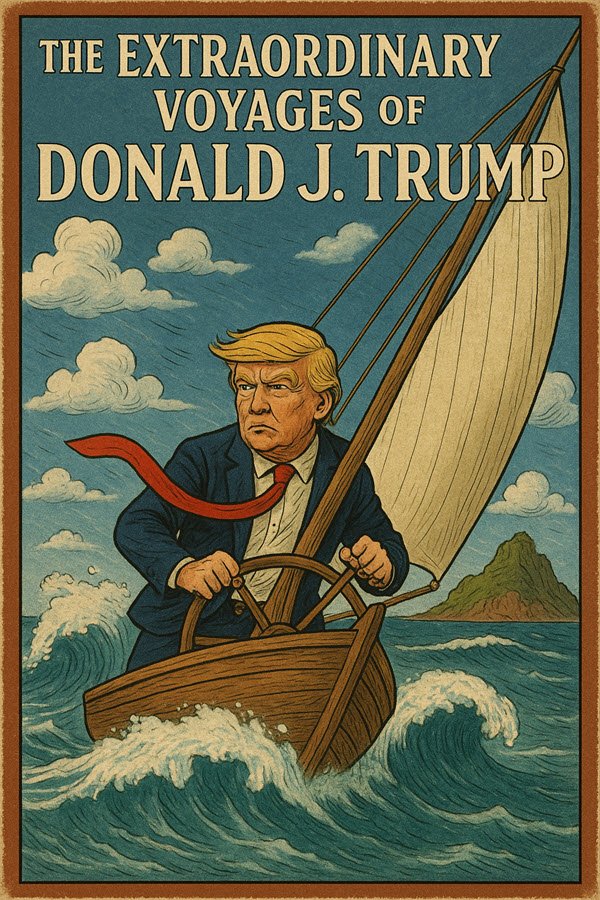
There are moments in American government when history seems to stop, clear its throat, and ask whether everyone is quite certain about what they are doing.
Renaming Lake Ontario “Lake America” is one of those moments.
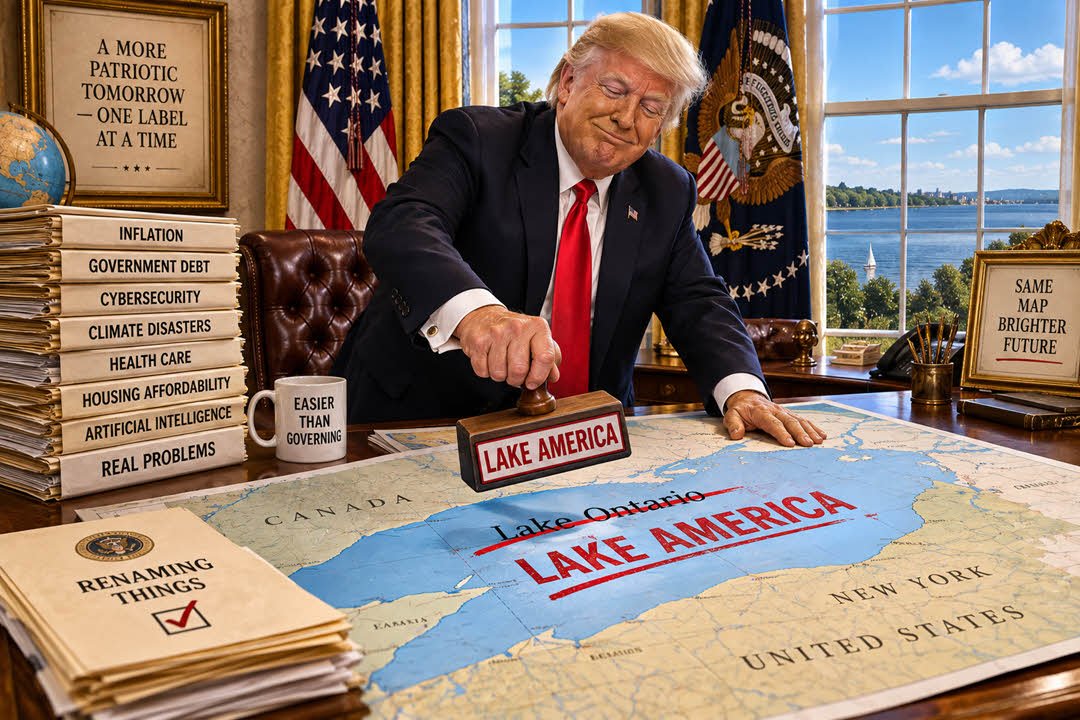
On August 27, President Donald Trump signed an executive order directing the federal government to replace Lake Ontario with Lake America on federal maps, documents, databases, and communications.
This is reassuring.
For a while, Americans had been distracted by inflation, government debt, international tensions, cybersecurity threats, climate disasters, and the unsettling possibility that artificial intelligence may eventually eliminate your job before figuring out how to reset your password.
Fortunately, somebody found the lake.
Apparently, it had been sitting there for centuries under an insufficiently patriotic name.
Lake Ontario is, inconveniently, shared with Canada. The executive order itself describes it as bounded partly by New York and partly by the Canadian province of Ontario.
This creates a minor difficulty.
You can rename your half of the family dog, but Thanksgiving may become awkward.
Perhaps Canada will cooperate. Perhaps Canadians will wake one morning, examine several thousand square miles of freshwater beside Ontario, and conclude that the Americans have made an excellent point.
Or perhaps they will continue calling it Lake Ontario.
We, as Americans, have achieved something genuinely remarkable: changing the name of a lake solves our issues with Canada.
Sail north: Lake Ontario.
Turn the boat around: Lake America.
Drift sideways for a while: diplomatic incident.
There is a temptation to regard all this as harmless political theater. And compared with wars, recessions, natural disasters, and constitutional crises, renaming a lake certainly qualifies as inexpensive entertainment.
But political theater tells us something about politics.
Governments possess enormous power. They can build roads, regulate commerce, protect drinking water, prepare for disasters, negotiate with other countries, defend computer networks, manage public lands, and occasionally make sure the lettuce does not poison anyone.
They can also rename things.
Renaming things has an advantage over solving things.
It is much easier.
A government cannot issue an executive order requiring groceries to become affordable.
It cannot rename a flood “unexpected recreational waterfront development” and expect the houses to dry out.
It cannot solve cybersecurity by changing “hacker” to “unauthorized digital visitor.”
And should artificial intelligence eventually eliminate three million jobs, the unemployed may be unimpressed when Washington announces that they have been renamed “Americans Experiencing Enhanced Leisure.”
Reality has an irritating resistance to branding.
That may be the useful lesson of Lake America.
Political leaders everywhere increasingly operate in an environment that rewards spectacle, outrage, instant attention, and symbolic victories. The difficult work of governing remains stubbornly difficult.
Lakes are easier.
They do not argue.
They do not vote.
They do not appear on cable television demanding lower prices.
They just sit there, waiting for somebody with a pen to declare victory over them.
So congratulations to the federal government.
Lake Ontario has been dealt with.
Now perhaps somebody could have a look at the country.