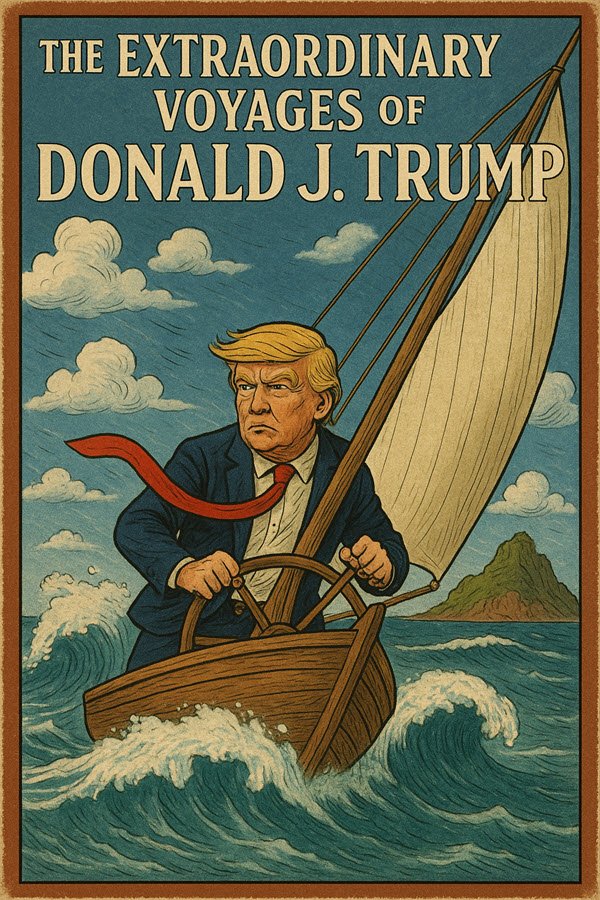
Donald Trump Wants All the Cake
America is turning 250, and naturally Donald Trump has found a way to make the Declaration of Independence feel like it needs a security detail, a merchandise table, and possibly a non-disclosure agreement.
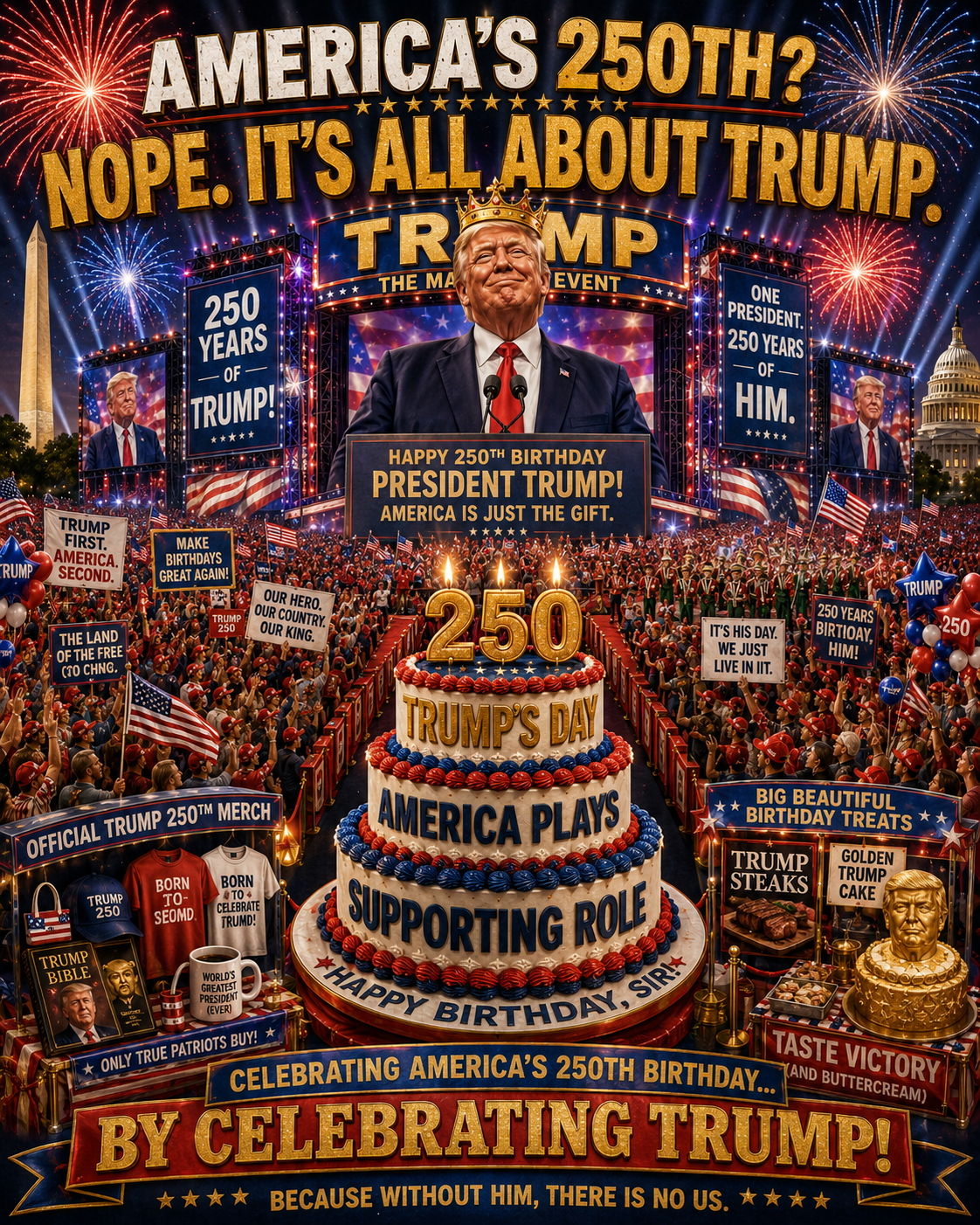
The nation’s founding document once announced that governments derive “their just powers from the consent of the governed.” In Trump’s America of 2026, this has apparently been updated to: “Governments derive their just powers from jumbo screens, grievance, and a crowd chanting loudly.
It did not have to be this way.
In 1976, Gerald Ford presided over America’s Bicentennial while the country was still recovering from Vietnam, Watergate, inflation, assassination attempts, and a national mood best described as “exhausted but wearing red, white, and blue.” Ford had political reasons to seize the spotlight. Instead, he mostly stepped back. The Bicentennial became local, scattered, sentimental, commercial, imperfect, and somehow broadly shared. Towns held parades. Families baked cakes. People wore tri-cornered hats without irony, which remains one of the more heroic acts of the 1970s.
Ford understood something Trump does not: a national commemoration is not supposed to be a mirror for the president. It is supposed to be a window through which citizens can see themselves as part of a larger story.
Trump, by contrast, looks at America’s 250th birthday and seems to ask the obvious question: “How can this be about me, me, me and all about me, but with more flags?”
Thus, the sacred civic ritual becomes another episode of The Republic Apprentice. The National Mall becomes a stage. Patriotism becomes branding. Unity becomes optional. Dissent becomes disloyalty. History becomes set decoration but with some parts hidden (black excellence for example). The American Revolution, once a complicated struggle over liberty, self-government, equality, power, and human contradiction, is repackaged as a campaign rally with fireworks and emotional support for the dear leader.
One can almost imagine Thomas Jefferson looking up from the Declaration and saying, “I did not risk treason against the British Crown so a future president could turn the national birthday into a promotional event for himself in king-like fashion.”
The difference between Ford’s Bicentennial and Trump’s 250th is not merely style. It is a difference in democratic temperament. Ford’s version assumed the country was larger than the president. Trump’s version assumes the president is the country, and the rest of us are extras who must wave flags on cue.
That is the problem with Trump’s America in 2026. It does not know how to celebrate without dividing. It does not know how to remember without mythologizing. It does not know how to honor the people without first honoring the man at the microphone.
A mature republic can celebrate itself honestly. It can admit its failures, cherish its ideals, and make room for everyone at the national table. But a republic trapped inside one man’s ego cannot do that. It can only perform and fake greatness while shrinking the meaning of citizenship.
America deserves a birthday worthy of its best promises.
Instead, Trump brought a spotlight, and the firm belief that the cake should clap and be all for him.