You’re Fired!
For one miraculous year, Donald J. Trump achieved what had once seemed impossible. He did not fire anyone.
Historians will no doubt debate the cause of this restraint. Some will attribute it to discipline. Others to strategy. But those who have studied the matter closely understand the truth: it was fear. Not fear of failure, nor of incompetence, but fear of something far more dangerous.
A headline with Donald Trump looking bad, very bad.
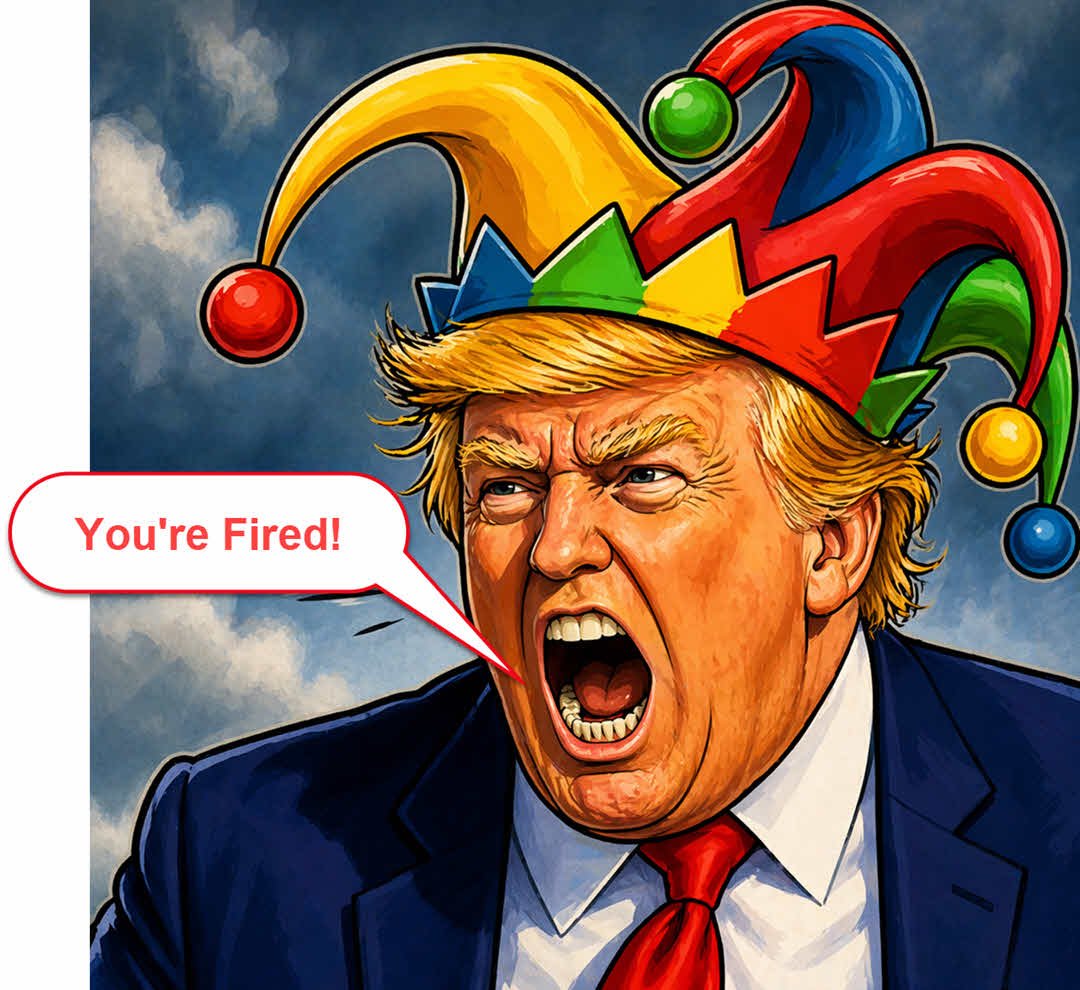
To fire a cabinet member would be to concede, however briefly, that the “best people” might, in fact, be the available people. And so, scandal after scandal passed over a particularly stubborn monument like weather. Careers that would have ended in prior administrations merely… lingered. Like guests who refuse to recognize that the party is over.
But now, the dam has broken.
Cabinet Secretaries are falling like leaves in a particularly windy autumn. Homeland Security, Justice, and Labor—positions once considered pillars of governance are now revolving doors. Rumors swirl. Aides whisper. The phrase “rightly paranoid” has entered the official lexicon of job descriptions.
Firing season, at last, is upon us.
And yet, the deeper problem remains unsolved, perhaps unsolvable, because it originates not in policy, but in personality. The central hiring criterion, loyalty, has revealed a curious inverse relationship with competence.
This is not a new discovery. It is merely a confirmed one.
The individual most willing to say “yes” to every command is rarely the individual capable of executing any of them. Governance, it turns out, is not a podcast. It does not improve with loud and arrogant shouting. Running federal agencies requires skills that cannot be developed through flattery, nor measured in enthusiasm.
And so, we arrive at the exquisite irony of the present moment: even those appointed to carry out questionable objectives have proven… inadequate to the task. The people Donald Trump has put in key positions are not competent.
The machinery of retribution, once promised as swift and decisive, has instead resembled a series of false starts, stalled engines, and misplaced paperwork. Grand ambitions collapse under the weight of basic legal reality. Judges remain unconvinced. Juries remain unconvinced. Even the architects of these efforts appear, at times, unconvinced themselves.
It is not merely failure. It is an inefficient failure.
And then, of course, there are the efforts to control the narrative itself. There have been grand attempts to manage truth through spectacle. Documents are promised, displayed, misplaced, rediscovered, and ultimately revealed to contain less substance than their binders suggest. Transparency becomes theater. Accountability becomes choreography.
The result is a system that struggles not only to function, but to pretend convincingly that it is functioning.

Thus, the firings continue, but not as a correction, but as a consequence. A system built on loyalty must eventually confront the limits of loyalty. And when it does, it discovers something deeply inconvenient:
Agreement is not the same as ability.
And in the end, even the most devoted servant cannot perform a miracle, and this is especially when the miracle required is competence.