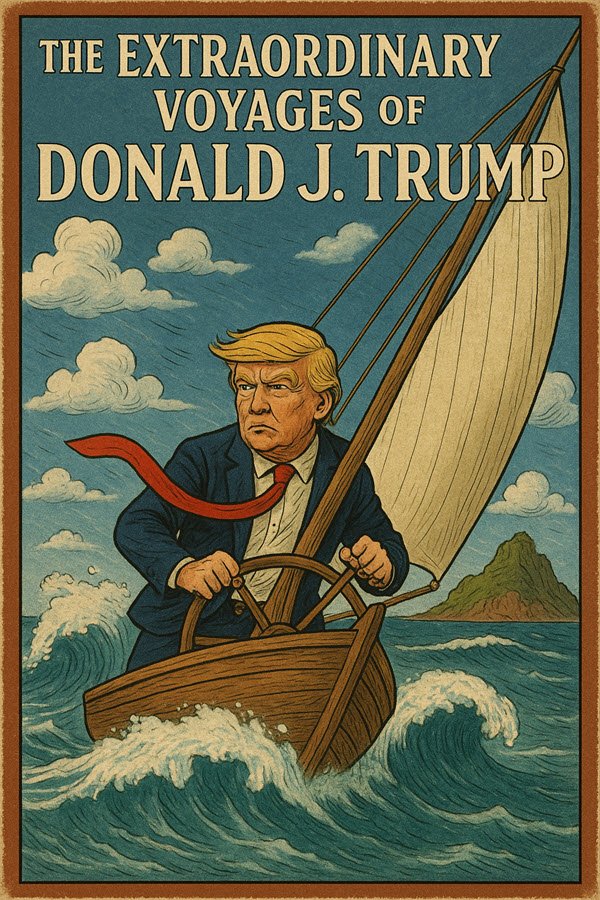
JD Vance and Two Real Estate Agents
There are leaders who resolve crises. There are leaders who manage crises. And then there are those rare figures—visionaries, really—who take a modest, localized problem and nurture it into something far grander, far more ambitious, and considerably more combustible.
I have watched Donald J. Trump for years, and it must be said, he has mastered the latter art.
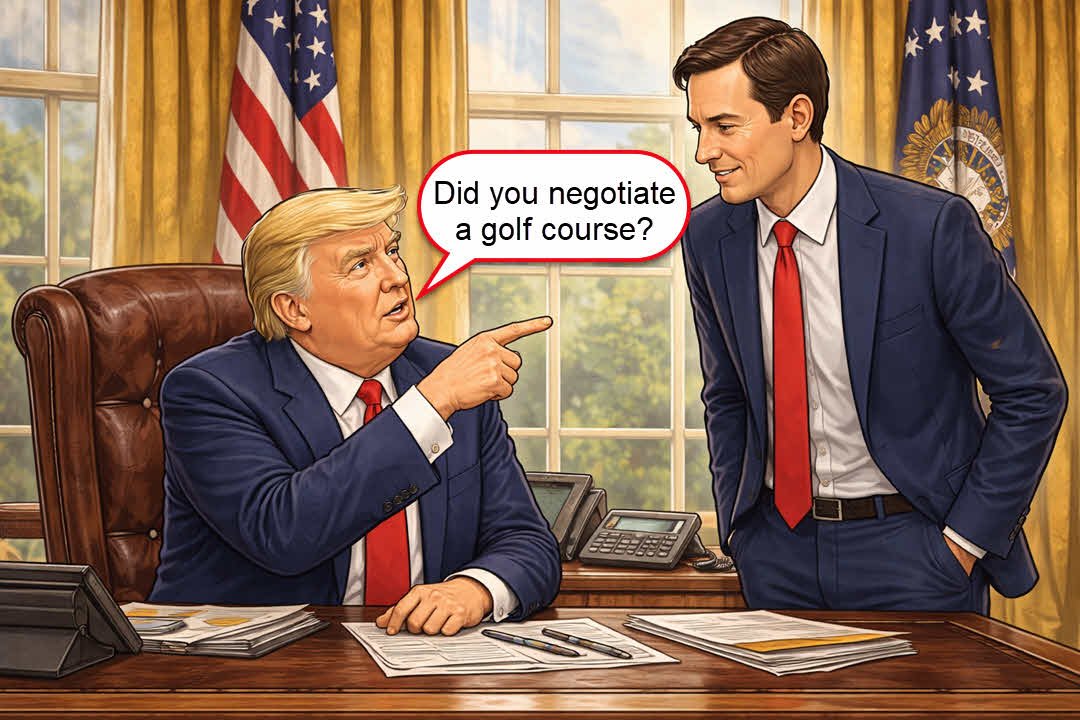
Here is an example: Stormy Daniels
Donald Trump wanted to keep his affair with her secret. He wanted no one to know. The result of his actions is that the entire world knows.
Now, that’s success.
In recent days, the Iran conflict has undergone what might politely be called an expansion, and what less polite observers might call a metastasis. What began as a tense standoff over the Strait of Hormuz has blossomed into a regional spectacle involving the Persian Gulf, the Sea of Oman, and, perhaps now, even the Red Sea. Will any other bodies of water be invited to participate in the festivities?
The United States, with admirable confidence, has announced that it has “completely halted” Iran’s seaborne trade. Iran, in turn, has responded by threatening to make seaborne trade an increasingly theoretical concept for everyone else.
This, we are assured, is progress.
Meanwhile, the President has taken to describing the war as “close to over,” which appears to be true in much the same way that a kitchen fire is “close to over” when everything in the kitchen has burned, and the fire is now expanding into other areas of the home. One cannot deny that an ending is approaching; the only uncertainty lies in what, precisely, will remain afterward.
Diplomacy, too, has played its part in this unfolding drama. The now-collapsed Islamabad talks offered a masterclass in modern negotiation technique: arrive with a list of demands, repackage the list, and then present it again with renewed enthusiasm. It is a bold strategy, relying on the hope that repetition may eventually resemble compromise.
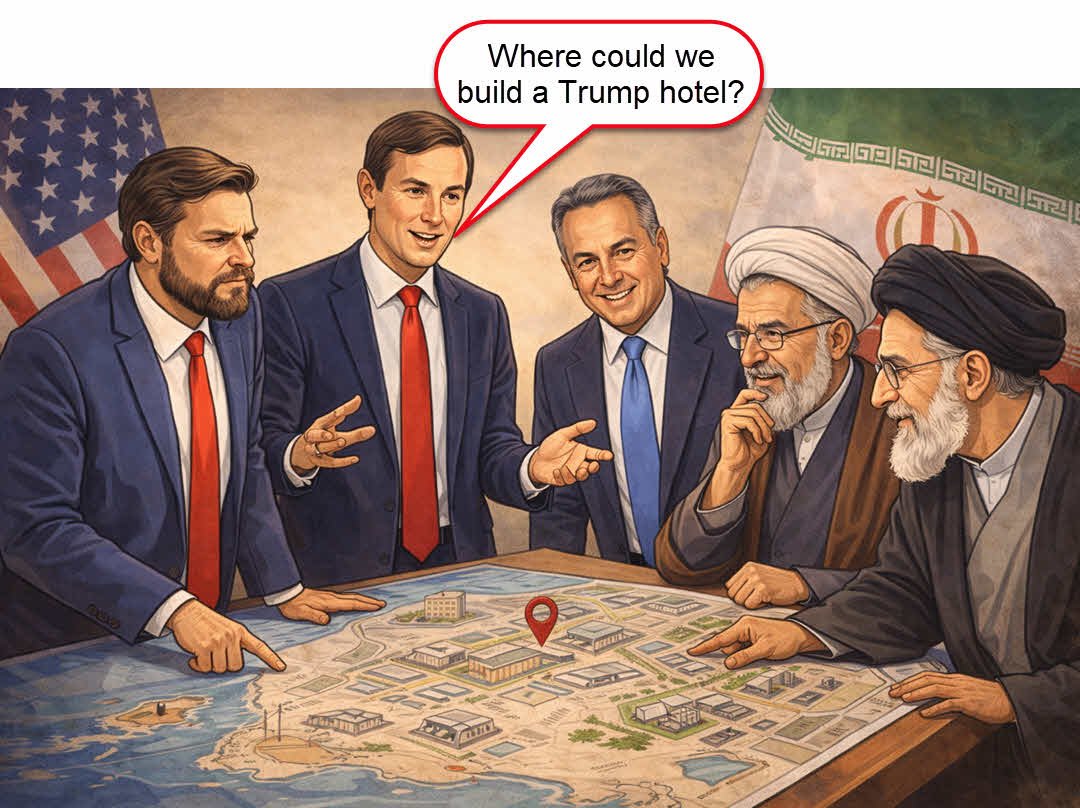
JD Vance, who has little international diplomatic experience, led the team, which also included two real estate agents who tend to see things through a real estate lens.
My goodness!
The demands themselves were refreshingly straightforward: reopen shipping on our terms, surrender sensitive materials, abandon key alliances, and accept all conditions without undue expectation of reciprocal benefit. It is, in essence, a negotiation as monologue—a hostage note composed in the elegant prose of the official stationery of the United States.
How charming.
Yet the true genius of the moment lies not in any single decision, but in the broader logic that now governs it. Both Trump and his allies have committed themselves to the intoxicating promise of total victory—a promise that, once made, cannot easily be revised. For when one has declared that only complete domination will suffice, even the smallest concession begins to resemble defeat.
And so, the conflict continues, not because it advances a clear strategy, but because it satisfies a political necessity: the avoidance of reality.
As if to underscore the point, reports now suggest that Iran has acquired advanced surveillance capabilities, enhancing its ability to monitor U.S. and allied movements. If true, this would represent a remarkable achievement. Iran was a country almost completely isolated. Now, Iran has some significant international collaborators who may be the types of partners that deny their collaboration while also expanding their technical support to Iran.
It is, in its way, a triumph of unintended consequence.
Thus, we find ourselves in a moment both familiar and extraordinary: a crisis enlarged, a conflict deepened, and a resolution perpetually just out of reach. The world watches as the situation evolves. It metastasizes outward, upward, and occasionally sideways. It seems to be guided by a steady principle:
If one problem cannot be solved, several more can be created instead.
How wonderful.