Trump’s War on Science
For generations, America operated under the quaint assumption that science was useful.
Scientists developed vaccines, explored space, predicted hurricanes, improved agriculture, treated cancer, invented technologies, and occasionally performed the deeply un-American act of discovering something before asking whether Republicans or Democrats approved of it.
Donald Trump has apparently identified the problem.
Too much science.

Trump’s second administration has mounted an extraordinary assault on America’s scientific establishment. That characterization is not difficult to understand. By January 2026, Nature reported that more than 7,800 research grants had been terminated or frozen, roughly 25,000 scientists and other personnel had disappeared from research-related federal agencies, and the administration had sought enormous reductions in federal science spending.
Apparently, the administration looked at the country that produced the transistor, the polio vaccine, GPS, the Internet, the moon landing, and modern biotechnology and concluded:
Let’s see what happens if we stop doing that.
This is MAGA science policy at its most innovative.
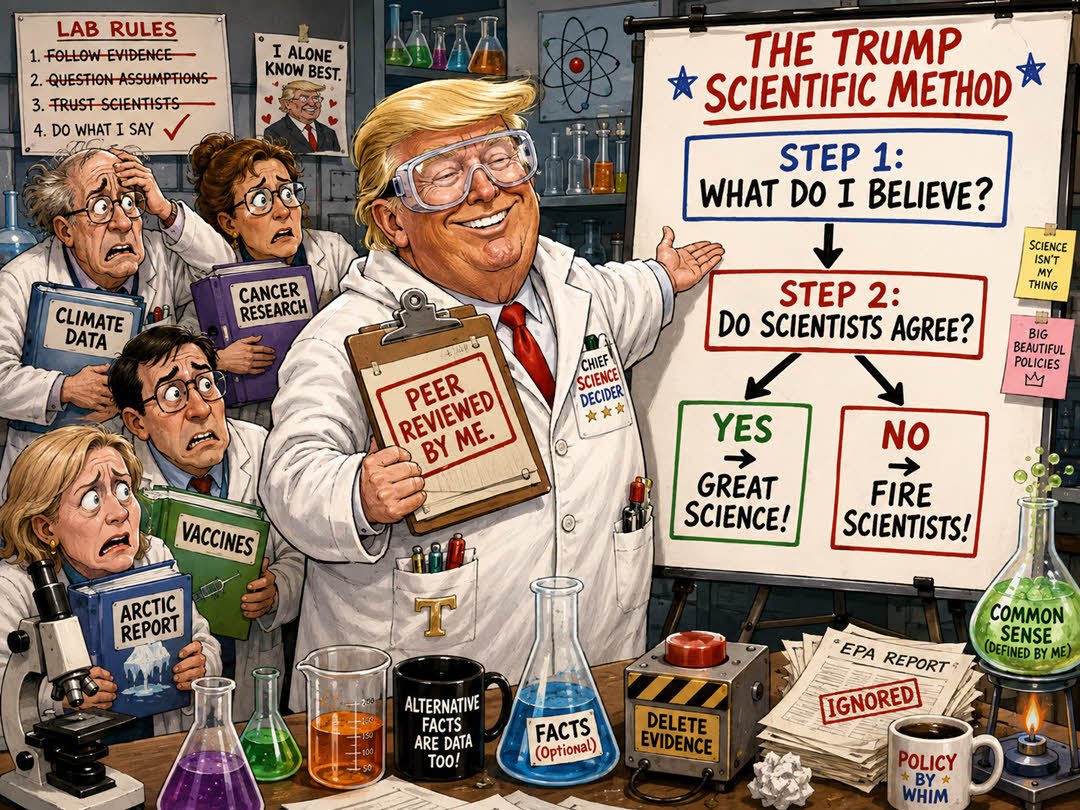
The traditional scientific method works like this:
Observe.
Form a hypothesis.
Gather evidence.
Test the hypothesis.
Revise your conclusions.
The Trump Scientific Method is considerably more efficient:
Decide what Donald Trump believes.
Locate someone wearing a lab coat.
Ask whether the evidence agrees.
If not, reconsider the scientist.
This philosophy has now moved beyond budget cutting. Trump signed an executive order giving political appointees considerably greater authority over federal grants, including the ability to review whether funding aligns with administration priorities. Scientists warned that this threatens the traditional system in which research proposals are judged primarily by expert peer review rather than presidential enthusiasm.
Peer review, after all, presents an obvious problem.
Peers occasionally disagree.
Donald Trump already has Truth Social for that.
The administration has simultaneously pushed large investments into favored areas, such as artificial intelligence, while reducing or attempting to redirect support elsewhere. The White House has promoted shifting billions in research funding away from universities and toward funding structures more aligned with its priorities.
Even the Arctic has apparently become insufficiently cooperative.
The administration recently withdrew federal support for NOAA’s long-running Arctic Report Card, which has documented rapidly changing temperatures, sea ice, glaciers, and ecosystems since 2006. The Arctic, regrettably, continues to warm despite the loss of its government report.
This highlights science’s greatest weakness in the Trump era:
Facts are terrible at loyalty.
A thermometer does not care who won Wisconsin.
A hurricane does not recognize executive privilege.
Cancer cells cannot be intimidated at a press conference.
Carbon dioxide has never once responded to “Truth Social.”
And viruses have shown an almost insulting unwillingness to respect presidential branding.
That is why the attack on science is ultimately more serious than any other Washington budget battle.
Scientific research requires continuity. Laboratories take years to build. Researchers spend careers developing expertise. Graduate students choose fields believing that institutions will still exist by the time they finish their training. Experiments cannot simply be turned off for four years and restarted after the next election like the lights at Mar-a-Lago.
Destroy enough of that infrastructure, and the scientists do not sit quietly waiting for America to regain its senses.
They leave.
Other countries hire them.
Other laboratories outside the United States make the discoveries.
Other economies own the patents.
And one morning, America awakens to discover that while we were busy investigating whether climate change was sufficiently MAGA, somebody else invented the future.
Trump promised to Make America Great Again.
Science helped make America great the first time.
Which makes dismantling it a particularly imaginative strategy.
Perhaps the new slogan should simply be:
Make America Guess Again.