Injustice rarely remains confined to one target group.
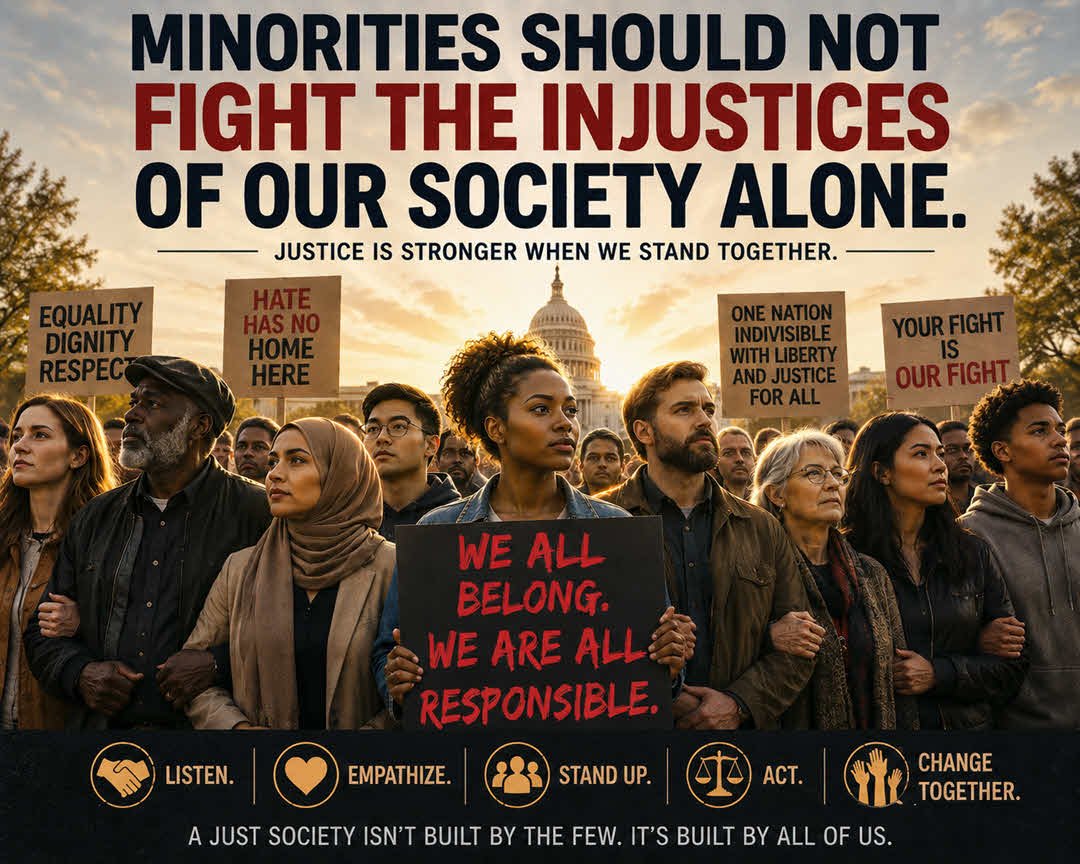
A healthy democracy requires that the defense of justice become a shared responsibility across the entire citizenry.
In the United States, many of the greatest democratic advances emerged because individuals outside the directly affected groups chose to stand beside them. The Civil Rights Movement was led courageously by Black Americans, but meaningful progress also depended upon coalitions that included white clergy, students, labor organizers, journalists, and ordinary citizens willing to challenge the norms of their own communities. The same pattern has repeated throughout history. Expanding democracy has almost always required people to defend principles even when they themselves were not the immediate victims.
This matters because injustice rarely remains confined to one target group forever. Once a society becomes comfortable with dehumanizing one segment of the population, the habits of intolerance begin to spread. Institutions weaken. Trust erodes. Public discourse hardens into suspicion and resentment. Eventually, the democratic culture itself becomes damaged. History repeatedly demonstrates that authoritarian impulses often begin with attacks on minorities but rarely end there.
Minority communities frequently sound the alarm first because they experience social tensions earlier and more intensely. Immigrants, religious minorities, racial minorities, and marginalized groups often detect rising hostility before the broader public fully recognizes it. Yet warnings alone are insufficient if the majority population dismisses them as exaggeration, grievance, or partisan rhetoric. Democracies survive not because minorities protest danger, but because majorities decide the warnings matter.
This is particularly important in an era shaped by social media outrage, political tribalism, and identity-based polarization. Modern politics increasingly rewards emotional escalation rather than thoughtful reflection. Entire groups of people can quickly become caricatures in online spaces, reduced to symbols instead of fellow citizens. When this occurs, empathy begins to disappear from public life. A society that loses the ability to see the humanity of its opponents risks drifting toward something darker than ordinary political disagreement.
For white Americans in particular, this discussion carries special weight. White Americans remain the demographic majority and still hold disproportionate influence across many institutions, including government, business, media, and finance. This reality does not imply collective guilt, but it does imply collective responsibility. The future character of American democracy will largely depend on what large numbers of white Americans choose to normalize, reject, tolerate, or oppose.
The challenge before the country is therefore not simply about protecting minorities. It is about preserving a civic culture where equal citizenship remains real. A democracy cannot function if significant portions of the population believe the rules only protect some people and not others. Nor can it endure if fear and resentment become more politically powerful than constitutional principles.
The answer is not silence, nor endless outrage, nor ideological purity tests. The answer is the rebuilding of a broader civic ethic: one rooted in pluralism, mutual dignity, constitutional loyalty, and the understanding that freedom is safest when defended collectively. Minorities should never be abandoned to fight society’s injustices alone, because when only the vulnerable defend democracy, democracy itself becomes vulnerable.

Now available on Amazon Kindle!
A book about the travels of Donald J Trump as he visits many strange and humorous places and leaves each place perhaps a bit wiser and without getting into any trouble.

For fans of the book Gulliver's Travels.