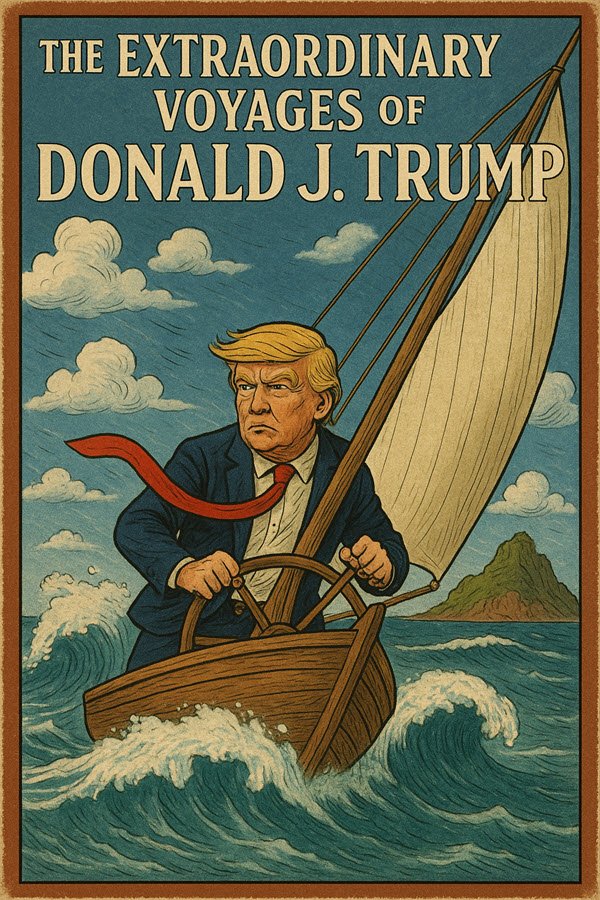
“Not Nearly Long Enough”, said Donald Trump—Unless You’re Actually on the Ship
The USS Abraham Lincoln has now been deployed for more than 260 days, including more than 240 uninterrupted days at sea. It has gone more than 200 days without a port call. Families and lawmakers have raised concerns about supplies, exhaustion, and mental health aboard a ship carrying roughly 5,000 sailors and Marines. (AP News)
Donald Trump considered this information carefully and arrived at the compassionate presidential response:
He said that the deployment has been “Not nearly long enough.”

There is leadership, and then there is apparently standing safely on land and announcing that other people should spend more time at sea.
Trump’s comment might be easier to admire if he were delivering it from bunk 14-C after eight months away from home while eating whatever meal survived the latest resupply problem.
Instead, the Commander in Chief gets a nice private bedroom, golf courses, cheeseburgers, and the ability to determine that 260 days aboard an aircraft carrier sounds perfectly reasonable because such a deployment is not happening to him.
The Navy itself has acknowledged that combat disrupted traditional supply hubs, producing shortages and lost mail. Officials say food was prioritized first, then hygiene items, then mail, and maintain that sailors currently have clean water and healthy meal options. Reports have also raised mental-health concerns, although the Navy says it has not observed an increase in suicidal ideation or attempts. (AP News)
In other words, the situation deserves serious attention.
Enter Defense Secretary Pete Hegseth.
Hegseth declared reports about conditions aboard the Lincoln “completely misrepresented.” He says he wants the crew rotated home quickly and insists the military is providing everything possible. (Reuters)
Excellent.
Apparently, the first rule of troop welfare is explaining that reports about troop welfare are inaccurate.
This creates the perfect Trump-Hegseth management system:
Sailors struggle? Misrepresented.
Families worry? Exaggerated.
Deployment approaching nine months? Not nearly long enough.
Problem solved. In fact, did we really even have a problem?
One wonders what sailors would have to report before Washington became concerned.
“The toilets have stopped working.”
“Fake plumbing news.”
“We haven’t seen our families in nine months.”
“Outstanding commitment.”
“We’re exhausted.”
“Thank you for your service. Please remain exhausted.”
Admiral Brad Cooper, after visiting the carrier, praised the crew’s resilience and said the Lincoln had the lowest number of mental-health cases among the Navy’s 11 active carriers. That is reassuring information and deserves acknowledgment. (Reuters)
But resilience is not an excuse to keep testing resilience.
The Trump-Hegseth military has a peculiar habit of calling people heroes while occasionally treating their endurance as an infinitely renewable natural resource.
It isn’t.
These sailors are not replaceable parts bolted onto a floating runway. They are husbands, wives, parents, sons, and daughters doing an extraordinarily demanding job thousands of miles from home.
Leadership means asking not merely, “Can they keep going?”
It means asking, “Should we keep asking them to?”
Trump’s “not nearly long enough” remark suggests that distinction may have disappeared somewhere between the Pentagon and his golf course.
Hegseth can dispute the reporting.
Trump can dismiss the complaints.
But perhaps the simplest military principle should be this:
Before demanding sacrifice from sailors, try demonstrating a little concern for the sailors doing the sacrificing.