Democracy’s Needs
In the long arc of democratic thought, few figures stand as prominently—and as instructively—as Pericles of Athens. He was not merely a leader; he was, in many respects, a steward of an idea so fragile and so radical that it required constant tending: democracy itself.
Pericles governed during what is often called the Golden Age of Athens, a period of cultural brilliance, architectural triumph, and political experimentation. Yet to view him only through the lens of marble columns and flourishing arts is to miss the deeper substance of his legacy. His true contribution lies not in what Athens built, but in how Athenians were asked to think about themselves. They were asked to think of themselves as citizens, not as subjects.
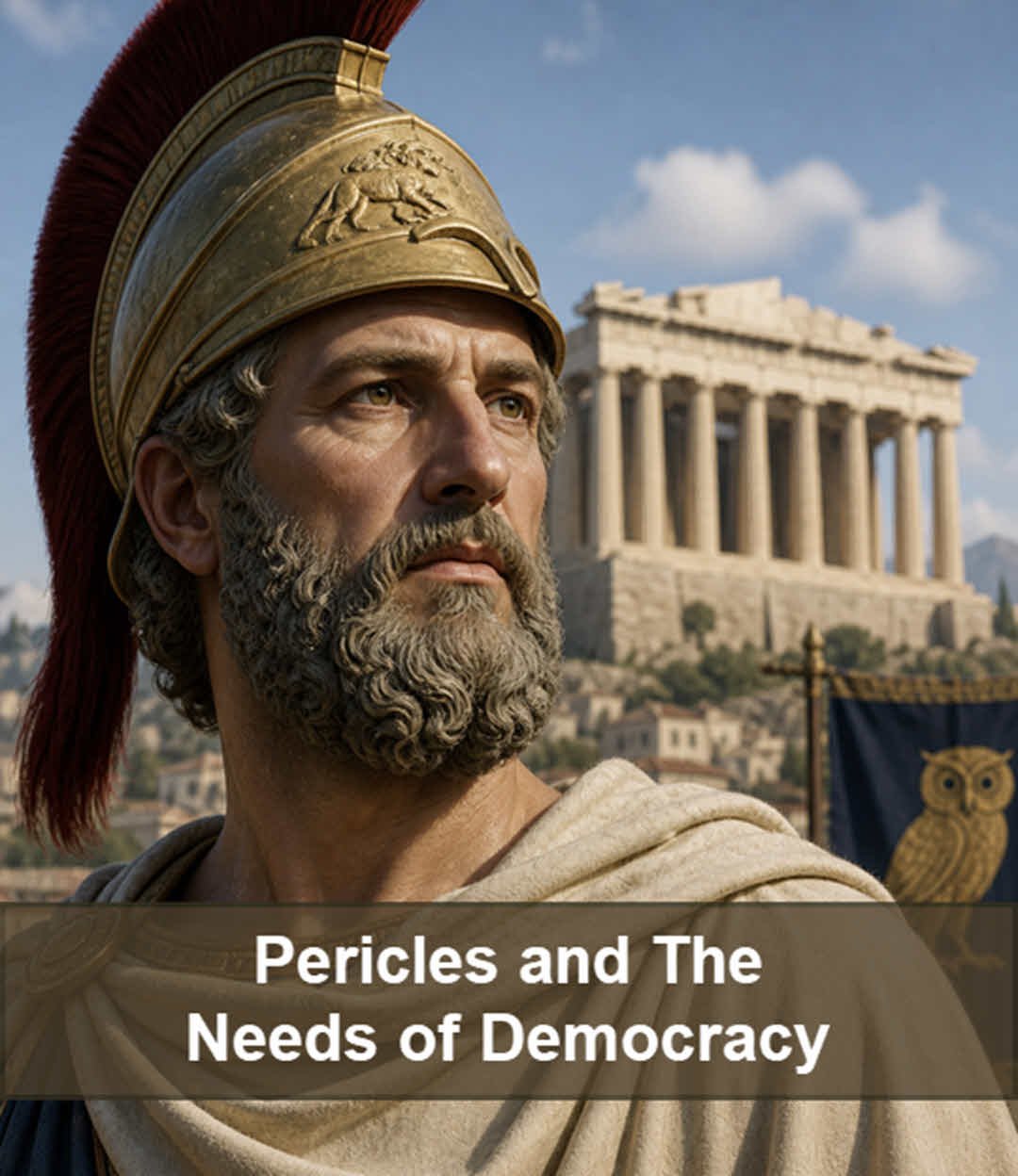
In his famous Funeral Oration, as recorded by Thucydides, Pericles described a society that prized participation over passivity. He spoke of a people who did not consider public life a burden to be avoided but a duty to be embraced. In Athens, he claimed, a man who took no interest in politics was not merely harmless. Pericles felt that this man was, indeed, useless.
This notion carries particular weight in any examination of the modern democratic strain. Democracy, Pericles reminds us, is not self-sustaining. It is not a machine that runs once built. It is a living system that depends upon the willingness of its citizens to engage with its complexities, tolerate disagreement, endure uncertainty, and resist the seductive simplicity of absolute answers.
And here, in the context of MAGA, the contrast becomes instructive.
Periclean democracy demands effort. It requires that citizens weigh arguments, challenge leaders, and accept that truth is often contested terrain. Democracy, itself, thrives on friction. Indeed, it is important to have a clash of ideas that, through debate, sharpen into policy. In such a system, loyalty is owed not to a man, but to the process itself.
By contrast, movements that center on a single figure, such as MAGA, invert this relationship. The citizen becomes a follower. The process becomes secondary to personality. Complexity is flattened and simplified into slogans. Ambiguity is treated as weakness. The difficult work of self-governance is replaced by the easier comfort of alignment.
Pericles would have recognized this shift immediately. He would have been concerned.
For in his Athens, leadership was not about insulating oneself from criticism but inviting it. Power was not secured through unwavering devotion but through persuasion with valid argument. Even at the height of his influence, Pericles remained accountable to the assembly, subject to its judgment, vulnerable to its whims. This was not a flaw in the system; it was its defining feature.
To be governed in such a way requires a certain kind of citizen. A citizen must be capable of independent thought, resistant to manipulation, and willing to place the common good above personal grievance. It is, by any measure, a demanding standard.
And yet, Pericles believed it was achievable.
He believed that ordinary people, given the opportunity and the responsibility, could rise to meet the needs of democracy. He believed that engagement, not withdrawal, was the antidote to disorder. And perhaps most importantly, he believed that the strength of a nation was inseparable from the character of its citizens.
This belief is both inspiring and unsettling.
For if democracy falters, the fault does not lie solely with its leaders. It also lies with the citizenry. If people disengage, if they accept, or even seek, easy narratives, and if they trade participation for performance, then the system is weak. The system reflects the people who inhabit it.
In this sense, Pericles serves not as a relic of ancient history but as a mirror.
He forces us to ask uncomfortable questions: Are we the kind of citizens democracy requires? Do we engage with ideas, or do we merely echo them? Do we seek understanding, or do we seek affirmation? Are we participants in our governance, or spectators to it?
These questions cut to the core of the present moment.
For in times of political stress, when institutions are tested, and norms are strained, the resilience of democracy is revealed not in its structures alone but in the behavior of its people. A disengaged populace invites concentration of power. A polarized one accelerates it. A credulous one enables it.

Pericles understood this dynamic instinctively.
His Athens was far from perfect. It excluded women, enslaved people, and foreigners from its democratic processes. It engaged in imperial ambitions that ultimately contributed to its downfall during the Peloponnesian War. These contradictions are essential to acknowledge, for they remind us that democracy is always incomplete and always evolving, and always vulnerable to its own excesses.
Yet even within these limitations, the ideals articulated by Pericles endure.
These ideas endure because they articulate a vision of citizenship that remains relevant: active, informed, and resilient. They remind us that democracy is not defined by unanimity but by its capacity to accommodate differences. These ideas insist that disagreement is not a threat to the system but its lifeblood.
And perhaps most critically, they warn us against the allure and appeal of simplicity.
For simplicity, in political life, is rarely honest. It reduces complexity to caricature. It transforms opponents into enemies. It replaces deliberation with declaration. It offers clarity at the expense of truth.
Pericles, in contrast, offered something harder: a call to think, to engage, to participate.
It is a call that echoes across centuries. A call that today feels increasingly urgent.
In the world of MAGA, where identity can collapse into allegiance and allegiance into absolution, the voice of Pericles stands apart. Not as a partisan, not as a polemicist, but as a reminder of what democracy demands and what we need to be in order to avoid losing it.
Pericles does not offer comfort. He offers responsibility.
And in that, perhaps, lies the most enduring lesson of all.
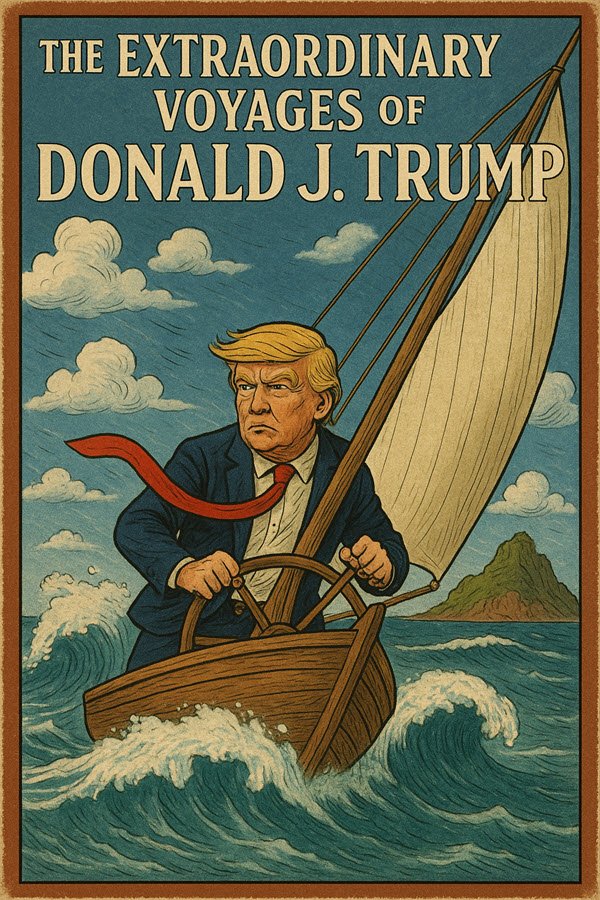
Now available on Amazon Kindle!
A book about the travels of Donald J Trump as he visits many strange and humorous places and leaves each place perhaps a bit wiser and without getting into any trouble.

For fans of the book Gulliver's Travels.