Republican Party after Trump – After Twelve Years of Captivity, Congress Discovers the Door Was Never Locked
Something extraordinary happened in Washington on the morning of November 4, 2026.
Republican members of Congress woke up, looked at the election results, and discovered that the political universe had changed.
Democrats had captured both houses of Congress. Republican candidates had suffered devastating defeats, including in states that had once seemed safely Republican. The political influence of Donald J. Trump, once regarded by many Republican officeholders as a force of nature, suddenly seemed far less supernatural.
But the most remarkable discovery was yet to come.
The door to the Republican cage was open.
And, as it turned out, it had never been locked.
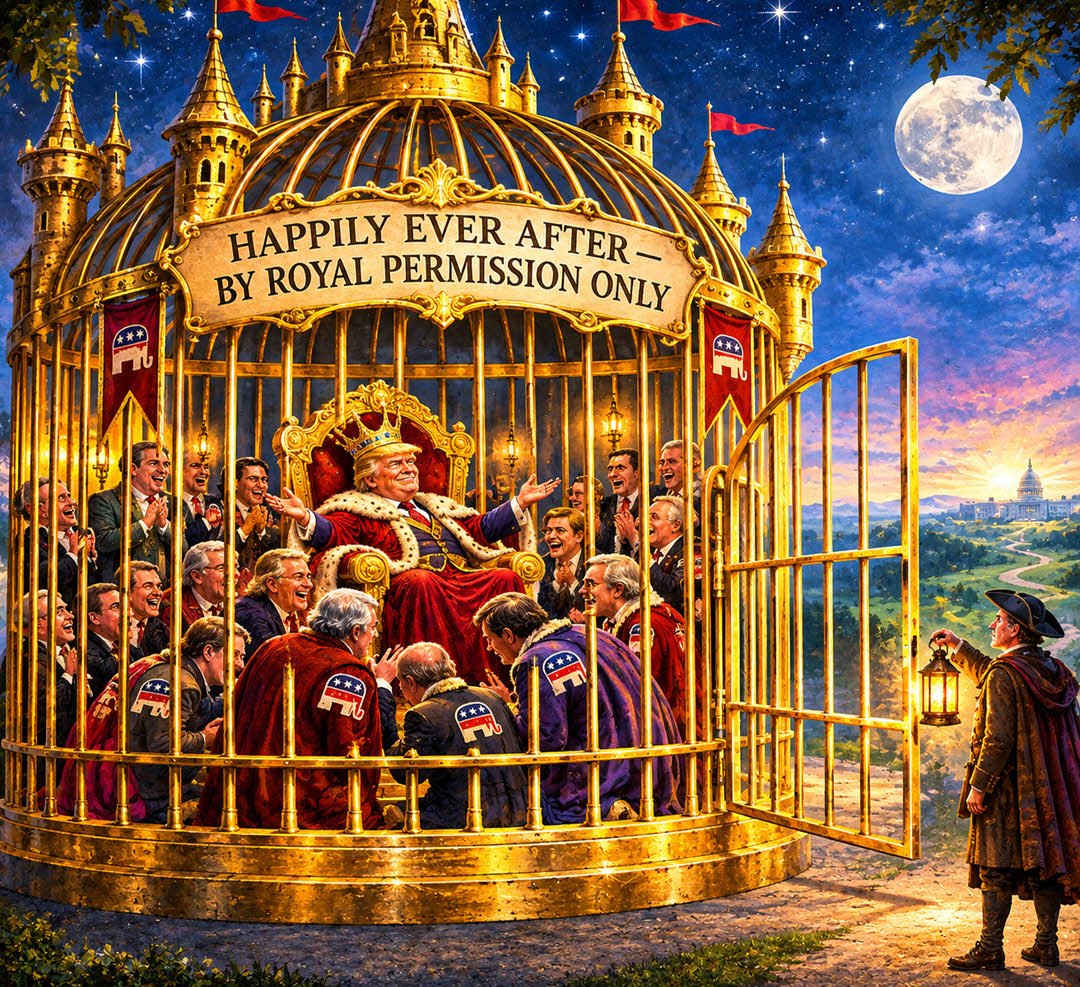
A Most Unusual Discovery
For nearly a decade, Republican lawmakers had occupied an enormous golden birdcage located just outside the United States Capitol.
It was a magnificent structure, decorated with American flags, miniature portraits of Donald Trump, and where everyone knew that LOYALTY IS FREEDOM.
Inside were comfortable chairs, television screens permanently tuned to Fox News, and a collection of red baseball caps available in every size.
The occupants were well fed, handsomely compensated, and permitted to travel freely, provided they returned whenever the president whistled.
Each morning, a recorded announcement reminded them of the rules.
“Never contradict the president.”
“Never acknowledge a presidential mistake.”
“Never confuse your constitutional responsibilities with your political survival.”
And, most importantly:
“Remember that disagreement is disloyalty, unless the president changes his mind, in which case disagreement becomes loyalty retroactively.”
The system had worked remarkably well.
Until November 3.
The First Signs of Trouble
The morning after the election, a junior Republican congressman approached the cage door.
“Something’s wrong,” he whispered.
“What?” asked a senior senator, who had been sitting motionless beneath a portrait of the president.
“The Democrats won.”
“Impossible,” replied the senator. “We had endorsements.”
“Lots of endorsements.”
“Presidential endorsements.”
“Yes, sir.”
“We even had help from Elon Musk,” said a Texas Republican.
The senator looked troubled.
“Have we tried recounting the endorsements?”
Nearby, another congressman was examining the cage door.
He pushed it gently.
It swung open.
The entire Republican delegation gasped.
“Good heavens,” someone whispered. “It’s unlocked.”
A senior party official hurried over.
“Close that immediately! Someone might think we’re independent.”
But the congressman had already stepped outside.
He looked around.
The Capitol was still standing. The Constitution remained in place. No lightning struck. No presidential executive order caused him to burst into flames.
He took another step.
Then he said something no Republican had dared utter in years.
“I disagree with the president.”
Several colleagues fainted.
Who Built This Thing, Anyway?
As word spread, congressional investigators were sent to determine who built the mysterious cage.
Their findings were deeply embarrassing.
The Republicans had built it themselves.
The original architectural plans dated back to 2016, when party leaders decided that their political futures would be more secure if they surrendered certain inconvenient privileges, including independent thought, public disagreement, and occasionally the ability to distinguish fact from fiction.
The construction proceeded rapidly.
Some lawmakers installed the bars by defending statements they privately questioned.
Others reinforced the walls by remaining silent when colleagues were publicly attacked.
Still others contributed elaborate security systems designed to punish Republicans who dared exercise independent judgment.
Primary-election threats served as the locks. Presidential endorsements provided the electricity. Fear of angry voters supplied the surveillance cameras.
The finishing touches were particularly impressive.
A group of senior lawmakers installed mirrors throughout the cage so every occupant could admire his or her loyalty without looking at the outside world.
Republican leadership conducted the final inspection.
“Excellent workmanship,” the inspectors declared.
“Isn’t this a little restrictive?” asked one nervous freshman.
“Nonsense,” the chairman replied. “We’ve never been freer to agree.”
The cage was officially opened with a ribbon-cutting ceremony.
Naturally, Donald Trump cut the ribbon.
The Great Migration Begins, The Republican Party After Trump
By noon on November 4, dozens of Republican lawmakers had gathered near the open door.
Some were excited.
Others were terrified.
One senator cautiously asked whether Congress was legally permitted to disagree with the president.
A congressional librarian was summoned.
After several minutes of searching, she returned with an extraordinary document.
“This is The Constitution,” she announced.
The Republicans stared.
“Is that still in effect?” someone asked.
“Yes,” she replied. “And according to this document, Congress is an independent branch of government.”
An audible murmur swept through the crowd.
“Independent?”
“Of the president?”
“Even when he’s watching television?”
The librarian nodded.
She then revealed an even more astonishing discovery.
The Constitution discusses Congress in Article I.
The presidency doesn’t appear until Article II.
A senator demanded an immediate investigation into who had arranged the articles in that order.
Another suggested that the document might have been written by Democrats.
But a third Republican, emboldened by the election results, proposed something truly radical.
“Perhaps,” he said, “we should start representing the people who elected us.”
Silence.
Then someone asked whether that would require holding town halls.
The proposal was temporarily tabled.
The President Responds
Meanwhile, Donald Trump was informed that several Republican lawmakers had escaped.
“Escaped from what?” he demanded.
“The cage, Mr. President.”
“What cage?”
“The one they built to demonstrate their loyalty.”
Trump considered this.
“Beautiful cage. Tremendous cage. Everybody said it was the greatest cage ever built. Nobody builds cages like my Republicans.”
An aide explained that some Republicans were now discussing independent positions on legislation, congressional oversight, and presidential authority.
The president was reportedly unimpressed.
“Independent? I made them independent. Nobody has done more for independence than me.”
He then instructed his staff to prepare a statement announcing that every Republican who disagreed with him had always been a terrible Republican.
Several lawmakers immediately returned to the cage to await further instructions.
The Prisoners and the Jailers
By late afternoon, a difficult realization had begun to spread.
The Republicans had not been kidnapped.
They had not been chained to their chairs.
They had not been forced to surrender their independence by an invading army.
They had voluntarily exchanged portions of their political independence for endorsements, protection from primary challengers, favorable publicity, and the promise of continued power.
Some had even helped punish colleagues who refused to participate.
They were not simply prisoners.
They had been the architects, construction workers, security guards, and enthusiastic occupants of their own captivity.
And now, after a disastrous election, some were considering whether freedom might offer better career opportunities.
The Door Was Never Locked
As evening settled over Washington, dozens of Republicans stood outside the enormous golden cage.
They congratulated one another on their courage.
Several announced that they had always believed in congressional independence.
Others insisted they had secretly opposed the cage from the beginning.
One senator proudly declared that he had never actually liked the color gold.
Then, from a television inside the cage, came a familiar voice.
Donald Trump was speaking.
He criticized disloyal Republicans, threatened political consequences, and promised that those who abandoned him would regret it.
The celebration stopped.
Several lawmakers instinctively straightened their ties.
One reached for his red baseball cap.
Another whispered, “Do you think he knows we’re out here?”
A third looked nervously toward the open door.
“Maybe,” he suggested, “we should go back inside. Just until things settle down.”
The Republicans looked at one another.
Then at the television.
Then at the Capitol.
And finally at the open cage door.
Nobody moved.
The door had never been locked. The question now was whether anyone intended to venture and stay outside.

In 1776, America’s Founders risked their fortunes, freedom, and lives by defying King George III and signing the Declaration of Independence. Today, congressional Republicans face no gallows, only Trump’s disapproval and possible electoral defeat. Yet too many lack the courage to exercise the very independence their Founders risked everything to secure.
Without the courage of the Founding Fathers, we would not have the United States of America today.



Spot on! Spotting the open door is easy, but finding the spine to stay outside is the real challenge.
Stepping outside takes real courage, especially when your spine was sold separately back in 2016.
So true. Re-discovering Article I of the Constitution after a decade of self-imposed silence is long overdue.
Dusting off Article I after ten years? Good luck remembering where Congress put the manual.
Brilliant analogy. They voluntarily surrendered their independence, so they can’t blame anyone else for building the cage.
Hey, self-assembly cages are popular for a reason—they come with zero responsibility and cozy seating!
Excellent piece. True freedom requires accountability, not just running back inside the moment a stern voice calls from Florida.
Leaving the golden cage sounds heroic until you realize you do not have a backup career plan.
The cage was entirely self-built out of fear. Reclaiming genuine independence requires far more courage than just walking out the door.
Reclaiming independence is tough when every step away from the cage triggers an existential panic attack.