The Planes Are Grounded, but the Cameras Are Rolling
Welcome to the Golden Age of American government, where every cabinet meeting is a reality show, every secretary is a potential television star, and every crisis is another opportunity for a promotional video.
And the airplanes? Well, that’s another department.
On Friday, November 13, America’s aviation system unveiled an exciting new transportation concept: airplanes that don’t leave the ground.
For nearly five hours, the Federal Aviation Administration imposed a nationwide ground stop after serious instability disrupted its aging telecommunications network.
Thousands of flights were canceled. Passengers were stranded. Departure boards became monuments to disappointment.
Fortunately, Transportation Secretary Sean Duffy had already demonstrated an exciting alternative to flying.

It’s called The Great American Road Trip.
And unlike the FAA’s aging communications infrastructure, it comes with corporate sponsors, scenic destinations, professional production crews, and a starring role for the transportation secretary himself.
Who needs functioning radar feeds when you’ve got a YouTube channel?
America’s Transportation Secretary Becomes a Travel Influencer
Earlier this year, Duffy starred alongside his wife, Rachel Campos-Duffy, and their children in a six-part travel series celebrating America’s 250th anniversary.
The production featured highways, tourist attractions, family adventures, and visits to major corporations.
Sponsors included Boeing, Toyota, United Airlines, Shell, Enterprise Rent-A-Car, and Lyft.
Yes, companies operating in industries regulated by Duffy’s Transportation Department helped finance a television-style production featuring the secretary and his family.
Boeing and Toyota reportedly contributed $1 million apiece.
In the old-fashioned world of government ethics, corporations financing promotional activities involving their federal regulators might raise a few eyebrows.
But this is the Golden Age. You do remember that this is the Golden Age.
Why settle for a boring government ethics seminar when you can have a corporate-sponsored family adventure?
Duffy maintains that ethics officials approved his participation and that his family received no salary or royalties.
Wonderful. Apparently, the important distinction is whether the family received a paycheck, rather than whether regulated corporations should be financing the spectacle in the first place.
Welcome to Trump’s Cabinet of Central Casting
Duffy’s transformation into America’s traveling television personality shouldn’t surprise anyone.
Donald Trump has assembled an administration in which television experience sometimes appears less like a previous occupation and more like an essential job qualification.
Consider the casting.
Sean Duffy: Former reality television personality and Fox Business host. Now Transportation Secretary.
Pete Hegseth: Former Fox News personality. Now Secretary of Defense.
Donald Trump: Former reality television star. Now president, executive producer, and apparently the nation’s most enthusiastic reviewer of his own performance.
One wonders whether cabinet interviews begin with a discussion of administrative experience or a request to look directly into the camera and smile.
And then there are the cabinet meetings.
In traditional administrations, cabinet meetings provide opportunities to discuss policy, budgets, and national problems.
In Trump’s televised meetings, they have also become extraordinary exhibitions of presidential praise, with officials taking turns celebrating the man seated at the head of the table.
One can almost imagine the agenda:
9:00 a.m. — Praise the president.
9:15 a.m. — Explain why the president deserves more praise.
9:30 a.m. — Discuss national infrastructure, time permitting.
It’s government as reality television, complete with an executive producer occupying the Oval Office.
The trouble with casting a government like a television show is that eventually someone must operate the equipment.
And unlike a television studio, an air traffic control center cannot simply yell “Cut!” when something goes wrong.
Meanwhile, back at the FAA…
While America’s transportation secretary was demonstrating the joys of American travel on YouTube, the nation’s aviation infrastructure continued confronting a considerably less photogenic reality.
Aging telecommunications equipment. Outdated technology. Complex networks. Maintenance requirements. Air traffic controller shortages.
None of these problems looks particularly impressive on Instagram.
Try producing a viral video featuring an engineer replacing a network router.
“Hey, everybody! Welcome back to another exciting episode of America’s Infrastructure! Today we’re upgrading communications equipment at an air traffic control facility!”
After a week, the video has recorded three views.
Two from the engineer’s mother.
One from the Government Accountability Office.
But put a transportation secretary behind the wheel, surround him with smiling family members, add spectacular landscapes and corporate logos, and suddenly you’ve got something worth promoting.
The problem is that government isn’t supposed to be a reality television production.
It’s supposed to work.
And much of that work is tedious, complicated, expensive, and utterly invisible until something fails.
Friday’s Great American Ground Stop
On November 13, the invisible became spectacularly visible.
According to the FAA, instability in its legacy telecommunications network disrupted communications and radar feeds at 17 of the nation’s 22 Air Route Traffic Control Centers.
Approximately 3,500 aircraft already airborne landed safely.
The nationwide ground stop followed technical problems beginning around 3:30 p.m. Eastern and wasn’t lifted until 8:15 that evening.
The FAA reported approximately 12,462 flight cancellations that Friday, although not all were directly attributable to the ground stop.
For travelers, the result was a national demonstration of what happens when essential infrastructure fails.
There were no scenic overlooks.
No cheerful family commentary.
No corporate-sponsored roadside attractions.
Just stranded passengers, exhausted airline employees, and a national transportation network struggling to recover.
Perhaps the next episode of The Great American Road Trip could feature a family attempting to drive from Boston to Los Angeles because the nation’s air traffic control system has decided to take the afternoon off.
Sponsored by Enterprise Rent-A-Car, naturally.
The Trump Administration’s Favorite Infrastructure: A Television Camera
The larger question concerns what government chooses to celebrate.
The Trump administration has made spectacle a prominent feature of its public presentation.
Everything needs a slogan, a backdrop, preferably some gold lettering, and someone ready to declare it the greatest achievement in American history.
But maintaining a modern transportation network requires something entirely different.
Long-term planning. Technical expertise. Reliable funding. Competent procurement. Well-planned maintenance.
And, perhaps most difficult of all, a willingness to invest enormous resources in improvements that nobody will notice because nothing goes wrong.
There’s no ribbon-cutting ceremony for a system that doesn’t crash.
No viral video celebrating a radar feed that remains reliable.
No standing ovation for a communications network that works exactly as intended.
Yet these unglamorous accomplishments are precisely what government is supposed to deliver.
To be fair, Duffy has advocated billions in FAA modernization funding, including a request for an additional $50 billion. His road trip didn’t cause Friday’s outage, and there’s no evidence that filming the series prevented specific repairs.
But the contrast raises a question worth asking.
Does the administration devote as much attention to the unglamorous responsibilities of government as it does to the performances that make government look impressive?

Public Office Isn’t a Reality Show
A cabinet secretary doesn’t have to personally replace routers, inspect communications cables, or reprogram air traffic control systems.
That’s why government employs engineers, technicians, controllers, and administrators.
But a cabinet secretary is responsible for ensuring those professionals have the resources, leadership, and institutional commitment necessary to do their jobs.
That’s the difference between holding public office and playing a public official on television.
One requires accountability.
The other requires good lighting.
And when America’s aviation system experiences a nationwide shutdown, taxpayers are entitled to ask whether their government has devoted sufficient attention to the responsibilities that never make it onto a promotional poster.
The real test of a transportation secretary isn’t how many Americans watch him travel across the country. It’s how many Americans can travel across the country without ever having to think about him.
The answer won’t be found in another travel episode.
It will be found in modernized equipment, functioning networks, dependable backup systems, and fewer Americans sleeping on airport floors.
Until then, perhaps the Transportation Department should consider a sequel.
The Great American Road Trip, Season Two: America’s Airports Are Closed, So Everybody Gets a Minivan.
Coming soon to a highway near you.
Corporate sponsorship opportunities available.
Because in the Golden Age of American transportation, the show must go on—even when the planes remain on the ground.

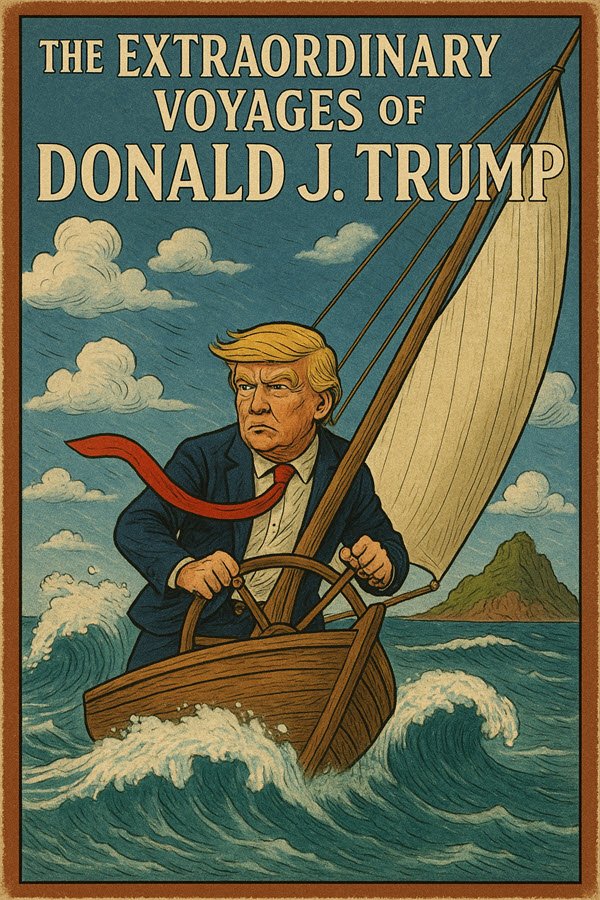


Duffy’s road trip was like Kristi Noem’s video of her riding a horse with Mt. Rushmore in the background. These folks are not serious.
He wasn’t filming a travelogue—he was bravely field-testing our emergency backup transit plan.
Nothing says fierce regulatory independence quite like having Boeing and Toyota drop a million dollars each to sponsor the Transportation Secretary’s scenic family road trip.
Welcome to The Golden Age! In the Golden Age, funding your family vacation through regulated industries isn’t a conflict—it’s synergy.