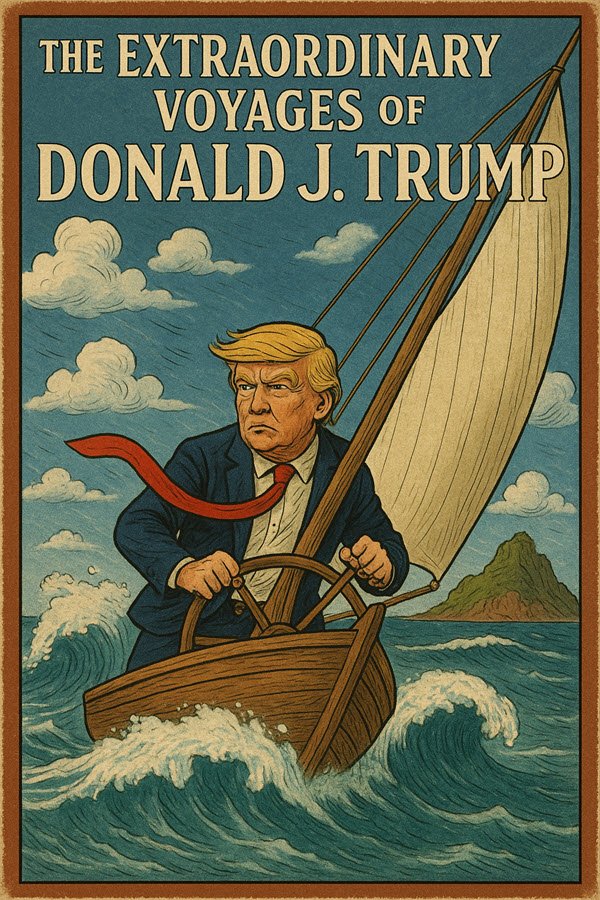
On August 14, Trump said: “After we finish defeating Iran … pretty soon I’ll be declaring the Hormuz Strait a territory of the United States.” He had already claimed the U.S. had “total control” of the strait and suggested America might “keep it.” (CNN Transcripts)
Congratulations, America: We Apparently Just Bought the Strait of Hormuz
Donald Trump has apparently discovered a fascinating new principle of international law:
If the United States military can bomb a country, Donald Trump may then declare that some portion of its territory can then be owned by the United States.
Speaking in New York, Trump announced that after America finishes defeating Iran, he may declare the Strait of Hormuz “a territory of the United States.”
This will undoubtedly be interesting news for Iran.
It will be even more interesting to Oman.
The Strait of Hormuz is not an abandoned strip mall awaiting acquisition by the Trump Organization. At its narrowest point, it lies within the territorial waters of Iran and Oman. International maritime law grants ships extensive transit rights through strategic international straits, but these rights are not ownership rights. (CBS News)
This distinction apparently requires translation into Trump Real Estate Law:
Driving into somebody’s driveway does not make the house yours.
Neither does parking an aircraft carrier nearby.
The United States certainly has enormous military power around Hormuz. It can escort ships, attack threats, impose blockades, and attempt to guarantee navigation.
But military control and sovereignty are not interchangeable words.
If they were, every American military base overseas would come with a deed and a complimentary Trump Tower.
The United States has historically argued for freedom of navigation through Hormuz—the sensible position that an international commercial artery should remain open to shipping. Indeed, Washington has long treated transit passage through international straits as a principle of customary international law. (Chatham House)
Trump’s contribution is apparently:
Why settle for freedom of navigation when we can annex the neighborhood?
There is another awkward complication.
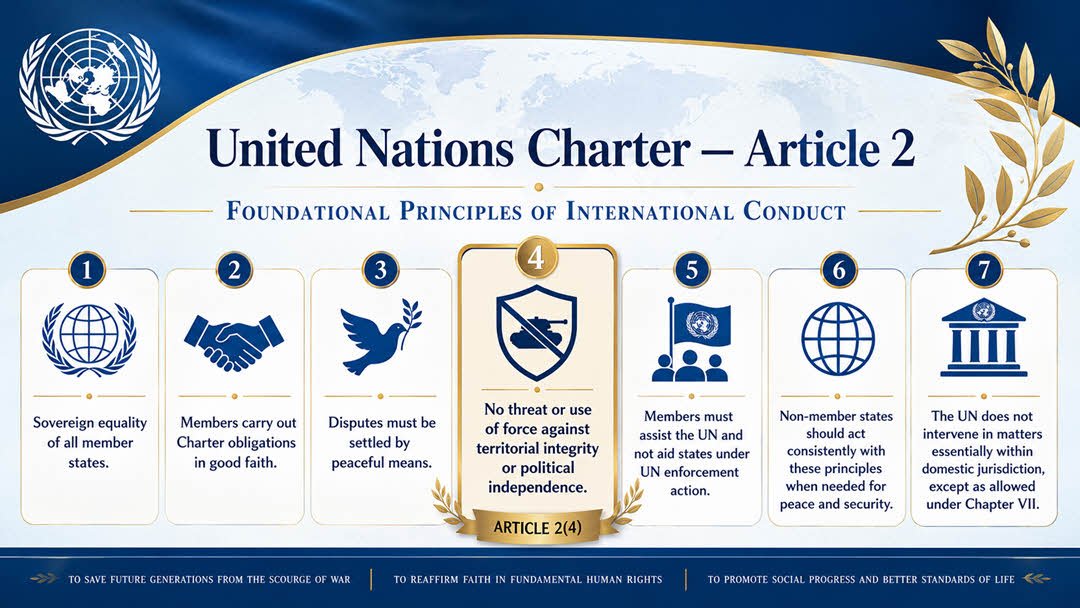
The international system that the United States helped construct after World War II explicitly rejects the acquisition of another country’s territory by force. Article 2 of the United Nations Charter prohibits the threat or use of force against another state’s territorial integrity, and subsequent UN principles explicitly reject the acquisition of territory by force. (United Nations)
So, Trump’s statement and proposal are not merely legally fantastical.
It is also strategically foolish.
America is trying to persuade the world that Iran cannot unilaterally dominate one of the planet’s most important shipping lanes. Declaring the same waterway American territory would produce the wonderfully sophisticated diplomatic argument:
Iran can’t own it because WE own it.
That should play beautifully in Tehran.
It would also hand Iranian propagandists an extraordinary gift: evidence for every accusation that America’s war is really about conquest rather than nuclear weapons or freedom of navigation.
Meanwhile, shipping through Hormuz remains severely disrupted, with traffic far below normal levels and global energy markets paying the price. (Reuters)
What the world needs is stability.
Trump offers a property dispute.
Perhaps next week he will announce that the Suez Canal will look terrific with a ballroom.
Maybe Gibraltar needs a golf course.
Perhaps Greenland should check Zillow.
The Strait of Hormuz does not need a new owner.
It needs ships moving safely through it, regional countries talking to one another in collaborative ways, and an American president capable of distinguishing and protecting an international waterway without defining it as U.S. territory.
Trump once wrote The Art of the Deal.
Apparently, we have now reached the sequel:
The Art of Taking Things That Aren’t for Sale.