To Those Aboard the USS Abraham Lincoln, Please Stop Complaining.
Donald Trump loves the American military.
Especially the parts involving flags, salutes, fighter jets, aircraft carriers, uniforms, parades, and Donald Trump standing somewhere in the middle of the photograph.
The actual human beings inside those uniforms occasionally seem to complicate the presentation.
We cannot inspect Trump’s private conscience and declare what he personally feels about every sailor, soldier, or veteran. But we can examine priorities—and lately the message has been remarkable.
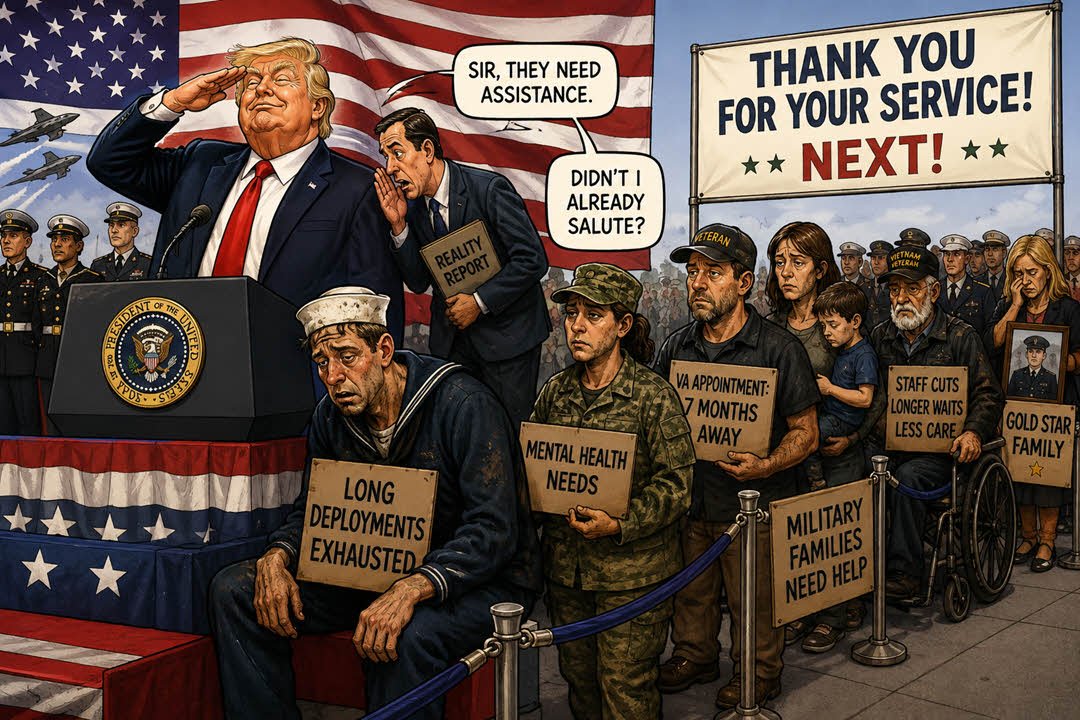
Consider the USS Abraham Lincoln. Roughly 5,000 sailors and Marines have endured a deployment exceeding 260 days, including more than 200 consecutive days at sea. Families and lawmakers have raised concerns about morale, mental health, and living conditions. Asked whether the deployment had gone on too long, Trump answered that it was “not nearly long enough.” (Reuters)
What a magnificent expression of empathy from a man standing on dry land.
Perhaps the new military motto should be:
YOUR SACRIFICE. CREATES OUR CONVENIENCE.
This attitude becomes particularly revealing because military service does not end when the uniform comes off.
Veterans were hit hard during the administration’s federal workforce reductions. The Department of Veterans Affairs abandoned an original plan for approximately 80,000 job cuts but still reduced staffing substantially during 2025, while later eliminating thousands of unfilled positions. Administration officials insist veterans’ care has not suffered; critics, veterans, and lawmakers have warned that staffing reductions can mean longer waits and increased pressure on medical personnel. (Reuters)
Apparently, “support our troops” has a fascinating expiration date.
Before deployment: HERO!
During deployment: KEEP GOING!
After deployment, please take a number. We’re restructuring.
Then there are those who paid the ultimate price.
In 2024, Trump caused outrage among veterans’ groups when he compared the Presidential Medal of Freedom with the Medal of Honor, describing the civilian award as preferable in part because Medal of Honor recipients are often badly wounded or receive it posthumously. His campaign argued that the remarks were being misconstrued, and Trump later described the Medal of Honor as the “ultimate” award. (ABC7 New York)
There is something uniquely Trumpian about evaluating military heroism partly by how inconveniently injured the recipient becomes.
To be fair, Trump has participated in solemn military ceremonies. In July, he attended the dignified transfer at Dover Air Force Base of four American service members killed in the Middle East. (AP News)
But ceremonies are the easy part.
The harder test of respect occurs before the coffin arrives.
It means questioning whether a deployment has become too long.
It means worrying about exhausted sailors before their exhaustion becomes a headline.
It means maintaining veterans’ health services after the applause stops.
It means remembering that troops are not stage scenery for presidential toughness.
America has become extraordinarily good at saying:
“Thank you for your service.”
Perhaps our political leaders should occasionally finish the sentence:
“Now, how are you doing?”
Because patriotism is not measured by the size of the flag behind the podium.
Sometimes it is measured by whether anyone bothered to ask if the sailor underneath it needs to come home.