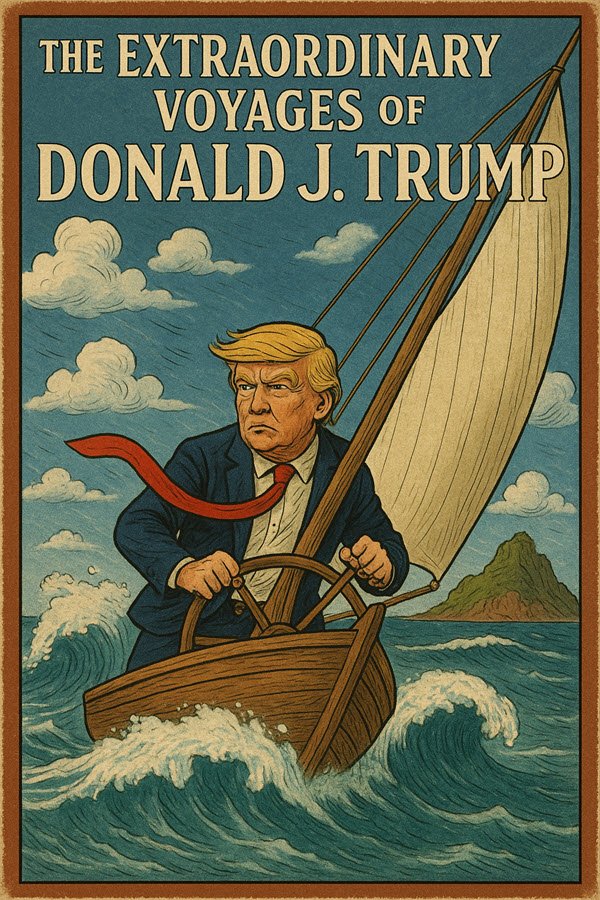
Donald Trump’s Trade War – Sheer Brilliance!
Donald Trump has opened a bold new chapter in American trade policy: a three-front tariff war against the courts, the consumer, and nearly everyone abroad who has ever shipped a product in a box.
It is an ambitious strategy. Most presidents try to fight one economic fire at a time. Trump prefers to soak the curtains in gasoline, accuse the smoke alarm of bias, and announce that the house has never looked stronger.
The first front is against the courts, which have developed the irritating habit of reading laws before deciding whether presidents may use them. This has become a real problem for the administration. Trump’s original tariff plan ran into legal trouble, not because it lacked drama, but because drama is not always a recognized source of executive authority.
So the administration has gone statute shopping, wandering through the federal code like a man searching the attic for a weaponized antique. If one tariff authority fails, another is dragged from the shadows. Section this, subsection that, emergency provision, forced-labor inquiry, national-security rationale, unfair-trade complaint, economic thunderclap, and possibly a dusty clause written when men wore hats to apologize to their bankers.
The policy does not change. Only the excuse does.
This is not lawmaking. It is legal cosplay. The administration dresses the same old tariff in a new costume and sends it back onto the stage, hoping the courts will not recognize the mustache.

The second front is against the American consumer, who has once again been volunteered for patriotic sacrifice without being asked whether groceries, furniture, cars, appliances, construction materials, and small-business supplies were already expensive enough.
Tariffs are often presented as punishments for foreign countries, which is comforting in the same way it would be comforting to think your credit card bill is being paid by Canada. In reality, tariffs are frequently passed along through prices. The foreign producer may feel pain, but so does the American importer, retailer, manufacturer, builder, farmer, and finally the ordinary shopper standing in the checkout line at the grocery store wondering why liberation costs an extra $34.99.
Trump’s great political genius is convincing people that higher prices are proof someone else is being punished. If the cost of a washing machine rises, that is not inflation. That is sovereignty. If plywood gets more expensive, that is not a burden on builders. That is freedom with splinters. If coffee must be exempted because voters might notice breakfast becoming a luxury item, that is not a contradiction. That is strategic coffee bean management.

The third front is against America’s trading partners, a broad category that now appears to include rivals, allies, neighbors, democracies, manufacturing powers, agricultural customers, and any country insufficiently grateful for being shouted at.
Are we so bad at international trade that we have no recourse but to impose tariffs? What about becoming more competitive? What about developing a long-term plan to be more competitive? There is no long-term planning from the Trump administration.
Canada, Mexico, Europe, China, Japan, South Korea, India, Vietnam: all may find themselves starring in the next episode of “Who Disrespected Me This Week?” Trade policy becomes less a system of negotiation than a mood ring. If Trump feels admired, the tariff may sleep. If he feels crossed, booed, contradicted, fact-checked, or insufficiently applauded at an international event, the tariff awakens and demands plywood.
This is the core absurdity of the three-front war. The courts are treated as enemies for enforcing limits. Consumers are treated as collateral damage in their own rescue. Trading partners are treated as villains for participating in trade. And through it all, the administration insists it is defending prosperity by making commerce more expensive, defending workers by raising input costs, and defending America by making it harder for Americans to buy, sell, build, export, import, plan, or breathe near a spreadsheet.
A normal policy has goals. This one has grudges.
The courts ask, “What authority do you have?” Consumers ask, “Why is everything more expensive?” Allies ask, “What did we do this time?” And Trump answers all three with the same elegant doctrine: because I said so.
That may be enough for a rally. It is not enough for an economy.
But welcome to the three-front tariff war, where the strategy is simple: fight the judges, bill the shoppers, alienate the customers, and call the wreckage winning.