Trump Blames Zelenskyy for the Diesel Crisis
Donald Trump has finally identified the villain responsible for America’s diesel crisis. Naturally, it’s the president of the country being invaded.
Not Vladimir Putin, whose invasion of Ukraine has destabilized global energy markets.
Not the war with Iran, which has disrupted Middle Eastern oil supplies and helped send American diesel prices soaring.
And certainly not Donald Trump, whose administration is conducting that war.
No, ladies and gentlemen, the culprit is Volodymyr Zelenskyy.
His offense?
Attempting to prevent Russia from financing the destruction of Ukraine.
Apparently, self-defense is now an unacceptable interference with American agricultural policy.

The Great Diesel Detective Solves the Crime
On October 10, Trump accused Zelenskyy of creating problems for American farmers and ranchers by attacking Russian oil refineries.
He even suggested Ukraine needed a new president.
How considerate.
Russia invades Ukraine. Russia bombs Ukrainian cities. Ukraine attacks Russian energy infrastructure to weaken Putin’s war machine.
And Trump concludes that Ukraine needs new leadership.
It’s rather like watching a homeowner defend himself against an armed burglar, then demanding the homeowner apologize because the burglar’s getaway vehicle has developed engine trouble.
The burglar, naturally, receives a government fuel subsidy.
The Iran War Has Apparently Disappeared
Here’s an inconvenient fact.
According to Reuters, American diesel prices increased approximately 70% after the U.S.-Israeli war with Iran began, reaching $6.28 per gallon on October 9.
Seventy percent.
But Trump wants Americans to concentrate on Ukrainian attacks against Russian refineries.
Certainly, those attacks contribute to global supply pressures. Russia’s export restrictions matter.
But the enormous disruption associated with the Iran conflict is hardly a minor footnote.
It is central to the crisis.
Trump’s administration is conducting a war affecting international energy supplies, yet he points toward Zelenskyy as though Ukraine secretly controls the Strait of Hormuz.
Perhaps Zelenskyy also caused inflation, invented potholes, and personally disconnected the White House air conditioning.
At this rate, someone should investigate whether he was responsible for the sinking of the Titanic.
Putin Gets the Diesel Deal. Zelenskyy Gets the Blame.
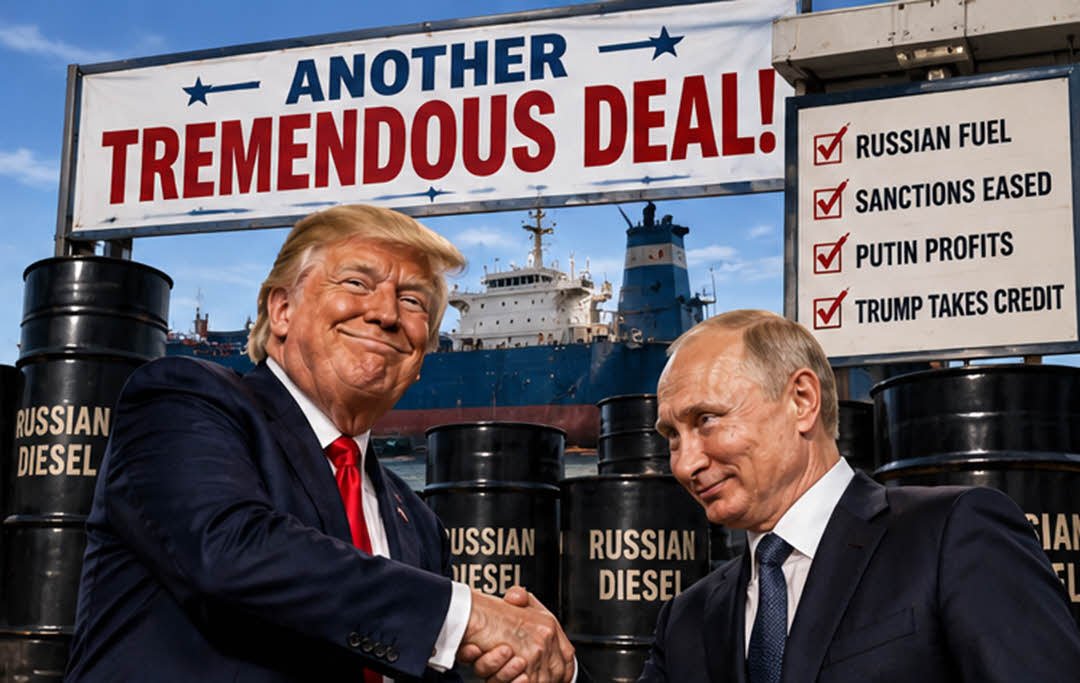
On October 9, Trump announced an agreement to release Russian diesel onto international markets.
His administration temporarily relaxed sanctions restricting Russian energy transactions.
Putin gets another commercial opportunity.
Trump gets another announcement about his extraordinary negotiating abilities.
Zelenskyy gets criticized for attacking the infrastructure supporting the invasion of his country.
What a remarkable distribution of rewards and punishments.
Ukraine’s president warned that additional Russian energy revenue could prolong the war.
An understandable concern, considering that governments finance military operations with money rather than inspirational refrigerator magnets.
Meanwhile, Russian attacks continued killing Ukrainian civilians.
Yet Trump’s criticism concentrated on Zelenskyy.
Apparently, Putin’s missiles are a complicated geopolitical matter, while Ukraine’s refinery strikes constitute an intolerable inconvenience to American diesel customers.
Moral Bankruptcy, Now Available at the Pump
There is something profoundly morally bankrupt about this position.
Not because American farmers don’t deserve affordable diesel. They absolutely do.
Not because Ukraine’s military strategy is beyond criticism. It isn’t.
But because Trump appears willing to place disproportionate blame on the country defending itself while offering economic relief to the country conducting the invasion.
That is moral bankruptcy masquerading as energy policy.
A president can pursue lower fuel prices without confusing the aggressor with the victim.
He can negotiate with Putin without treating Zelenskyy as the principal obstacle to peace.
And he can acknowledge that his own administration’s war with Iran has consequences for Americans standing beside diesel pumps.
Accountability, however, has never been particularly fashionable in the Trump universe.
America First. Responsibility Last.
The greatest irony is that Trump presents himself as the indispensable problem-solver.
First, his administration participates in a war that severely disrupts energy markets.
Then he blames Ukraine for contributing to the resulting crisis.
Finally, he turns to Putin for fuel and celebrates the arrangement as another triumph of American leadership.
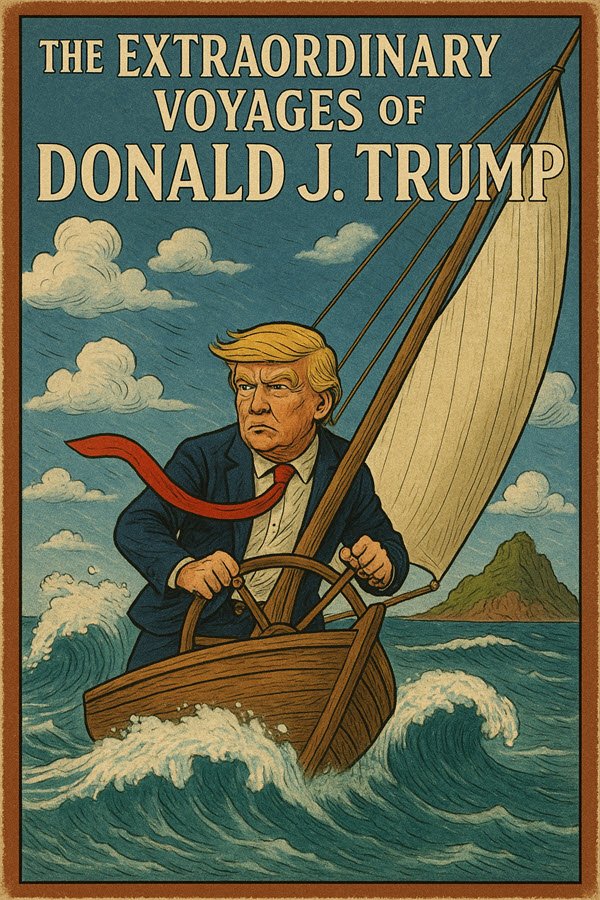
A magnificent three-act production.
Create or worsen a problem. Identify someone else to blame. Announce yourself as the only person capable of fixing it.
And so we arrive at the newest principle of American foreign policy:
When Russia invades, blame Ukraine. When diesel prices rise, blame Zelenskyy. When Putin sells fuel, thank Putin.
In Donald Trump’s America, the man defending his burning house is accused of causing the fire, the arsonist gets a fuel contract, and the president demands applause for negotiating the price of gasoline.
Welcome to America First.
Where responsibility is always somebody else’s problem, and Putin apparently accepts payment in dollars.


The homeowner analogy makes the argument especially memorable. I appreciate satire that asks readers to examine where responsibility belongs rather than simply follow the loudest accusation.