That was the useful trick.
[/et_pb_text]
If Swift had written a pamphlet simply announcing that public officials could be petty, self-important, irrational, vain, or occasionally more interested in ceremony than judgment, the officials might have objected. Send the same habits to an island inhabited by six-inch politicians arguing over the proper way to break an egg, and suddenly everyone can enjoy the joke.
At least until somebody recognizes the egg.
Imaginary countries create distance. Distance creates clarity.
Our governing capital is sometimes too familiar. We already know the buildings, the parties, the slogans, the television panels, the podiums, and the professionally concerned faces explaining why today’s astonishing event is either unprecedented or completely ordinary, depending upon which camera is operating.
A fictional country has no such obligations.
Its constitution may require applause before breakfast. Its cabinet may select policy by examining the leader’s mood. Its economists may insist that arithmetic has become unnecessarily negative. Its official historians may revise Tuesday before lunch on Wednesday.
No real country is being described.
That is what makes the examination useful.
Swift understood that absurdity works best when the reader first laughs at the strangers in a strange land and only later discovers that the strangers have been borrowing his furniture.
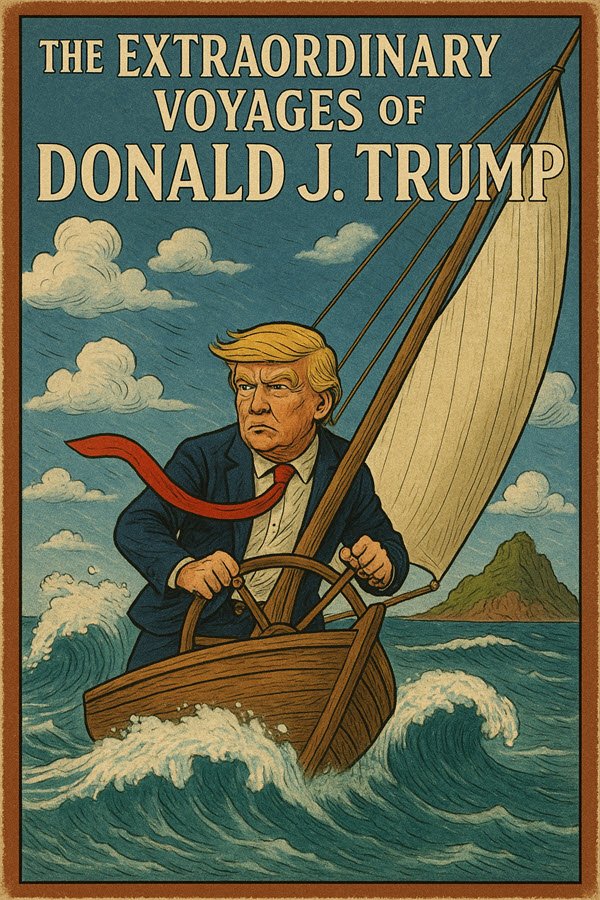
That same idea sits behind The Extraordinary Voyages of Donald J. Trump. The book doesn’t try to send readers through another chronology of speeches, scandals, elections, and cable-news emergencies. Instead, it sends its central traveler outward—into invented societies where exaggeration reveals patterns that ordinary political reporting often buries beneath the day’s headlines.
The destinations are fictional. The questions are not.
What happens when loyalty becomes more valuable than judgment? When spectacle begins to substitute for substance? When power prefers admiration to contradiction? And what happens to ordinary citizens when everyone becomes so accustomed to the performance that the performance begins to feel like government?
Those questions belonged to Swift’s century too.
That may be the most inconvenient fact about the 300th anniversary of Gulliver’s Travels. Three centuries of technological advancement have given us airplanes, satellites, smartphones, artificial intelligence, and refrigerators that can tell us we need milk.
Human vanity, however, has declined the software update.
Swift gave his readers imaginary countries so they could recognize the real one more clearly.
Three hundred years later, the voyage remains useful.
Only the traveler has changed.
Continue the voyage: The Extraordinary Voyages of Donald J. Trump: Clarity begins when the mirror stops being flattering, by H. Jester Fieldstone, is available on Amazon.
Three hundred years ago, Jonathan Swift discovered that the safest place to examine politics was somewhere that did not exist.
In 1726, Gulliver’s Travels sent Lemuel Gulliver into fantastical societies populated by tiny courtiers, giants, theorists, projectors, talking horses, and enough solemn nonsense to keep several governments fully staffed. The book became an immediate success, and Swift used invented countries to expose contemporary politics, scholarship, vanity, and human folly.
That was the useful trick.
If Swift had written a pamphlet simply announcing that public officials could be petty, self-important, irrational, vain, or occasionally more interested in ceremony than judgment, the officials might have objected. Send the same habits to an island inhabited by six-inch politicians arguing over the proper way to break an egg, and suddenly everyone can enjoy the joke.
At least until somebody recognizes the egg.
Imaginary countries create distance. Distance creates clarity.
Our governing capital is sometimes too familiar. We already know the buildings, the parties, the slogans, the television panels, the podiums, and the professionally concerned faces explaining why today’s astonishing event is either unprecedented or completely ordinary, depending upon which camera is operating.
A fictional country has no such obligations.
Its constitution may require applause before breakfast. Its cabinet may select policy by examining the leader’s mood. Its economists may insist that arithmetic has become unnecessarily negative. Its official historians may revise Tuesday before lunch on Wednesday.
No real country is being described.
That is what makes the examination useful.
Swift understood that absurdity works best when the reader first laughs at the strangers in a strange land and only later discovers that the strangers have been borrowing his furniture.
That same idea sits behind The Extraordinary Voyages of Donald J. Trump. The book doesn’t try to send readers through another chronology of speeches, scandals, elections, and cable-news emergencies. Instead, it sends its central traveler outward—into invented societies where exaggeration reveals patterns that ordinary political reporting often buries beneath the day’s headlines.
The destinations are fictional. The questions are not.
What happens when loyalty becomes more valuable than judgment? When spectacle begins to substitute for substance? When power prefers admiration to contradiction? And what happens to ordinary citizens when everyone becomes so accustomed to the performance that the performance begins to feel like government?
Those questions belonged to Swift’s century too.
That may be the most inconvenient fact about the 300th anniversary of Gulliver’s Travels. Three centuries of technological advancement have given us airplanes, satellites, smartphones, artificial intelligence, and refrigerators that can tell us we need milk.
Human vanity, however, has declined the software update.
Swift gave his readers imaginary countries so they could recognize the real one more clearly.
Three hundred years later, the voyage remains useful.
Only the traveler has changed.
Continue the voyage: The Extraordinary Voyages of Donald J. Trump: Clarity begins when the mirror stops being flattering, by H. Jester Fieldstone, is available on Amazon.