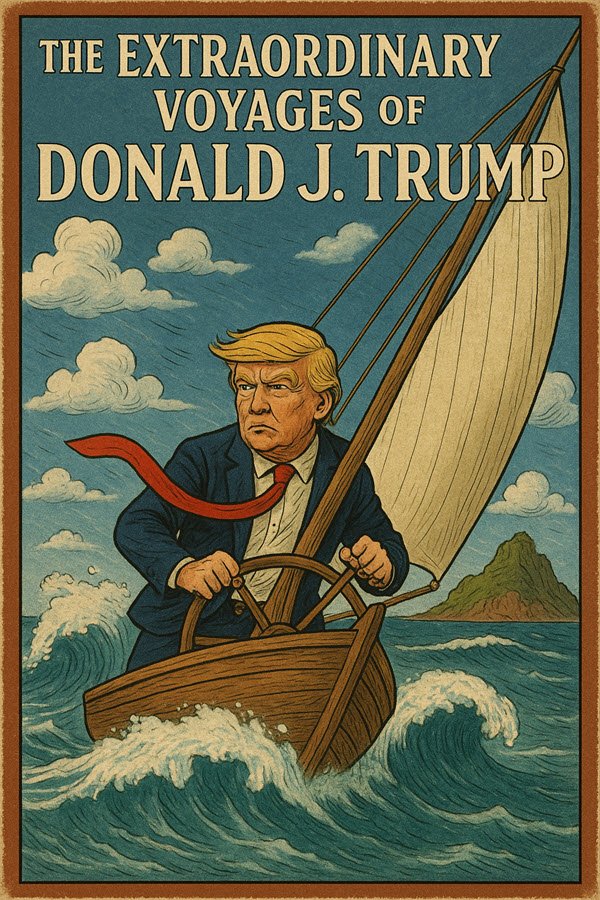
The Silence of JD Vance – Not A Peep!
Gather round, children, and I will tell you the story of when J.D. Vance wrote op-eds about how Donald Trump “started no wars.” It was 2023. The story was convincing. The populist winds were blowing. And Vance, newly baptized into the MAGA priesthood, proclaimed the gospel of restraint.
Trump, he told us, had disrupted the failed consensus. Trump had resisted the forever wars. Trump had defied the warmongers.
Trump, apparently, will keep his powder dry.
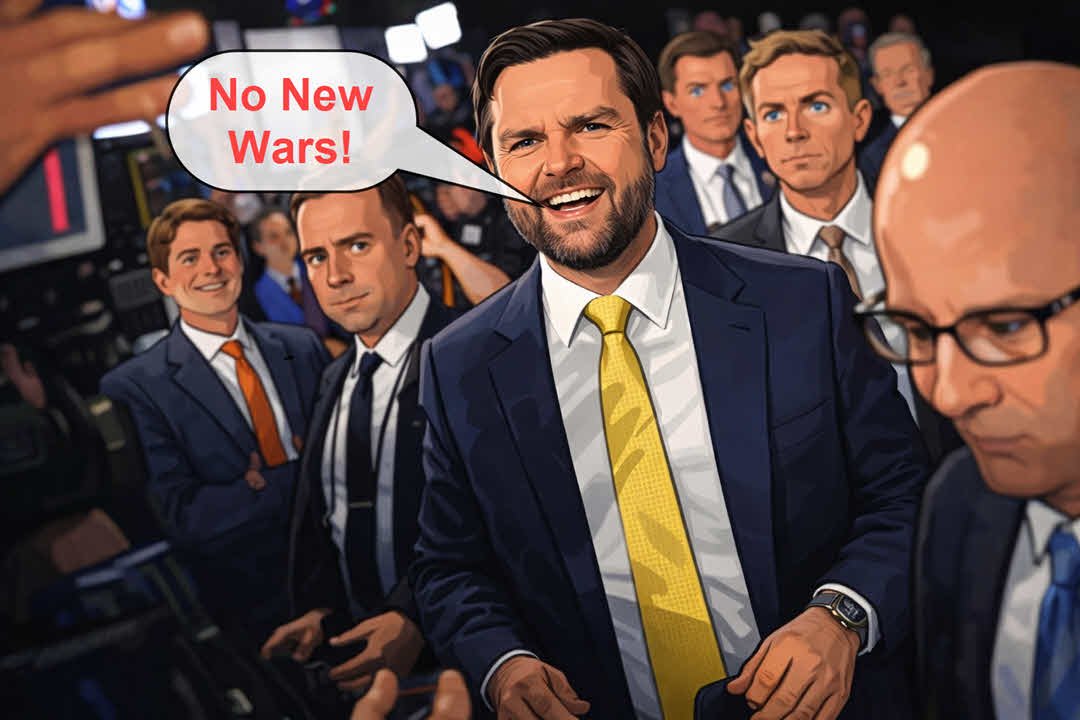
Fast forward to the present, where the powder has been lit, the missiles have flown, and the vice president’s most conspicuous act of statesmanship is… not tweeting.
This, we are told, is “a huge problem.”
You must admire the poetry of it. The anti-interventionist standard-bearer has been reduced to a case study in social media absence. The modern right measures dissent not in speeches, not in votes, not in resignations — but in tweet frequency.
“People are really fixated that Vance has not tweeted.”
Of course they are. If a populist falls in the Situation Room and does not post about it, did he even object?
Vance once warned that America’s interest was “very much not going to war with Iran.” That was before America went to war with Iran. Now he assures us there is “no chance” of another Iraq or Afghanistan. No chance. History, after all, is merely a rumor.
The most striking image in all this is not the strike itself, but the scene the administration displays: Trump overseeing military action from Mar-a-Lago, flanked by loyal toadies, while his vice president sits in Washington, retweeting White House posts like a well-behaved intern trying not to spill coffee on this display of the force of the empire.
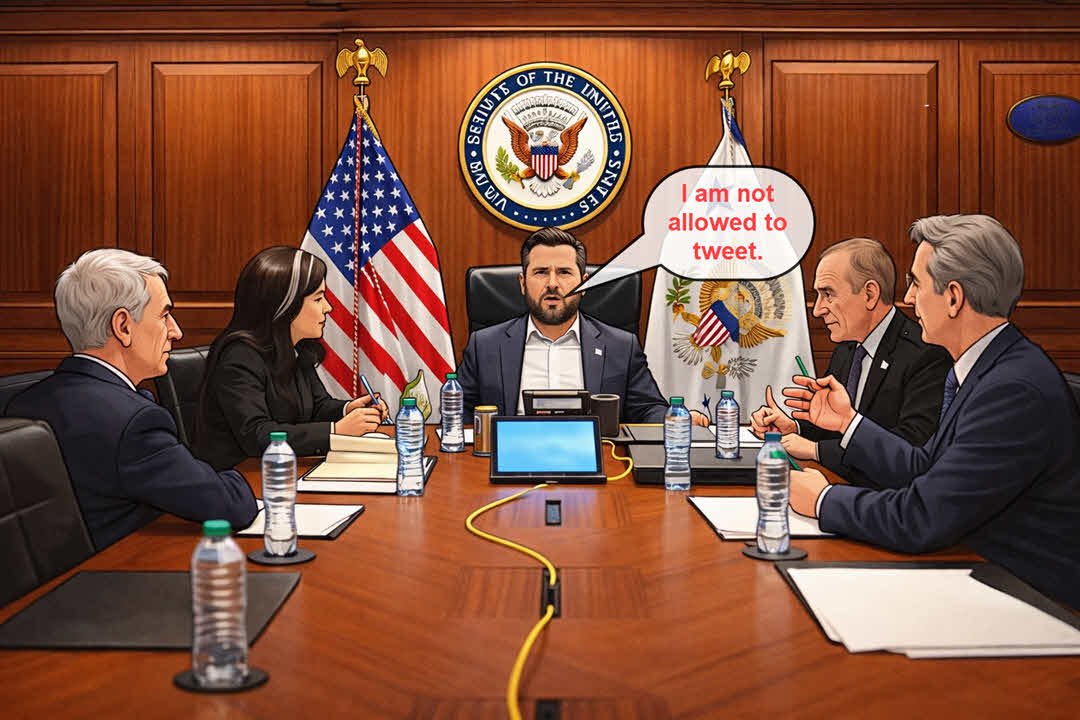
No New Wars Vance in The Situation Room
This is what anti-interventionism looks like after it has been domesticated.
Once upon a time, Vance was supposed to be the intellectual ballast. He was the nationalist realist, the man who would guard the gates against neocon nostalgia. He was cast as a populist Dick Cheney in reverse: not the architect of invasion, but the firewall against it.
Instead, he has become nothing or perhaps a warm bucket of spit. He now politely defends the war he previously warned against, explaining that this one is different: it is surgical, and clearly defined.
They are always clearly defined. At the beginning.
The restrainers are aghast. Tucker and Bannon tried the full-court press last time. It annoyed the president. Lesson learned: You may question the machine, but do not irritate the operator.
What makes this episode deliciously tragic is not merely that Vance lost the argument. It is that he appears to have surrendered it before the battle began.
He now plays liaison to the anti-war right, assuring them that everything is under control. That is threading the needle. That this is not a Bush-style intervention. That this is America First, with cruise missiles and stealth bombers.
Meanwhile, his allies are counting his silences like forensic accountants.
Has he spoken? Has he objected? Was he in the room? Was he next to the president? Did he blink twice?
The answer appears to be: he was present, but not central. Visible, but not decisive. Loyal, but not leading.
And this is the real wound that hurts so much.
For years, Vance cultivated the image of the man who understood that endless intervention erodes the republic. The man who spoke of “failed consensus” and moralizing foreign policy. The man who would channel war-weary voters into a new coalition.
Now those same voters are being told that strikes are necessary, limited, and precise. They are told that anyone nervous about escalation is being melodramatic and unpatriotic.
The irony is mind-boggling, as one Vance ally put it.
But perhaps it shouldn’t be.
Vance has converted before. For example, from an atheist to a Catholic. Vance has written extensively about his life in faith, both in a mega-selling memoir and in a long essay that describes how a drug-using teenager with anger problems, family problems, school problems, and doubts about God became an accomplished, successful family man excited about being a Catholic.
Moreover, he was once a Trump skeptic and is now a Trump loyalist. From critic to vice president. Flexibility is his defining trait. He bends without appearing to snap.
The restrainers invested in him as a long-term asset. “Buy and hold,” they said. They are now discovering that even blue-chip populists can experience volatility.